
Son de la Selva: Murui Indigenous rap in the upper Amazon
Six young people in their 20s compose and rap in their native language and in Spanish about the history of their communities
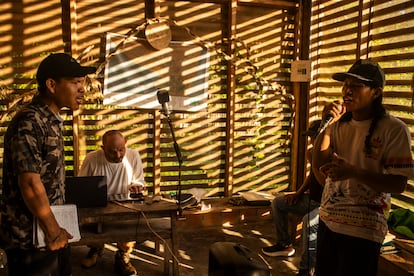
Concerned by the impact his musical project might be having on the community, Héctor Morales asked one of his grandmothers whether he and he friends were doing the right thing: rapping in Murui, the language of the Father-Creator and of their ancestors. “If the birds themselves get creative and imitate the song of other birds,” responded the elder, “Why then should humans have to limit themselves from singing what they like?” Her words calmed the younger man. Son de la Selva, the rap group Morales had founded with five other young men from the Murui community at highway marker Km 11 in Leticia, located in the Colombian Amazon and in the triple-border region shared with Peru and Brazil, was no nonsense. Nor was it an affront to the traditions of their people.
“This runs in our blood, the Murui sing by nature,” says Morales, who is 22 years old and also goes by the name HM, speaking of the Indigenous people who live in the Peruvian and Colombian Amazon. Rap in Indigenous languages has been around for a long time. But a group of six twenty-somethings who rap in an Indigenous Amazonian language, in a community located in one of the largest cities on the border, is more or less an anomaly. At least, on the Colombian side of the border.
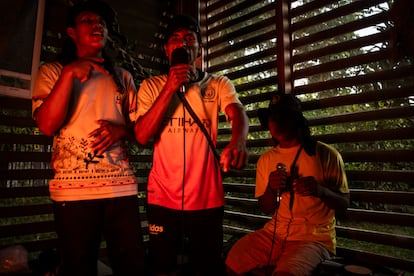
HM, Totty, Parrot, Yova, Sonjack and AVJ Checo perform at Indigenous community events and celebrations, and also in the town center of Leticia. They say they don’t do it for the money or the fame, but rather, a less-sought after goal than those of personal branding and going viral: the power that music holds to set people free.
To date, they have six songs and four more they are working on. The most recent, “MARE UAI (The good word)”, has to do with the Murui people during the Amazon’s rubber cycle, in which they were among the most impacted by its colonialist violence. It is also about survival and redemption. “Sistema perverso, asesinó y maltrató a nuestra gente / desde el más inocente / Resina por vidas / Narrar nuestra historia para no olvidar y saber sanar (Perverse system, murdered and mistreated our people / from the most innocent / Resin for lives / Telling our story to not forget and to know how to heal),” run its lyrics.
It is the group’s most “ambitious” song so far. It features production by Vist Projects and collaboration by the Colombian MC Mismo Perro. Its music video shows members crossing the Amazon rainforest, harvesting coca leaves to toast them for ceremonial mambe and playing traditional musical instruments like the maguaré. “We don’t want to make rap, which is popular artistic revolution, but rather ‘rac’: revolución artística cultural,” explains Morales. Still, the road to achieving this is full of challenges.
A rap of lament
First there was Giovany Morales, aka Yova. While still in school, he heard rap for the first time from the voice of Laberinto ELC, from Medellín. “I had heard a lot of songs about going to the moon, to the stars, but he was talking about his suffering,” says Yova, standing in front of his home in the Kilometer 11 Murui community in the town of Patio de Ciencia Dulce.
Yova was the pioneer who presented the musical genre to his brother Héctor, to their cousin José Vázquez aka Totty, and to their other Murui friends. “Jackson, Héctor and Totty were little kids,” says the eldest Morales, who is 29 years old. “I told them, ‘Boys, speak of your pain, your laments,” and the process began.”
A few feet away, Totty explains that he didn’t just learn about rap from his cousin, but also because he was a “curious” and “really dumb” kid. Back in his wild-child era, when he used to spend all his time holed up in internet cafes, he listened to “nothing but crazy music.” Until he discovered the Spanish rapper Porta. “Before the group [Son de la Selva] even started performing, I got some lines tattooed that allude to what we do,” says Vázquez, 25, showing one of his arms, where “Rap, hip hop, dance” is written in black ink.
Son de la Selva were founded in the middle of the Covid-19 pandemic, when residents in Leticia and Patio de Ciencia Dulce were confined to their homes. The young people, who had grown up together, met up and decided to create something different than what they knew — a musical revolution for their community. But to do that, they knew they had to seek advice from their elders.
Rapping and ‘mambe’
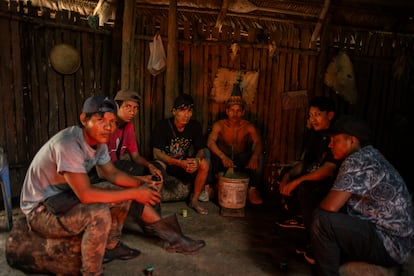
Inside a cabin in Patio de Ciencia Dulce, Daniel Vargas aka Parrot, another member of Son de la Selva, says that he learned his way of rapping the same way the Murui learn about other important subjects in life: mambeando.
Mambe is the dust is obtained by grinding toasted coca leaves with ash from the yarumo tree. It is a traditional preparation in the Murui culture that is used in rituals, as medicine and for reflection among peers.
A mambeadero — according to 25-year-old Parrot — is a place where mambe is exchanged and conversations are held. “The tradition is shared, the word of the Father-Creator that He left for us in these elements: tobacco and coca.”
“We are Indigenous singers who have our own chagra, our own mambe plot,” HM had said days before. “Being Murui, you must ask if they know how to make their own mambe. Respected Muruis make their own medicine.” The members of Son de la Selva are rappers because they are Murui and they are Murui because they practice the rite of mambe.
The mambe, the mambeo, the mambeaderos inevitably lead to “the elders” — that is, the oldest members of the communities, who are the most knowledgeable and wise. HM, Yova, Parrot, Sonjack and AVJ Checo went to them to ask permission to rap in Murui. They didn’t want the elders to see it as too transgressive, or even offensive. But the elders didn’t object to their innovation.
“I like to hear what they sing. I like it because they sing purely for the jungle, they name the natural ingredient, they name the mambe,” says Tomasa Morales, one of the Murui elders of Patio de Ciencia Dulce, and biological grandmother of Héctor and Giovany. “In their rap, I hear them name everything in their language.”
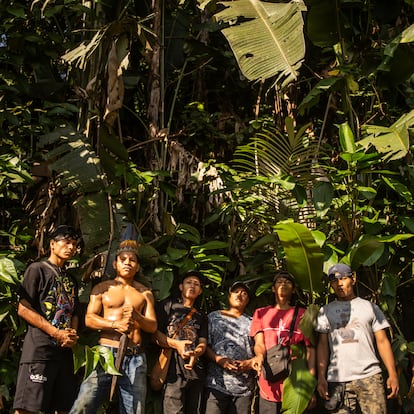
The members of Son de la Selva also went to their grandparents to listen to Murui history and learn their language, a lesson that the majority of them had been unable to get from their family members when they were children due to their fear of discrimination and rejection. “The elders are already leaving, it’s important to take advantage of them,” says Vargas on the urgency of preserving the Murui tradition and memory. At the end of the day, the rap group is thinking past themselves, in the young people who will come after them.
The good word on colonialism
They had heard pieces of it. Since they were young, they had heard that their people, the Murui, had not been born in this area, that they were orphans and arrived here fleeing barbarism. The massacre, the Amazonian Indigenous extermination due to the exploitation of the rubber plant, had scattered them. And so, they wanted to rap about that era of pain and sadness. To make a song that recalled the tragedy of their ancestors — but also, their people’s recovery.
“The elders advised us: ‘be careful with words that can cause injury, awaken things that one might not understand,” says Totty. “They are things that have been covered up that still really hurt, and if someone is going to open them up, they need to know how to close them.”
In the middle of this planning, they met people from the visual narrative foundation Vist Projects. With them, and with MC Mismo Perro, they started a project that involved several months of research, composition, and production for “MARE UAI”. The song, explains Héctor, is divided into six parts: calm, first treaty, prejudice, resilience, resistance and healing. Each one is composed and performed by a member of Son de la Selva.
The beat is punctuated by the drumming of the manguaré, birdsong, and that soft, tinkling sound characteristic of the Amazon rainforest. Toward the end, AVJ Checo sings, “En las hojas vive nuestra sanación / de la vida / cada hoja representa saberes para el ser / sembrar nuevas semillas pa’ que crezcan al pensar (Our healing lies in the leaves / of life / each leaf represents knowledge for the self / sowing new seeds so that they may grow through thought).” These are the words Son de la Selva has chosen to close out these dark times and to open a future where light begins to shine.
Sign up for our weekly newsletter to get more English-language news coverage from EL PAÍS USA Edition









































