
The soft power of flowers: their influence as a diplomatic tool in state visits and peace talks
The blooms adorning the Vatican during Easter and the tulips in the White House gardens come from the Netherlands. But this cultural symbol is also used extensively by other countries in their international relations
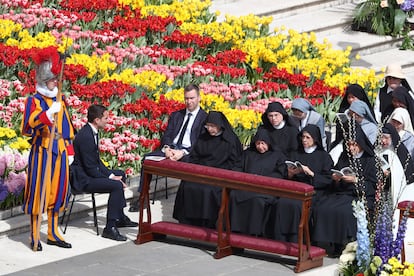

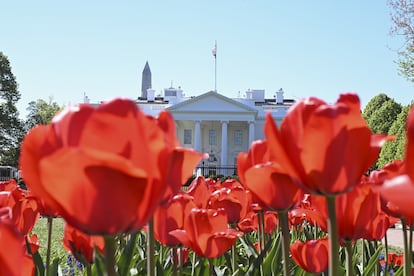
This Easter Sunday, during the Urbi et Orbi blessing, it is quite possible that Pope Leo XIV, on his first Easter as pontiff, will express his gratitude for the flowers sent from the Netherlands. His predecessors did the same with the floral arrangements that arrived each year, having already been blessed by the Bishop of Rotterdam. And in a couple of weeks, in the gardens of the White House, the tulips gifted every year by Dutch growers will bloom. At political summits and official visits, flowers are often chosen to underscore the importance of the occasion. It is the soft power—in international relations—of these fragile and symbolic blossoms.
Delicate yet powerful, flowers have been a spiritual and communicative tool since Ancient Egypt, where the lotus appeared inside pyramids and temples. In Greece and Rome, the olive branch embodied both peace and an offering of it, and flowers were associated with the gods. The emotional response they generate has not faded, and those that adorn public and private spaces today at political events, official and state visits, and peace negotiations go beyond aesthetics and have special status within protocol.
“They relax the atmosphere and contribute to what we understand as soft power,” says Nicholas Cull, an expert in Public Diplomacy at the University of Southern California, speaking by phone. “You can’t imagine a political summit without flowers,” he continues. “It would suggest a lack of preparation and care for something so important. Furthermore, they are part of a country’s image.” Oddly enough, their freshness and ephemerality are what make them so enduring. “If they were made of plastic and didn’t need to be cared for, they wouldn’t help create an atmosphere of goodwill in situations of high political tension,” Cull warns.
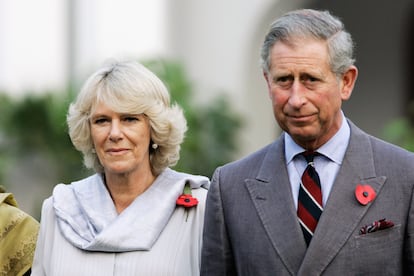
They can also cause problems. In the 1990s, during the peace talks in Northern Ireland—culminating in the Good Friday Agreement signed on April 10, 1998, which established power-sharing between Ireland and the United Kingdom—great care had to be taken. According to Cull, “lilies are associated with Catholic republicans, while roses are associated with Protestants, and no flowers with even the slightest political connotation could be displayed depending on the moment.” This demonstrates, he points out, “that culture can unite us, but also divide us at times.” At the same time, there are symbols that transcend the political and human failures of war. “Think of the poppy fields that bloomed on the battlefields during the First World War [in Flanders (Belgium) and northern France] and the enduring power of that flower in the collective memory of the United Kingdom.”
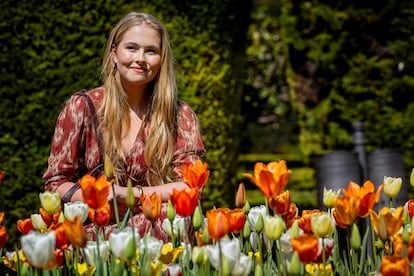
The robust, multicolored tulip is immediately associated with the Netherlands, even though it’s not the national flower. Native to Central Asia, it’s planted in autumn “and represents hope for spring; that not everything comes immediately and it’s necessary to wait,” explains Mark-Jan Terwindt, president of Royal Anthos, the Association of Nursery Products and Bulb Traders, responsible for the annual donation to the White House. Last March, supported by a European Union subsidy, bulb exporters gifted 150,000 tulips to the United States to mark the 250th anniversary of its Declaration of Independence. They were displayed on the National Mall in Washington, D.C., so people could take them for free. The Dutch embassy in the country also contributed, and at a time of trade pressure due to the fluctuating tariffs imposed by President Donald Trump, the visual spectacle reinforced the sector’s commitment to remaining on that side of the Atlantic. “We also send tulip bulbs to Canada, and they are a shared heritage,” says Terwindt.
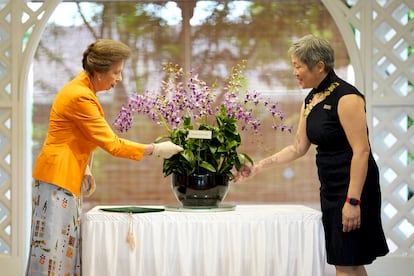
Some countries leverage their floral wealth as a direct diplomatic tool. The Principality of Liechtenstein, located between Switzerland and Austria, uses its national flower, the edelweiss, in bouquets presented to foreign dignitaries. In Southeast Asia, Singapore boasts a National Orchid Garden and a section dedicated to orchids named after various world leaders. Among them are orchids for former U.S. president Joe Biden and his wife, Jill. Another one is named after his predecessor, Barack Obama. The late South African President Nelson Mandela and former British Prime Minister Margaret Thatcher each got their own. Since 2023, Jill Biden has also had an apricot-colored tulip named after her in the famous Dutch flower garden Keukenhof. In April 2024, another one was dedicated to King Charles III in the same location. It is golden yellow. And Princess Amalia of Orange gifted Madrid a tulip garden in 2025, in gratitude for the hospitality she received when she lived secretly in the Spanish capital during 2023, due to threats from an organized crime group.
In 2022, a tulip bulb collection campaign in the region, organized by Dutchman Michel de Bruine from the Tulip Store nursery, gathered 150,000 bulbs that were donated to Dobropark, a park near Kyiv, the capital of Ukraine. The land had been used by Russian soldiers during the invasion of the country and was able to reopen the following year with the flowers as a symbol of life.
Between 1634 and 1637, tulips triggered the first speculative crisis in the history of investment in the Netherlands when bulb prices reached exorbitant levels. Then demand plummeted, and speculators were left with massive debts. The tulip craze, which saw tulips cost as much as a house in Amsterdam, faded, but the flower remained popular at affordable prices. “The tulip is an icon today,” says Mark-Jan Terwindt. And although the diplomatic image the Netherlands wants to project abroad “is that of a country that can help manage water; a champion of human rights, thanks to the international courts based in The Hague; and a leader in trade thanks to the port of Rotterdam,” notes Cull, something as spectacular as flowers “always helps.”
So, what is the national flower of the Netherlands? In 2023, the humble daisy, which grows in the fields, was chosen in a radio program in which 53,000 Dutch people voted. The tulip is the national flower of Turkey and Hungary.
Sign up for our weekly newsletter to get more English-language news coverage from EL PAÍS USA Edition









































