Broken Social Scene: “We remained true to ourselves”
Kevin Drew talks to EL PAÍS about his upcoming album ‘Remember the Humans’, which reunites the collective that transformed indie rock at the beginning of this century

“We’re going to get through this,” it’s the central message of Broken Social Scene’s new song, Not Around Anymore, in which Kevin Drew, one of the two leaders of the Canadian indie rock collective, tries to offer calm amid the chaos of the current era to anyone who needs it. Although the lyrics don’t directly address it, they fit perfectly into the context of tension in North America and the rest of the world. “I didn’t want it to sound condescending or minimize the difficulties of people protesting around the world,” the musician explains to EL PAÍS from his native country via video call. “The point is to be part of it,” he says.
Drew says the song’s lyrics were inspired by the death of his mother, but admits that the message can be applied to different contexts. “There is a surrender that comes with accepting the truth, and a relief in that. Once you accept it, you can start again,” he says, suggesting that humanity is at a point of recognition amid the chaos. The idea in the track is expanded upon in the accompanying music video: in some shots, two children appear holding a sign that reads “We need role models.” “They don’t have them beyond their parents,” Drew says.
“Right now we are in an identity war, not a spiritual war, and leaders are failing them,” he says, referring to the current global sociopolitical state, which in this conversation immediately brings to mind the title of Canada vs America, a song by Broken Social Scene released in 2005, two decades before Donald Trump’s trade war against Canada and Mexico began, which has led to anti-U.S. sentiment in the northern country.
“Canada vs America was always a cheeky song,” he says. “It was about neighbors fighting each other, but I never want to see that happen. The song is a call for hope, a call to arms for it. America is in a hard spot right now, as a lot of countries are. It never ends.”
The musician does not consider his opinion on the subject to be relevant, and believes that artists “don’t matter,” and that all he wants is to “make people feel a little bit better,” as is the case with Not Around Anymore.
Remember the humans
Not Around Anymore marks the band’s return after seven years of inactivity. Now, different cells of the organism that is Broken Social Scene have come together to work on a new album called Remember the Humans, whose title seems to evoke that of the album that won them an international audience, You Forgot it in People (2002). According to Drew, it’s no coincidence: “We’ve forgotten ourselves again.” “As a society, we’re very bad at memory muscle. Songs teach memory. So Remember the Humans became a reminder of ourselves, because there is a lot we have forgotten,” he says.
The singer refers to the dynamics of the collective, which has changed dramatically since it began to form more than 25 years ago. While their early work was born in makeshift studios where young musicians gathered in the city of Toronto (which inspired the group’s spirit of collectivity), now “a lot is done from a distance,” explains the composer.
Similarly, there are members who come and go, depending on their availability. “The hardest part is getting everyone together. Many of the people have families, live in different cities, have different schedules, and all have other jobs, but that’s what makes it interesting.”
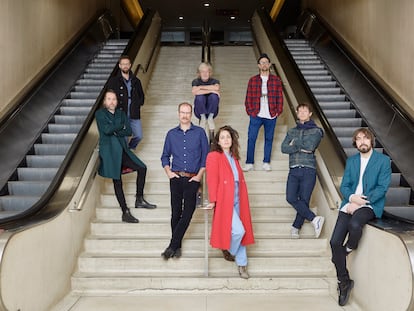
Among the collective’s collaborators are musicians who have other projects that have also found a massive audience, such as Emily Haines (with Metric), Leslie Feist (with her solo project), and Evan Cranley (with Stars). In fact, Drew explains that the reunion came about thanks to another key member of the group: David Neufeld, who produced You Forgot it in People and Broken Social Scene (2005), and who decided to return for Remember the Humans.
“We’ve always remained in each other’s lives thanks to this band, but it was really nice to see some familiar faces and some fresh ones come together,” says the musician. “When you have your life be full of success and death, failure, aging, divorce, weddings, funerals, partners and kids — so many kids — there’s some kind of synergy that you have together. You develop an understanding that you can’t get from afar.”
That feeling is probably even stronger after the release a couple of years ago of It’s All Gonna Break, a documentary by Stephen Chung that tells the story of the collective from the perspective of its many members. “It was very sentimental to watch,” he confesses about the film, which is also a record of a different era for music, before high-speed internet, Spotify, and social media.
Regarding the band’s transition to the changes that came after their first albums, he says: “We gave power to the capitalists,” referring to a collective “we.” “And if you think about Spotify, you can see that the company is part of a hypocritical world that we have built for ourselves, from which we cannot escape.” Their response, as a band, was to “adjust our values and morals, and ask ourselves why we do this.”
As an act of resistance, Broken Social Scene has remained an independent band despite having the opportunity to enter the world of major record labels. In fact, Drew is also the founder of Arts & Crafts Productions, a music-focused service company that releases the collective’s albums, including Remember the Humans, and those of his fellow bands, such as Metric’s Romanticize the Dive, which will also be released soon. “We saw other bands surpass us, playing stadiums, touring with four buses. Does it hurt? Yeah, it sucks. But we stayed true to ourselves, and I’m happy with that. I’ll keep playing the game to get into people’s lives, into their living rooms, and into their hearts. That’s what this band wants to do.”
Remember the Humans will be released on March 8, and with it, the band will embark on a tour with Metric and Stars, mostly in the United States. Drew sees it not just as a tour, but as a huge tribute and a necessary voice for many: “We’re still alive, and we’re still here, and we’ve lost a lot of our friends. We have to represent them and the people who are suffering.” In other words: remember the humans.
Sign up for our weekly newsletter to get more English-language news coverage from EL PAÍS USA Edition