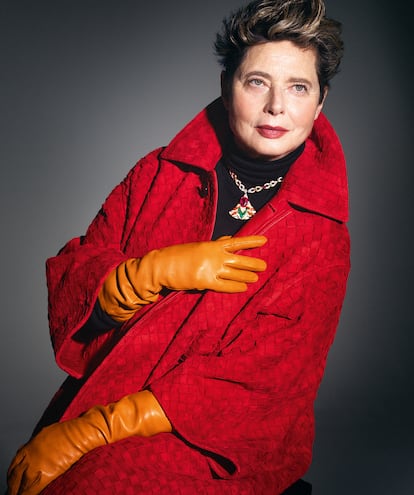
Isabella Rossellini: ‘If I started now, I would be a director, something unthinkable in my youth’
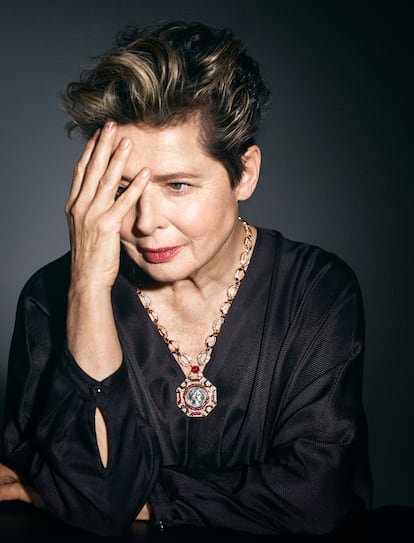
The actress, model and farmer who grew up surrounded by cinema disappeared when the industry stopped calling in her 40s and hasn’t stopped working in recent years (Oscar nomination included). She now shines in Bvlgari jewelry with the light of an eternal diva
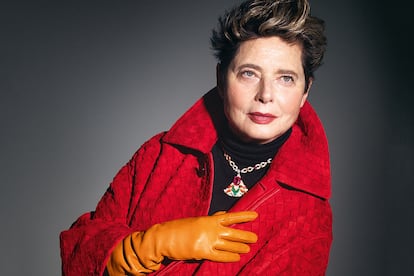

At 73 years old, Isabella Rossellini traverses the world as a curious mix of wild and cosmopolitan woman, a 21st century farmer-performer and heir to a classic charm from another era. The daughter of two legends of cinema history, Ingrid Bergman and Roberto Rossellini, she has been familiar with scandal since she was young, when her mother suffered the consequences of having left her previous husband for the famous director. After moving around Europe with her family, Isabella began establishing her own career in 1970s New York. She became a fashion and film icon during the ‘80s and ‘90s, was David Lynch’s muse, the most beautiful face of Lancôme, and modeled for Richard Avedon and Steven Meisel for Madonna’s book Sex.
But with the turn of the new century, the offers dried up as she hit a certain age, a period of professional adversity that she nonetheless managed to turn into opportunity. When the telephone stopped ringing around her 40th birthday, Rossellini reinvented herself through the study of animals and their behavior. The best decision she ever made, she says.
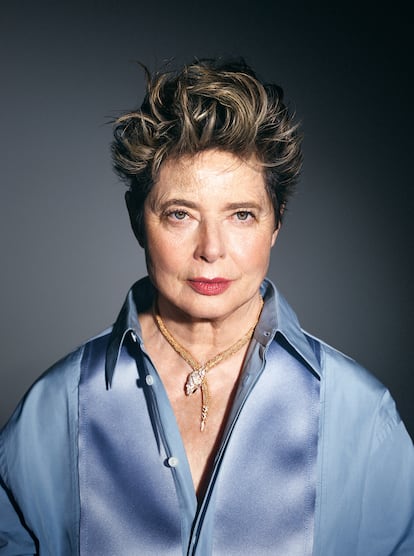
The actress, model and farmer now lives on her Mama Farm, surrounded by dogs, sheep and chicken. Her extraordinary maturity is proof that accepting the effects of aging is a wise decision, one that in her case, has brought many rewards. Two decades after her contracts ran out, Rossellini’s career in both film and fashion has undergone a resurgence. The saying in plastic surgery “win a battle, but lose the war” may as well have been about her. Her decision not to go under the knife may have to do with the back problems from which she has suffered since childhood, leading to a lifelong aversion to the operating room. Her first dog, she recalls, was a present from her mother when she was very small, meant to raise her spirits after her first surgery.
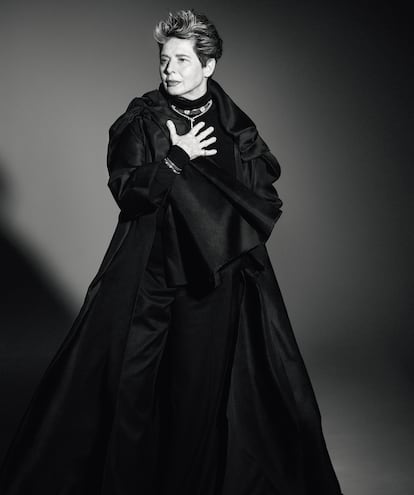
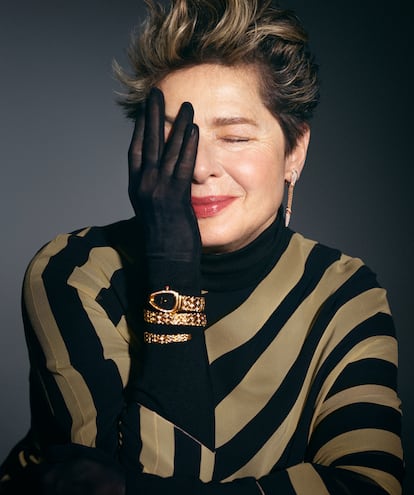
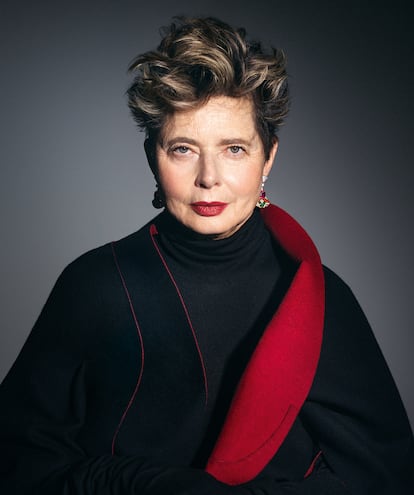
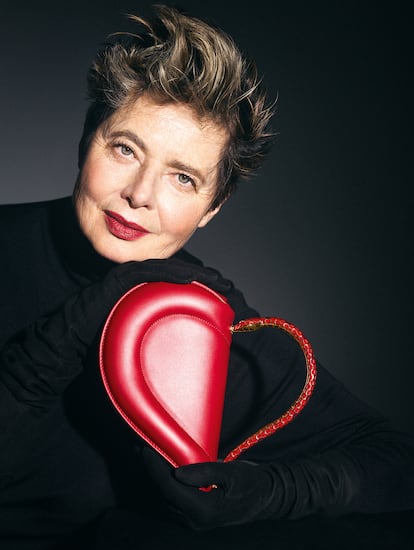
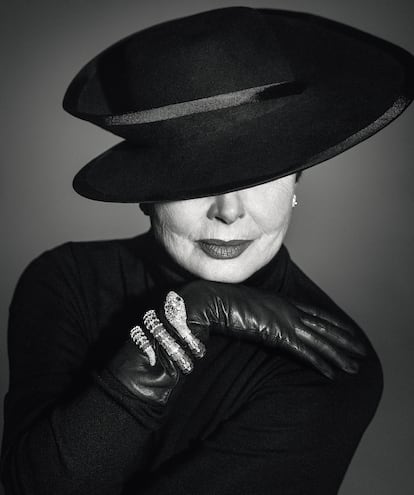
Elegant and relaxed, she has her mother’s mouth and a frosty sweetness that can intimidate. She is a serious woman who smiles all the time, with the same control she displays as a model in front of the camera. The art of posing is, to a great extent, the art of knowing how to stay still — and Rossellini exhibits a physical calm that presents a contrast to her busy life, which she spends between Europe and the United States. Her English, spoken with an Italian accent, has characterized her career, but also endowed her with a mysterious aura that David Lynch knew to exploit so successfully. Seated in her photography studio on the outskirts of Rome, extremely deliberate and professional, Rossellini responded to interview questions during a long photoshoot with Bvlgari jewelry. “I am proud to work with this great Roman fashion house,” she says, shutting down all queries having to do with the current moment: “I am neither a politician nor a sociologist.”
Question. Why did you decide to locate your farm in the United States?
Answer. I have lived my whole life in the United States. I was born in Rome, but when I was three years old, we moved to Paris. Then my parents got divorced and I didn’t return to Rome until I was eight or nine, for middle school and high school, until I was 18. At that age, I went to the United States to continue my studies and there I have remained. I began to work, I got married two times… New York has been my home, where my oldest daughter was born and where I adopted, as a single mother, my son. At the time, it was the only place I could have done that. This is all to say that really, I have never especially felt part of anything. I grew up in France and Italy, my mother was Swedish, and because of my parents’ work, we moved a lot. It wasn’t a premeditated decision for me to stay in the United States, either
Q. As a committed advocate for animals, was your choice to live on a farm a political decision?
A. No, it was a personal decision. When I was 45, the telephone stopped ringing and I had to invent a new life for myself. I had no work, my children were still growing up, and I decided to go back to university. Animals have always interested me, I used to go to a lot of talks. One of them was at Hunter College, where they passed out some brochures about the recently created etology department, which is dedicated to the study of animal behavior. I signed up. Instead of feeling marginalized, I followed my curiosity and it worked. By the time I graduated, I had already moved to the countryside.
Q. Do you miss the city?
A. I had a home outside New York that I used to go to on the weekends. It was after 9/11 that I decided to make a definitive move. My son was young and the attack was traumatic for him. He was happy in the country, the city was getting to be too restrictive for a child. When the opportunity arose to buy the farm property, I took it. At first, I only wanted to plant a garden for myself, but the farm began to grow, because there was a real need in the community around us. Mama Farm became a place for the children of my friends to visit, for their grandchildren, for my daughters’ friends and for their children. They came from the city to see animals and plants. We never thought about turning it into a public place, but now that is what it is.
Q. Does country life bring you peace?
A. That is always the urbanite’s question. Many people who are from the city think the countryside is a place to be at peace. But it’s the opposite; the countryside is difficult and one works a lot. It is never about retiring to lead a more peaceful life. Right now I have three dogs, sheep, bees and chickens… We feed 150 members with our products and receive up to 300 people per week. Everything changes depending on the season, but the work is very intense. In the country, the cycles of life play a central role. Living on a farm has something very dramatic and poetic about it at the same time.
Q. Where did the inspiration come from for Green Porno Live, your series about the sexual behavior of animals?
A. Well it’s all more or less from the same time period. The idea was to do something avant-garde, with very little money and very independently. I had done a lot of collaborations with the Sundance Institute, which was founded by Robert Redford, and they helped to give shape to the experiment.
Q. The series is an outpouring of humor and imagination. Why do you think it connected so well with the public?
A. It coincided with the birth of YouTube. Sundance created its channel, and they told me that my project made a lot of sense on YouTube. It was made up of very short pieces, just a few minutes each. I started out with five and they were so successful that I wound up doing 45.
Q. What was the first animal you portrayed?
A. I remember the dragonfly. But I think the first one was a flying spider… Spiders are so eccentric…
Q. The wardrobe for the series was your own.
A. Mine, by Rick Gilbert and Andy Byers, two of my collaborators. They contributed so much. I came up with the idea and they added new layers. But wardrobe design has always interested me, in fact it was my first job and when I got done with school in Italy, it was my top choice to study. I am very interested in it.
Q. You worked in it professionally?
A. When I began to work as a model, everything changed. I was successful and I didn’t have time for anything else. But my experience with wardrobe really enriched my work as a model and actress. Deep down, everything is very connected.
Q. This year is the 80th anniversary of Rome, Open City, the foundational work of Neo-realism that was directed by your father and the first part of the post-war trilogy comprised of Paisan and Germany, Year Zero, a film in which your father dared to look at the trauma of war from the point of view of a German boy. He was undoubtedly a very brave filmmaker, a humanist who was concerned with the truth. How do you carry on the responsibility of his legacy?
A. My siblings and I have been very active in the study and conservation of both my father’s archive and that of my mother. We have worked very closely with the extraordinary Cineteca di Bologna in the restoration of his work. A significant part of my father’s archive is in my brother’s home in Rome. And my mother’s is in the United States, at Wesleyan University in Connecticut.
Q. What do you think your father would say about the world today?
A. My father went through two world wars, it was something I have always reminded my children of when, whether because of the pandemic or other events, things seemed apocalyptic. I told them, “Your grandfather went through two world wars and never stopped making things or being happy.” And that is exactly what we should do, to me that was his lesson: his vitality, his desire to create.
Q. There is a precious photo of you on a film set, sitting on your father’s lap, looking at his wristwatch. I imagine that even though he married several times and familial relations were not easy, he was a central figure in your childhood.
A. I adore that photograph. My father had seven children with three wives, but our relationship with him was always very close, for all of us. He was a patriarch that inspired all his children, and my cousins, a lot of them went into careers related to cinema. My paternal grandfather Angelo was an architect and he built the first movie theater in Rome, the Barberine. So my father also got into film through his father.
Q. Which of his films is your favorite?
A. It’s not easy to choose… I adore The Flowers of St. Francis, but I share his devotion to Germany, Year Zero. It moves me, how my father went to Germany at that time to show how, underneath the ruins of Nazism, there were also innocent Germans. Without a doubt, it is a film that conveys the magnitude of the wonderful man he was. I also like the experimental films he made with my mother and how he was always searching for new languages. Actually, what I admire most about my father is that he never stopped pursuing new ways of storytelling. And it’s funny, because he didn’t watch much cinema. He wasn’t competitive. Do you know who he had a photograph of on his desk? Charlie Chaplin. He was his greatest inspiration.
Q. And your mother? You now know what it’s like to age in front of cameras. Unfortunately, that can be hard for an actress.
A. My mother died [in 1982] when she was 67. But she encountered rejection by Hollywood well before that, when she fell in love with my father and the scandal kept her from ever working there again. That was a blow to her. When she divorced my father [in 1957, seven years after the birth of their first son, Roberto] she was already too old for Hollywood, something that has not changed for the mature actresses of today.
Q. But she worked a lot…
A. Mostly in theater. She moved to London and from, there, traveled the world. Even when she got sick with cancer, she continued working. But like any actress, from then or now, she suffered because of her age. If anything has changed in the current panorama, it is because actresses are producers and make their own films. Nicole Kidman is a producer, she develops the material for her films. That didn’t exist in my mother’s time. One of the positive effects of streaming is that you can reach very diverse audiences, and one of them is housewives who don’t have time to go to a movie theater. Things are changing, the discrimination is not as severe as it was in my mother’s time, but that doesn’t mean that it doesn’t exist. There is still a lot of discrimination against older actresses.
Q. What is it like, as her daughter, to see her on screen? Did you want to be like her?
A. I admire her very much, I love watching her films. Her influence on me is tremendous, but things can’t be that literal, and when I act, I am not fixating on her. When I filmed Conclave, I could have thought about her nun characters in The Bells of St. Mary’s, but I did not.
Q. You were nominated for an Oscar for Conclave. Will you continue working as an actress?
A. I never thought I would go back to working, truthfully. Not as an actress or as a model. I love it, but I am still not sure what to do with it. I just finished filming a movie in London about Wallis Simpson with Joan Collins, who is 94, and the film is directed by Mike Newell, who is 83. They don’t let us say much about it… And I also shot the science fiction series The Beauty with Ryan Murphy.
Q. You are also part of the cinematic universe of David Lynch. How would you describe your work with him?
A. It is a universe so peculiar and fascinating that I don’t know how to explain it, although the strange thing is that everyone who worked with him wound up being part of his family in some way. He was a great creator of atmosphere. In the majority of his stories, there was no direct narrative, perhaps you didn’t understand what the thing was about, but his way of capturing the environment, the mystery, that was the interesting part.
Q. How did the two of you meet?
A. I had barely worked as an actress before Blue Velvet. We met at a restaurant that Dino de Laurentiis had just opened. I was with Dino’s wife, and [Lynch] was with some of his friends. By the end of the meal, we wound up at the same table. The next day, he sent me the script.
Q. Do you prefer being an actress over being a model?
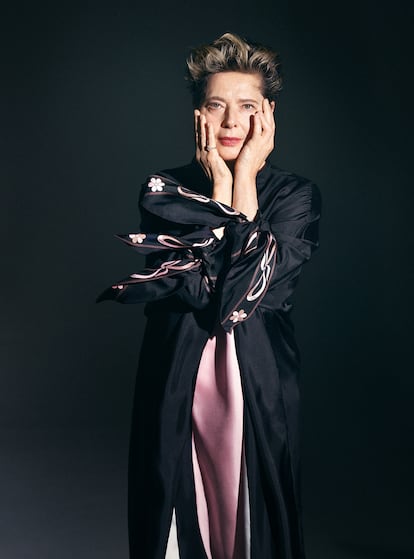
A. For me, being a model is acting. As a model, I also invent a character. Like today, with the jewelry and the clothes from this session. Ultimately, it’s about creating an emotion with the person’s face. As a mother, also, it was always easier doing the work of a model than that of an actress. The process is shorter. I adore it for that.
Q. The place of women in cinema and fashion has changed a lot in recent years. How do you think your career would have been if you were starting out today?
A. Being here now is proof that things haven’t gone so badly for me. But I probably would have been a director, something unthinkable in my youth. I remember my mother once whispering to me that at that point in her life she could have been a film director. She said it very quietly because at the time the idea of a woman directing was absurd. But that’s how she felt; she felt capable after everything she had learned as an actress. She had stories to tell and knew exactly where to place the camera.
Q. You worked on La Chimera with Alice Rohrwacher. She is one of the most talented modern-day filmmakers, who is also interested in the idea of community from a gender-based perspective. Does working with women interest you?
A. I loved working with her and I hope she calls me again. I am very interested in women directors. I am attracted to the angles that women bring to stories. Cinema directed by women is a new wave I feel very close to.
Q. Rohrwacher’s gaze is very poetic and at the same time, very political in her critique of the system. Do you consider her an heir to your father?
A. I do not see my father as a political filmmaker, but rather, a humanist one. In fact, I think that he fled from politics to talk about human beings. He did not go to Germany to say that the Nazis were fascists, but to look for redemption in the human.