
Actor Robert Redford dies at 89
The legendary actor, who starred in classics such as ‘The Sting’ and ‘All the President’s Men,’ passed away at his home in Utah
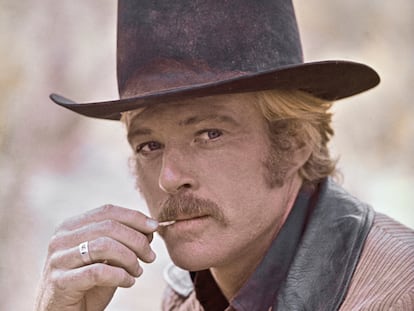

He was a titan of acting, a legend among indie filmmakers in the U.S. — he was the driving force behind the Sundance Festival (named after his character in Butch Cassidy and the Sundance Kid) — a beacon for Democrats, and an activist dedicated to social and environmental causes. With Robert Redford’s death, it’s not just one Redford who is gone, but all the Redfords who have existed across different fields in the United States. The country also loses a fierce adversary of U.S. President Donald Trump.
Redford passed away Tuesday morning at the age of 89 at his home in Provo, Utah, according to the U.S. newspaper The New York Times. The news was announced to the paper by Cindi Berger, an executive at the publicity firm Rogers & Cowan PMK, who explained that he died in his sleep but did not specify the cause of death.
The actor, one of the most legendary in the history of cinema, starred in films such as All the President’s Men, Butch Cassidy and the Sundance Kid, and The Sting, and won an Academy Award for Best Director for Ordinary People. His last on-screen appearance, however, was in a big-budget film, Avengers: Endgame (2018), although, later, after the pandemic, he lent his voice to two more projects.
Not even Redford expected such a long and successful career. He told this journalist that in his youth he was very attracted to the hippie lifestyle. Twice he decided to “burn his bridges” at the start of his career: the second time was in 1966, when he moved with his wife and children to southern Spain, to Málaga, even though he had already made a name for himself on Broadway and left his mark on cinema with four films.
“I was clear about it; they didn’t like it. I wanted to be a painter. It took me a while to accept that painting would remain my hobby and that acting would take center stage,” he recalled. “And do you know when that happened? I was called to star in Barefoot in the Park, and I came back home.”
He never doubted his abilities again. Like many actors, he announced his retirement a couple of times, only to return to the screen afterward. In 2018, at the premiere of The Old Man & The Gun, he told EL PAÍS: “I’d like to be remembered for all my work on television, in film, and on stage. And for my environmental work.”
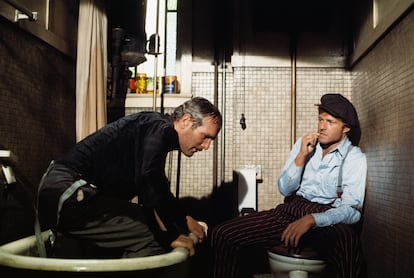
Redford spent his life struggling against his obvious good looks, against his all-American California boy appearance. He was a star — one of the most recognized and respected in cinema — but he sought out diverse acting projects, dedicating himself to films that went beyond mere entertainment.
“For me, the story is what matters most,” he explained in that EL PAÍS interview. “That comes first. Throughout my career, I’ve developed a three-step strategy: first, the story. Second, the character. And third, the emotion. What’s happened over time is that fascination with special effects, explosions, and action has overshadowed the story. And that, to me, is extremely important. Is there any phrase more evocative than ‘Once upon a time,’ with which all stories begin?”
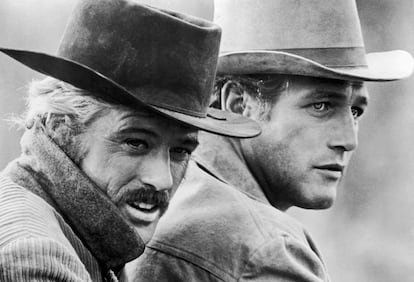
Even in 2018, he said that the project he remembered most fondly was The Sting: “In Butch Cassidy and the Sundance Kid, I played a role in which I felt comfortable, and it was a pleasure to work with George Roy Hill. That’s when Paul Newman and I became friends — a friendship that lasted a lifetime. But as much as I adore Butch Cassidy, The Sting strikes me as one of the best films in cinema history. And all the credit goes to Hill.”
Charles Robert Redford Jr. was born in Santa Monica in 1936 and grew up in the San Fernando Valley. When he was 18, his mother died from a blood disease, and Redford, passionate about painting, moved to Europe with dreams of being a bohemian. He abandoned his studies and ultimately scraped by in France (studying at the École des Beaux-Arts in Paris) and Italy from 1955. He returned to California in 1957. “As a child, I had very large teeth, excessively red and wild hair, and a face full of freckles. The physical appeal came much later and surprised me. I wasn’t ready for it,” he recalled.
Upon his return, he enrolled in an art school, thinking more about pursuing a career in costume design. After marrying Lola van Wagenen, for whom he gave up alcohol, they had their first child, who tragically passed away a few months later in 1959. That same year, a professor helped him secure a small role in a Broadway play. Redford began stringing together work in theater and television, and in 1962 he appeared on stage in Barefoot in the Park, chosen by director Mike Nichols. In film, he also started appearing in Inside Daisy Clover, The Chase and Situation Hopeless… But Not Serious.
Yet his passion for painting and the hippie lifestyle still called to him: he moved with his wife and children to Málaga, Spain, before Barefoot in the Park brought him back to film. For the 1967 big screen version of the story, he starred alongside Jane Fonda, who replaced Elizabeth Ashley.
“Hollywood never seemed like a magical place to me. It wasn’t my dream. Fame arrived unexpectedly. I began to feel treated like an object— the dark side of fame. First, you feel treated like an object, then you start behaving like one, and if you’re not careful, you become one. Hollywood is good for business, but I’d rather live elsewhere.”
Fonda was present both at his early steps as a film star and later, as his co-star in Our Souls at Night (2017), and she did not have fond memories of him. In 2023, at Cannes, she summed up their relationship: “Robert Redford? He arrives three hours late and angry, but he’s a nice guy, you know? Anyway, I’ll add that he has a problem with women.”
Barefoot in the Park catapulted Redford to fame. His next project was Butch Cassidy and the Sundance Kid, which began with Newman eyeing the blond, star-quality newcomer from the corner of his eye and ended with the two becoming close friends.
In the 1970s, he became a key figure in cinema of distinction, particularly in political works: The Way We Were, Jeremiah Johnson, The Candidate, The Sting, The Great Gatsby (a bit younger and he would have been the perfect Gatsby…), The Great Waldo Pepper, Three Days of the Condor, All the President’s Men, The Electric Horseman, and Brubaker. A brilliant and eclectic résumé, yet Hollywood’s Academy largely overlooked him: he was only nominated for the Best Actor Oscar for The Sting.
These were also the years when his environmental and social activism took root: in 1970, he opposed the construction of a highway through a Utah canyon, and five years later he led a campaign against a coal-fired power plant in the same state on land that was later protected.
“We expand and generate wealth, but what will we have left if we continue at this pace? The future should not only focus on development but on conservation if we hope for the survival of our species. Otherwise, why have children? That’s why I decided to dedicate my efforts to the environment,” he explained to EL PAÍS. In 1977, Redford wrote a critical book about the U.S. westward expansion titled The Outlaw Trail.
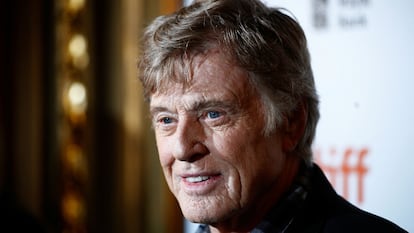
By then, the filmmaker was already living in the mountains of Utah (actually between Utah and Santa Fe, New Mexico), and in pursuit of something more, he founded the Sundance Institute in 1981, from which the Sundance Festival emerged in 1984. “The festival and the institute are a way to offer these opportunities to others. The original idea was to provide a place where creators could see each other’s work because their work was being ignored. What we weren’t prepared for was the energy it generated, the number of people who became interested in this endeavor.”
In the early 1980s, Redford began developing his career as a director and made his debut with Ordinary People (1981), a landmark in intimate cinema that brought him box office, critical, and awards success: he won the Oscar for Best Director. His influence in the industry reached its peak, although he would never shine quite as brightly as a director again.
He did direct other interesting, though uneven, films: The Milagro Beanfield War (1988), A River Runs Through It (1992), Quiz Show (1994) — arguably his best work behind the camera, earning four Oscar nominations — The Horse Whisperer (1998), The Legend of Bagger Vance (2000), Lions for Lambs (2007), The Conspirator (2010), and The Company You Keep (2010).
In the 1980s, Redford struggled to reconcile his physical appearance with the roles offered to him: The Natural (1984) was ill-suited to his age, whereas his appearance in Out of Africa (1984) strengthened the romantic narrative. In Legal Eagles (1987) he could laugh at his own acting tics; Havana (1990) was a misfire attempting to recapture the passion of Out of Africa. From then on, he seemed more aware of his age and screen presence: Sneakers, Indecent Proposal, The Last Castle, and Spy Game portray him as mature, with subtle signs of fatigue that add depth to his characters.
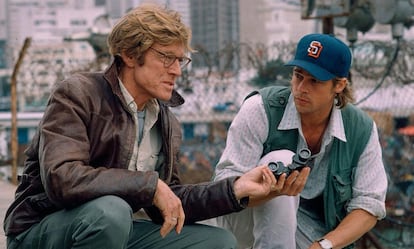
In the 21st century, he maintained his activity as a star, though the only role in which the classic Redford actor resurfaced was as the lone sailor in All Is Lost (2013). And after twice hinting at a well-earned retirement, he went on to star in Avengers: Endgame, continuing the character he had already played in Captain America: The Winter Soldier. “Do I think about death? It’s part of life. And surely somewhere in my mind I’m terrified. It’s inevitable, but I can choose between living in fear or carrying on with my life and laughing at death. With age, I’ve had to step back from certain things, but as long as I can take long walks and ride horses, I will keep laughing at it,” he said in Toronto in 2018.
A year earlier, in April 2017, alarmed by Trump’s attacks on the media during his first presidency, he published an op-ed titled 45 Years After Watergate, the Truth Is Again in Danger in The Washington Post. There, he argued that Trump had taken the “false accusations of shoddy and shabby journalism” from the Nixon administration to “new and dangerous heights.” “Sound and accurate journalism defends our democracy. It’s one of the most effective weapons we have to restrain the power-hungry. I always said that All the President’s Men was a violent movie. No shots were fired, but words were used as weapons.”
Of Redford’s four children, his two daughters survive him. James, who passed away in 2020, and his youngest, Amy, have built their own careers in film and television, though far from the reach of their father, a titan of American culture.
Sign up for our weekly newsletter to get more English-language news coverage from EL PAÍS USA Edition









































