
Harris Dickinson, from heartthrob to Ken Loach torchbearer: ‘We have lost faith in politicians’
The star of ‘Triangle of Sadness’ and ‘Babygirl’ makes his directorial debut with a film that draws from classic British social realism
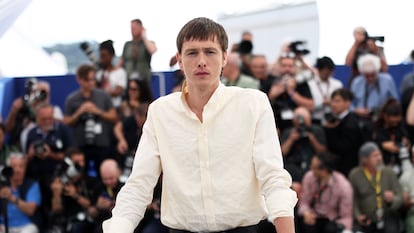

Harris Dickinson, 29, has several tattoos. On his right shoulder, as can be seen in some of his films, is the word “KES,” a reference to Ken Loach’s 1969 film of the same name, which was also Polish director Krzysztof Kieslowski’s favorite movie. Now that’s a statement of intent.
Dickinson’s directorial debut, Urchin — which hits cinemas on Friday — screened at the San Sebastián Film Festival in September. When asked about his tattoo by the press, the Londoner rolled up the short sleeve of his T-shirt and proudly displayed the reference. “Loach is one of my guys,” he laughed.
Dickinson’s public image is likely shaped by his acting work: he starred in Triangle of Sadness (2022) by Ruben Östlund, appeared in The King’s Man the same year, played Nicole Kidman’s turbulent lover in Babygirl (2024) — Antonio Banderas spoke highly of him on that shoot — and was in Blitz (2024) by Steve McQueen. But he has a much more eclectic career; he first drew attention in 2017 with Beach Rats and has gravitated toward auteur-driven, risky projects (The Souvenir: Part II, The Iron Claw, Where the Crawdads Sing) rather than those offered for his good looks (Maleficent: Mistress of Evil).
Everything will change when Sam Mendes’ quartet of Beatles films premieres, in which Dickinson will play John Lennon. At least that September morning in San Sebastián, the actor was relaxed. He checked his phone briefly, and, smiling and speaking slowly, explained why he decided to direct and why he debuted with a socially conscious film like Urchin.
“As a child, I thought I would be a cameraman,” he said. “I made skate videos, and then, at university, I started making my own short films and a comedy series that I posted on YouTube every week.”
But film school was too expensive for the son of a social worker and a hairdresser. Indeed, there was even a time when he almost joined the Royal Navy. “Acting became a more realistic project,” he explained. “I started in theater when I was 20 or 21, although I never gave up writing.” “I’m already writing my second feature film,” he added.
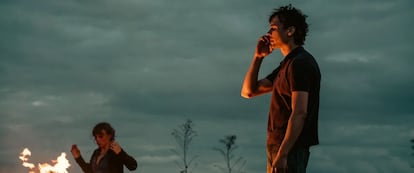
The drive remained, which is why he directed the short 2003 in 2021, while his acting career was already on the rise. “I felt I finally had permission to shoot a feature.”
And does he wonder how audiences will react to this shift in his career? “People probably don’t know what I’ve been spending my time on. When I said I wanted to make this film, and even when I made it, I sensed a general feeling of… ‘Oh, you wanted to make a film? Are you a privileged actor who’s decided he wants to try directing?’ What they don’t know is that it was actually my goal. It’s just that I haven’t been going around announcing it. From the outside, it seems frivolous, but I’ve dedicated years to this.”
Urchin was born from what he saw through his father’s profession and his own experience. “In 2019 and 2020, I worked with an organization in my community in East London with people who had been living on the streets for years. It was a topic that both interested and outraged me. The local government doesn’t necessarily help in the right way, despite its efforts. These shortcomings motivated me to try to tell a story about someone struggling against themselves.”
Urchin opens with the film’s protagonist, Mike, sleeping sprawled on the sidewalk of a London street. It’s daytime, and hurried pedestrians pass around him. A preacher shouts, trying to convince passersby of the wonders of his religion. The yelling wakes the homeless man, who, after an argument with the zealot, gets up and begins his own journey — during which he will attack and rob the only man who tries to help him.
“It’s important to care about your characters, even when they have questionable behavior,” said Dickinson. “I wanted to show the struggle someone faces in that situation, without focusing on the institutions, as if it were an odyssey, not a reflection of the shortcomings of parole or prison reform. I greatly admire the people who work in those fields, like my father. I don’t want it to seem like I’m blaming anyone.”
And then comes the moment to delve into the meaning of his tattoo. “My mother is a huge film buff. She used to take me to the cinema when I was little. She introduced me to Mike Leigh, and I identified with the characters in his world. They felt like people from my own life, and I found it intriguing.” Then came “Ken Loach, Lynne Ramsay, who started in social realism, Shane Meadows, Andrea Arnold, Sarah Gavron, Clio Bernard — all filmmakers from the U.K. — and Joanna Hogg as well… They are the foundation of a tradition that I’m grateful to be a part of.”
Dickinson spotted the star of Urchin, Frank Dillane, the son of acting legend Stephen Dillane, in the series Fear the Walking Dead. “When we started auditioning actors, he walked into the room and gave an incredible audition. I found him intriguing. I knew I didn’t want to fall into the stereotype of the rebellious youth. Frank embodied exactly what I needed, because he had to be charming and eccentric, and he had to be both embarrassed and pathetic. An imperfect human being.”
And did Dickinson keep the supporting role for himself? “Not at all! A week before filming, the actor we’d cast left, and Frank looked at me and said, ‘You’re the only one who knows the entire script.’ I had no choice.”
Urchin is not a political film, the director insists, but… “I wanted to get involved in causes, I wanted to mobilize, even though I didn’t know how. Many people feel the same level of frustration. We want change; however, we don’t know where to start. Whether with activism, with legislative change from the government, or with individual support. There’s an incredible charity in London called Under One Sky. They go around the city in groups of five, and they find people in vulnerable situations. They give them food, they hand out sleeping bags. It may not be changing the whole picture, but they answer a question: what can be done today that is effective?”
“We’ve lost faith in hierarchical structures, we’ve lost faith in politicians,” he added. “I don’t want to be cynical, but where are we going if there’s so much distrust in people? Change lies in the community, in local efforts, in understanding and empathy. All things considered, I don’t have a prophetic answer.”
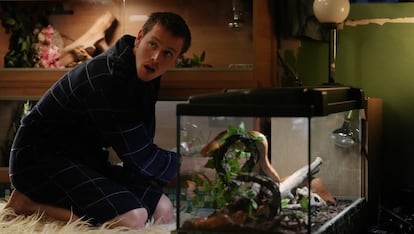
Religion surfaces in the first and last sequences of the movie. The street preacher scene was inspired by a personal experience. “He wouldn’t stop talking and shouting, as if he went from innocent religious rhetoric to blind rage. It’s confusing because religion is supposed to be something kind, even though we know it isn’t,” said Dickinson. “I’m interested in faith and spirituality. Perhaps many of us share that feeling of confusion about faith in general and feel that we’re part of something bigger, but without knowing what it is and without wanting to label it.”
Sign up for our weekly newsletter to get more English-language news coverage from EL PAÍS USA Edition









































