
Lux Pascal, actress: ‘I’m not the only trans person in Pedro Pascal’s life’
The performer stepped into her first leading role with ‘Queen of Coal’ — and after being extremely guarded about her personal life, she’s ready to explain her hesitance
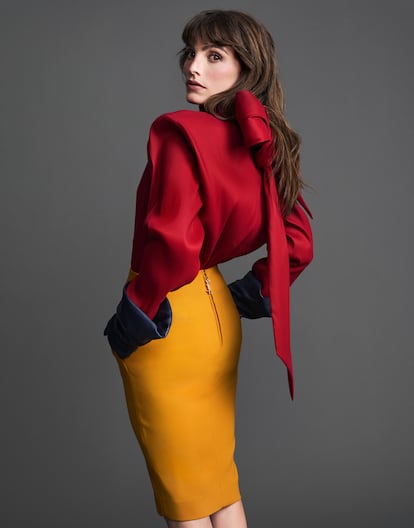

“Look, I have a Rubik’s cube to calm my anxiety,” says Lux Pascal, 33. Every time she meets a new person, they’ve likely labelled her as one of two things. Either she is nothing more than the younger sister of Pedro Pascal — the actor from the biggest series in recent years (Game of Thrones, The Mandalorian, The Last of Us) — who leaped into movie stardom in the last 12 months (Materialists, Fantastic Four: First Steps, Gladiator II and Eddington), or she is nothing more than a trans celebrity in a country obsessed with demonizing or canonizing them en masse. Or sometimes, the two merge, and she is seen as nothing more than “Pedro Pascal’s trans sister.” Judging from how she takes the Rubik’s cube out of her backpack, and regards the audio recorder the journalist has just turned on in a hotel restaurant in central Madrid, she seems to be waiting to see which of these paths the interview will take, and modulate her responses accordingly.
“I grew up going to Catholic school, in uniform,” she says. “I’m not afraid of the religious side of life, because I was raised around Christian and Catholic people. The Jesuits were the first to promote education in America, there has always been that connection between knowledge and theology. The church, and rightly so, is seen in a critical light today, but it has a lot of interesting material, which is undeniably part of our culture.”
“Is the world a more interesting place to you, beyond what we can see with our eyes?”
“People are much more complex than what others think, that’s what draws my attention.”
She raises her gaze and returns the cube to her backpack.
If Lux Pascal didn’t have to speak for people who aren’t in the room, if the things she says weren’t eclipsed by the ones she hasn’t, things would be different. The focus might be on the fact that she is an actress on the rise, who trained at leading schools of performance in Chile (Pontifical Catholic University) and the United States (Juilliard School, the alma mater of Adam Driver, Jessica Chastain, Viola Davis, Robin Williams and Patti LuPone, and whose music department produced the likes of John Williams, Miles Davis, Nina Simone and Philip Glass). She was admitted on her own merits into both institutions, and since graduating, has racked up on-screen credits. For example, the starring role in Queen of Coal, an Argentinian-Spanish film by Agustina Macri about Carla Antonella Rodríguez, the first trans woman miner in Patagonia. Pascal also models. On Monday, she walked in the Chanel show at Paris Fashion Week, and in 2022, was featured on Carolina Herrera’s catwalk at New York Fashion Week, in addition to appearing in fashion editorial shoots for various magazines.
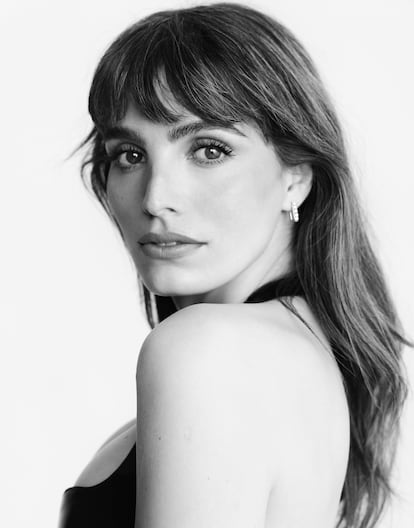
Pascal is the youngest of four children born to a Chilean couple who in the 1970s fled the military regime that had taken control of their country. Her father, José Balmaceda, was a doctor specializing in fertility; her mother, Verónica Pascal, a childhood psychologist turned visual artist. “They were defenders of democracy, but also allies of people who were being persecuted by the dictatorship,” their daughter explains. They lived in Denmark for a period of time, and then in Texas, before finally settling down in Orange County, California. That’s where Lux was born, and spent her early years. “There are photos from that time,” is all she can say about that period of time. “It’s funny, because we seem like a traditional family, all of us on the beach, my mother, my father.”
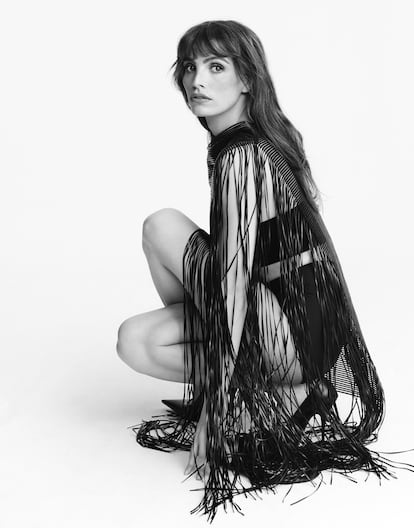
In the 1990s, Pinochet lost the presidential election and his successor, Patricio Aylwin, began the transition to democracy, opening the door for the return of the political refugees who had fled to other countries. Balmaceda’s clinic fell on hard times, as did the family itself. Lux was three years old when her mother left her father and returned with her and her brother Nicolás to Santiago. This is when her memories start: her school Saint George’s College, religion, her uniform. The Chronicles of Narnia, her favorite books. Being different from other people her own age. “I grew up always having older people around me. I was comfortable surrounded by adults, having conversations with them. My older brother was on a different level, culturally. I quickly absorbed a culture that wasn’t meant for people my age. That led to a disconnect with the children in my class, which happens with a lot of youngest siblings.”
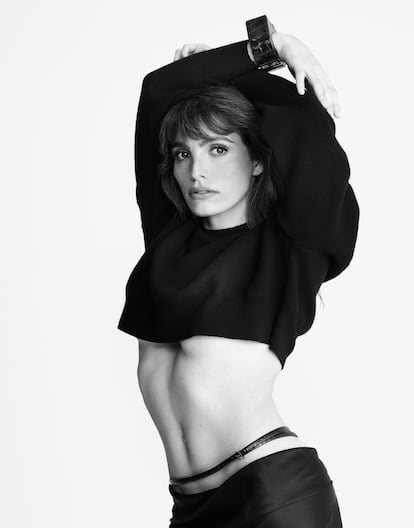
As a child, she had a motto: the world is not as interesting as what we do with our imagination. She began to write. “My mother wrote poetry and I kept diaries, I wrote every day in them, it was all very pictorial, very cinematic,” she recalls. She was seven years old when Verónica died. She doesn’t go into detail about that time, besides to underline how her siblings came together. “It made us not take life for granted. All my siblings are my favorite people in the world,” she says.

With time, her restlessness turned into something more solid. “There were people who saw something different in me and I tried to offer it to them,” she says. One of those people was her eldest brother Pedro, who was at the time a struggling stage actor in New York. When he visited Chile, he brought DVDs, candy and CDs that couldn’t be found in Chile, or that Lux had been too young to seek out: David Lynch’s Mulholland Drive,which she saw when she was 12; and Scream.“There was a time when I wanted to be a film director, or at least work in movies. Later, when I saw more theater, I felt like it was my calling, you know? I didn’t choose it, but that’s why it felt so right, because it was part of me.” Acting allowed her the mechanisms she had been searching for in her writing. “My imagination was creating dramatic situations,” she says. By the time she got to high school, she was able to verbalize that which would come to define her future: she actually wanted to be — she had to be — an actress.
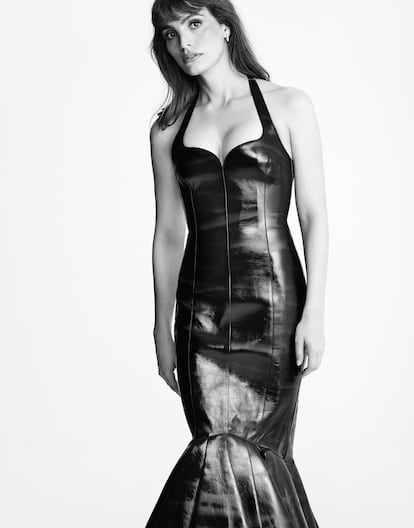
She enrolled at Pontifical Catholic University. “Many of my teachers had came out of that place,” she says. At first, everything went well. “I had a successful career,” she says. Between 2014 and 2016, she acted in Chilean soap operas. She made her film debut in a comedy and in 2017, she appeared in Narcos, the Netflix series starring Pedro. “I had a very comfortable life, I was with my father and had a long-term relationship with my partner.” But she also had the feeling that it was just the beginning. “I began to go to therapy. It was the first thing that I wanted to pay for on my own, even though I was young [she hadn’t yet turned 25], because I was going to take it more seriously if I was paying for my own sessions,” she says. What she realized in those sessions turned out to be serious, indeed. “I wasn’t satisfied. I saw myself in another country, exploring,” she remembers.
If her motto was true, if the world was more than that which surrounds us, Lux Pascal was also something more. And if all that was correct, she had to distance herself from the settled life she had built for herself. “But only if I had a really good reason,” she explains. “And the best possible reason I could imagine was being accepted into the world’s best acting school.”
It took her a year and a half to prepare her application for Juilliard. The school’s selection process took another three months. “I arrived in January, I had to come back in February and we finished in March. First, they watch your tape to see if they want to see you at the university, then they audition like, 3,000 people. 300 make it through, then 50. Of those, 18 get a final audition.”
“What did you learn at Juilliard?”
“That hard work is done in the present. Control is only an illusion. As much as you prepare, you do the important work in the present,” she says.
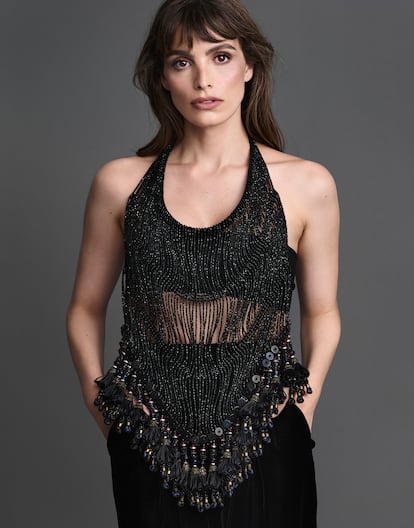
The pieces that currently comprise her image, perhaps her life, began to take shape at that point. She took on serious roles in school productions of Hamlet, Pericles, Chekov’s The Seagull. She transitioned into her current gender expression, her imposing physique. She became a model. “That is what I chose for myself. I have photographer friends and I met others who wanted to take my photo. I began to get attention, I got an agent. But modeling was a complement to my film career, not the main event. I try to avoiding calling myself a model because people can assume a lot of things about it.”
That was another thing: labels. When she graduated in May 2023, her name was already Lux, and her last name, Pascal, that of one of the world’s biggest rising stars. Pedro had just starred in the Almodóvar film Strange Way of Life, which premiered at Cannes, raising his visibility as an actor whose filmography has grown to become as enviable as his popularity. He attended her graduation and her classmates scuffled to ask him for selfies. “Who wouldn’t?” Lux reasons.
Question. For you, he’s your brother, but for us, he’s an international celebrity.
Answer. I have always known that he is a very special person. He has been a tremendous support to me, and that support has always been mutual.
Question. Have you inherited your family’s political drive?
Answer. I’m more cautious. I’m not an activist, I’m an artist. My political point of view will always be expressed through art.
Question. Even when you see that the United States, where you have citizenship, is now openly hostile to people like yourself?
Answer. Continuing to work, looking for ways to open doors for us and for the people who come after us, is the best way to generate resistance. And I don’t think that social media is a very good place for political opinions. I talk about those personally, with the people I work with, who I decide to go have a beer with, have dinner with. I try to stay informed through my circle, and to inform. Social media is great for people to tell you the most hateful things. I also try to protect myself.
Question. Are you afraid of what you could provoke by speaking out?
Answer. Oppression creates a mental health crisis. It makes us question if our life is valid, and that provokes one to stop believing in one’s own humanity, if you’re deserving of love, of forming part of society. It’s a problem that I resist. It’s hard for me to have this conversation, I don’t think it’s it’s fair that I have to have it.
Question. I feel like I’m pressuring you. If I had a Ukrainian actress in front of me, I would ask her about Ukraine.
Answer. No, it’s OK that we talk about it. It’s a question that I think about a lot. But also, that I try to ignore as much as possible.
Question. Also, because your brother has supported trans rights publicly and repeatedly (e.g., his criticism of J.K. Rowling, wearing the “Protect the Dolls” shirt at appearances) — a lot of people say, “Ah, it’s because of Lux.”
Answer. I’m not the only trans person in Pedro’s life. His heart is so big. He lived in New York in the ‘90s, he knows a lot of people who are being affected by transphobia and they aren’t just trans women. Transphobia is part of misogyny. Scratch a transphobe, a misogynist bleeds.
She looks down, as if looking for her Rubik’s cube.
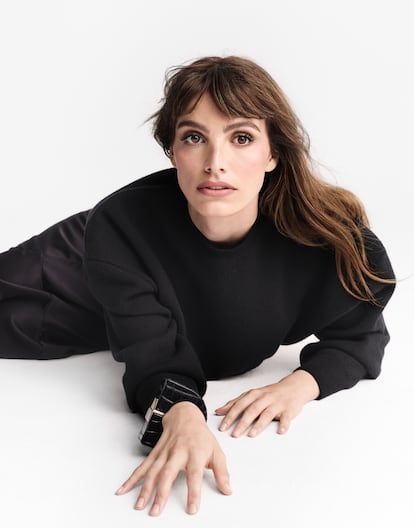
Before graduating, she had already been cast in Queen of Coal and has been promoting the film for nearly a year, the biggest media exposure of her life. Her success has come from her resistance to being defined; her most significant achievement is not yet delineating her own bounds. To do so now would be a betrayal of all that might come in the future, to the doors she has already opened. After decades of celebrities with something to say — TikTok sincerities, late night moralizing in reels and stories — she find herself somewhere between the benefit of the doubt and professional agnosticism. “My aspirations are the things I have. I am ambitious, but there are limits,” she says. “Success is closer than one thinks. I don’t believe in it in the conventional way. I have personal projects I want to fulfill. Sitting here, talking about the premiere of a movie I star in [Queen of Coal recently became available in Spain] — that is the success I’m feeling right now.” The only thing that speaks for her are her actions, and even there, she hasn’t yet begun to express herself fully through them.
“What is the biggest obstacle you’ve had to overcome?”
“Being at peace with myself,” she says.
“Have you been that for long?”
“Well. Today you caught me on a good day,” she responds.
Lux Pascal is an actress, that much is clear. Ahead of her lies the premiere of Alicia Scherson’s Summer War, a Roberto Bolaño adaptation, as well as that of Love & Chaos, her first Hollywood movie, hailing from a world that as of now, only holds attraction for her insomuch that it doesn’t close other doors. “I’m not looking for validation from doing things that are considered big,” she explains. “Someone once told me that Hollywood is not a place, it’s an idea. You’re part of it, or you’re not. I still feel alien enough to do things in other places. And other times, I feel like I’ve been invited to be a part of it. That’s a huge freedom, it’s how I measure success, how free I can be. If I have the opportunity to work on an international film and then go back to the country I’m living in, the United States, and have work there: that is what I long for most. And, what I want to continue conquering.” Lux Pascal is an actress, she is incredibly prepared for what is to come, and she has learned that the real work is done in the moment.
CREDITS
Sign up for our weekly newsletter to get more English-language news coverage from EL PAÍS USA Edition









































