
Michael J. Sandel: ‘The left needs to learn to speak the language of patriotism’
The US philosopher warns of the danger of trying to combat Trump with ‘purely economic arguments’
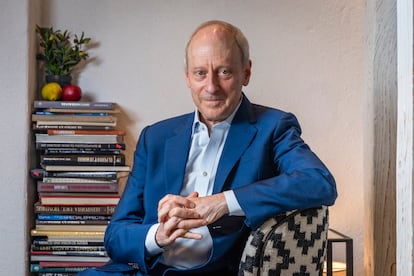

The words justice, equality, and dignity seem like echoes from another time — until they are spoken by philosopher Michael J. Sandel. Then they return with force, helping us understand today’s world, explaining how and when it fell apart, and what allowed someone like Donald Trump to rise to power. The American theorist, a leading voice in progressive thought, dissects causes and consequences with surgical precision in each of his books, and never shies away from bringing some of the great ideas of classical and contemporary thought to everyday citizens. Philosophy can also be a mass phenomenon, and his packed lectures are proof of that.
His work, which includes titles such as Democracy’s Discontent (1996), Justice: What’s the Right Thing to Do? (2011), and The Tyranny of Merit (2020), has traveled around the world, and recently landed in Mexico City. There, the Harvard professor presents it in full, invited by the Faculty of Law at Mexico’s Autonomous University (UNAM) and by the Monterrey Institute of Technology. Sandel met with EL PAÍS at the hotel where he is staying, south of the Mexican capital, shortly before facing a large audience, and a day after a federal judge ordered that the funding Trump had cut be restored to the university.
Question. What did you think of the court ruling?
Answer. It’s good news that the judge ruled that Trump acted illegally. These are funds that had already been allocated, mainly for biomedical research. However, the Trump administration will appeal and it may reach the U.S. Supreme Court and it’s hard to predict what they will do. It’s a good first step, but I think it’s important for a university like Harvard to stand firm in defense of academic freedom, because Trump’s attack is not only about money. He’s trying to impose an ideological vision of what students should be admitted, what faculty should be hired, and what academic programs should be taught. And universities can’t give in to that kind of violation of academic freedom.
Q. How would you describe the mood among your students? Is there fear, hope, a sense of resistance?
A. I think there’s a sense of resistance. There’s understandable fear and uncertainty among students from abroad because, although Trump’s first attempt to deny Harvard the ability to provide visas for its students failed, the courts only struck down one version of that attempt. There’s apprehension.
Q. Economic pressure has also become Trump’s way of negotiating with other countries. U.S. Secretary of State Marco Rubio signed a security agreement in Mexico as a way to ward off the imposition of new tariffs. How do you view Trump’s relationship with the rest of the continent?
A. I think his approach is deeply regrettable. It’s an attempt to bully rather than to cooperate; that’s not the best way to live with one’s friends and allies around the world. Mexico has done a good job under difficult circumstances, trying to contend with his bullying tactics. There are areas where there can be cooperation to combat the drug trade. That’s a legitimate basis for cooperation, provided it’s done on the basis of mutual respect and respect for sovereignty. Do you think the meeting [on September 3] points in that direction?
Q. Sure, but he switches between a hard and soft approach depending on the day and the country, doesn’t he? Just the day before, he attacked a boat coming from Venezuela.
A. Yes, it’s a chaotic approach to foreign relations, to say the least. The tariff policy has created all sorts of instability and, more importantly, mistrust. The punitive way Trump has gone about tariff policy — in the case of Brazil, trying to punish the fact that they are trying the former president [Jair Bolsonaro] for attempting a military coup — is very damaging.
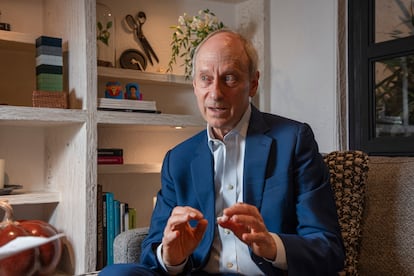
Q. You’ve done a lot of work on the ideas of justice and inequality, but it’s freedom that has captured the rhetoric of our time and of reactionary projects like Trump’s and Bolsonaro’s. What happens when we dissociate freedom from these other two democratic pillars?
A. A conception of freedom that is separated from justice, equality, and democracy is an impoverished conception of freedom. It’s a purely market conception that assumes I’m free insofar that I can get what I want as a consumer. But that misses the fact that being truly free requires that citizens have a meaningful say in how they’re governed. To be a free citizen is to have a meaningful voice, not to be disempowered. That, too, depends on a certain conception of equality: citizens with equal status and equal respect.
Q. Why do you think it is easier to politically manipulate the concept of freedom, sometimes to the point of perverting its original meaning?
A. This is true of freedom, and of other ideals as well, including democracy. One way to explain this is that it’s a contested idea — it’s not as if we can just agree on a definition and be done with it. Much of politics and political discourse consists of healthy debate about what freedom means and how we can achieve it. Part of the problem is that our public discourse is empty and hollow of larger moral and civic issues like the ones we’re discussing. This opens the way for the right-wing, often xenophobic, authoritarian populism that Trump represents.
But the alternative is not to simply to go back to the neoliberal version of globalization that produced the widening inequalities, the anger and the sense of grievance that he’s exploited. The solution is to recognize the failure of the neoliberal model and propose an alternative politics. And I would say an alternative idea of national community. The center-left has made a mistake by ceding the language of patriotism to the right. This is understandable, because today it is too often associated with xenophobia and hostility to immigrants. But that need not be the only version. The alternative to Trump needs to acknowledge the importance of national community and identity. The left needs to learn to speak the language of patriotism, community, and belonging. Unless it does, its case will be purely economic, as it was during the technocratic politics that the center-left parties fell into in the 1980s.

Q. You have been very critical of the role that the left played in the consolidation of the neoliberal model because it did not question the premise that solutions would come from the market.
A. Exactly. This goes back to Margaret Thatcher and Ronald Reagan. They explicitly argued that markets were the solution, while government was the problem. But even when center-left parties succeeded them, they never challenged that market faith. They softened the harsh edges of laissez-faire politics, but they didn’t articulate a politics of the common good, and that paved the way for Trump. It led to the backlash, widening inequalities, and to the sense of elites looking down on working people. It alienated working people from the center-left parties, who once constituted their primary base of support. They have to figure out how to reconnect with them.
Q. In the last century, taxes on the wealthy reached 80%, but now it’s difficult to talk about profound tax reforms, even on the left. When did the consensus on progressive taxation break down?
A. It happened mainly during the years we’ve been discussing, in the 1980s. Tax rates were higher than they are now even when Reagan left office, but that’s where it all really began. And we’re not going to be able to change that by making purely economic arguments. We’re only going to be able to change it, I think, by a shift in the conception of democracy and the common good. There should be debate between parties across the political spectrum, but we’re not even having the debate on those terms.
Q. Does the radical distinction between economic and cultural aspects impoverish the debate?
A. Yes, and then we debate what accounts for Trump’s support. Is it the economy? The fact that workers have faced job losses, hollowed out of industrial communities, and stagnant wages. Or is it culture? He attacks elites who workers feel look down on them, and they like his harsh rhetoric about immigrants. That’s seen as cultural, but they actually come together if we think about dignity, and in particular the dignity of work. I think it’s important to distinguish the legitimate grievances that underlie support for Trump from the racism, xenophobia, and misogyny he also appeals to. The legitimate grievances are connected to the sense among many working people that elites don’t recognize the work they do, especially if they lack a university degree.
Q. In your work, you draw a strong connection between political polarization and meritocracy, which is about a system that creates winners and losers. How has the concept of meritocracy weakened our social ties?
A. This goes together with the period of neoliberal globalization. Those who landed on top during that period came to believe that their success was their own doing and that they therefore deserved the bounty the market bestowed upon them. And by implication, those who struggled, those left behind, must deserve their fate too. What this attitude forgets, or encourages the winners to forget, are the luck and good fortune that helped them on their way. Their indebtedness to those who made their achievements possible from families, to neighborhoods, to the countries and the times in which they live. If neoliberal globalization created the divide between rich and poor, meritocratic attitudes toward success created the divide between winners and losers. The former is about income and wealth; the latter is about honor, recognition, and dignity.
Q. Do you see any space where solidarity prevails over competition?
A. If we look back, the creation of welfare states. That achievement was possible because political parties, politicians, and social movements pushed for a safety net and public healthcare and education. It’s not possible to cultivate the creation of a welfare state without an ethic of solidarity. Now, one could say that solidarity was easier to inspire after the Second World War, which itself generated sources of national solidarity. Now the welfare state is under siege; it’s eroded; market faith has made the ethic of solidarity less available as a resource morally and politically. We need to rethink a politics of the common good that is appropriate for our time.
Q. Where could a hopeful alternative for the future come from? Can educational institutions like Harvard lead that effort?
A. I think it has to come from many directions at once. Universities have to do more to cultivate students’ civic education, so that they can become effective citizens, able to reason and argue effectively in the public realm and to listen to those with whom they disagree. That’s a challenge for higher education. The media also has a role to play in creating better forums for these kinds of debates. And I think we need to create more common spaces that bring together people from different class backgrounds. Part of what the inequality of the neoliberal era has produced is a kind of segregation by class. Those who are affluent and those of modest means live, work, shop, and play in different places. This is not good for democracy: democracy requires that citizens from all walks of life encounter one another in the course of their everyday lives.
Sign up for our weekly newsletter to get more English-language news coverage from EL PAÍS USA Edition









































