
Brazil vs. Bolsonaro: Keys to a historic coup attempt trial
The Supreme Court is expected to issue a ruling this week on the former president and several military officers accused of leading a conspiracy against Lula


This week the future of Brazil’s former president, Jair Messias Bolsonaro, will be decided. The Supreme Court has convened four sessions (from Tuesday to Friday) to deliberate and rule on this historically significant case. The 70-year-old far-right politician is accused of leading a coup plot to subvert the election results and remain in power after being defeated in the 2022 elections by Luiz Inácio Lula da Silva. Never before has a former Brazilian president or member of the military establishment been brought to justice for an uprising. Until now.
Bolsonaro is charged with five crimes that carry a total sentence of more than 40 years in prison. The five judges of the Supreme Court’s First Chamber must first decide whether each of the eight defendants is innocent or guilty of the various crimes with which they are charged. Once that has been decided, they will debate the sentences. The deliberations will be broadcast live on television, radio, and YouTube.
Bolsonaro is not expected to appear before the Supreme Court. Last week, he cited health problems as the reason for his absence.
The investigating judge, Alexandre de Moraes, will be the first to announce his vote, in principle on Tuesday September 9. To reach a verdict — whether acquittal or conviction — three votes are required. Bolsonaro’s defense has called for his client’s acquittal due to lack of evidence. The rest of the defendants also pleaded not guilty.
U.S. President Donald Trump has described the trial is “a witch hunt” and, in an explicit attempt to exert pressure, he has punished Brazil with 50% tariffs and imposed sanctions on the judges.
These are the keys to the process:
The accused
Bolsonaro, a figurehead of the Brazilian right, was president from 2019-2022, a former army captain, and a congressman. He has been imprisoned in his home, a villa in Brasília, since August 4, when the judge ordered his house arrest for violating precautionary measures.
Due to the risk of flight the judge revoked his passport in February 2024, and last July he was fitted with an electronic ankle tag. Police patrols are monitoring his home after investigators discovered a letter requesting asylum in Argentina. He is prohibited from contacting foreign authorities, approaching embassies, speaking on the phone, or using social media.
The far-right politician suffers from health problems, gastrointestinal issues, and hiccups. He has requested permission to undergo skin surgery on Sunday September 14.

The accusation
Bolsonaro is being tried for five crimes: attempted violent abolition of the democratic rule of law, coup d’état, membership in an armed criminal organization, damage to government property, and damage to protected property. They carry a maximum sentence of 43 years in prison.
The complaint filed last February by the Attorney General’s Office alleges that the former president led “a criminal organization structured to prevent the fulfillment of the popular will expressed in the 2022 elections, implying his continued rule without the endorsement of universal suffrage.” Those elections were won by Luiz Inácio Lula da Silva, the current president.
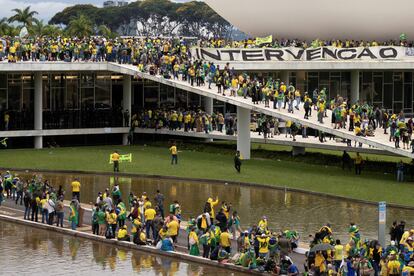
The plot culminated in an assault by thousands of Bolsonaro’s supporters on the headquarters of the executive, legislative, and judicial branches on January 8, 2023. Bolsonaro was in the United States that day.
According to the complaint, the coup plotters planned to poison President Lula and to kill his vice president, Geraldo Alckmin, and the investigating judge, Moraes.
Bolsonaro pleads not guilty to all charges and insists he always acted “within the four lines of the Constitution.” In his court statement in June, he emphasized that “without a leader, without the Armed Forces, and without financial support, there is no coup.” He did admit that he held meetings to discuss options for overturning the election result.
Other defendants
Along with Bolsonaro, several former high-ranking officials of his government are on trial: Lieutenant Colonel Mauro Cid (the president’s personal secretary, who confessed to the plot), General Walter Braga Netto (Minister of the Civil House and candidate for vice president in 2022), General Gustavo Heleno (Minister of Institutional Security), General Paulo Sérgio Nogueira (Minister of Defense), Admiral Almir Garnier (Commander of the Navy), Police Commissioner Anderson Torres (Minister of Justice) and Commissioner Alexandre Ramagem (director of ABIN, the domestic intelligence agency).
Braga Netto, the first four-star general to be imprisoned in Brazil, has been held in pretrial detention for months in a military prison for obstructing investigations.
The evidence
The cornerstone of the complaint is the testimony of Bolsonaro’s secretary, Cid, who agreed to cooperate in exchange for a lighter sentence. The lieutenant colonel mediated many contacts between the defendants. Through this, the police collected hundreds of messages detailing the plotter’s preparations and, according to the prosecution, it gathered its own evidence corroborating the confession, which the defendants have attempted to have overturned.
Prosecutors accuse Bolsonaro of sowing doubt, starting in 2021, about the security of the voting system to contest the results. Investigators found a draft decree purportedly intended to provide legal cloaking for the annulment of the elections. The document containing the assassination plans was printed in a presidential office.
There are also the meetings in which Bolsonaro, according to the prosecution, presented the heads of the Armed Forces with a draft decree containing emergency measures and sought their support to overturn the election results. The commanders of the Army and Air Force refused. The former warned him that this was illegal. The prosecution argues that the coup failed because the military leadership did not join in.
The judges
The five members of the Supreme Court’s First Chamber will hand down the sentence. The other major protagonist is the case’s investigating judge, Moraes, who temporarily shut down the social network X in 2024 and is leading a crusade against extremist digital populism. He has set the pace for the court throughout the judicial process and has generally been supported by his colleagues. The complaint against the eight was accepted unanimously. Only one of the judges, Luiz Fux, has expressed disagreement with the harshness of the sentences throughout the proceedings. He has sat on cases related to the assault on Brasília.
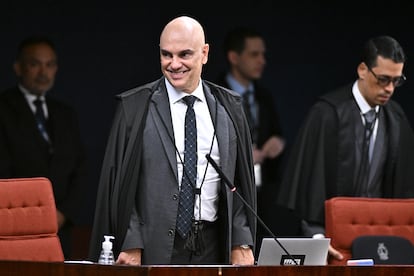
Moraes, a lawyer, was previously Minister of Justice; his fellow judges are: Carmen Lúcia Rocha, the only woman on the court, and also a lawyer; Fux, a veteran jurist; Cristiano Zanin, who was Lula’s personal lawyer (the president rewarded him with a place on the Supreme Court bench for securing his release from prison); and Flávio Dino, Minister of Justice on the day of the attack on Brasília, who was also appointed by President Lula. Bolsonaro attempted to remove the latter two from the case, but his appeal was rejected.
The timetable
The Supreme Court, the court of first and last instance in this case, has extended this week’s sessions from three days to four in order to deliberate and issue its ruling. The sessions will take place on September 9, 10, 11, and 12, when they hope to reach an agreement on the rulings.
The deliberations
The judges’ votes are expected to begin on Tuesday, September 9. Moraes will be the first to announce whether he considers each defendant innocent or guilty of each crime. They will proceed in alphabetical order by name. Bolsonaro is sixth.
The decision is made by a majority of three votes. Once innocence or guilt is established, the judges will deliberate on the sentence. A judge could request a postponement of up to 90 days to study the case more thoroughly, although this is considered highly unlikely in this case.
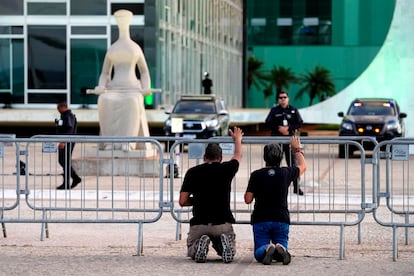
The Brazilian Supreme Court is one of the most transparent in the world. As Rubens Glezer, professor of constitutional law at the Getúlio Vargas Foundation, explains, “the deliberations are televised live. Public access to the courtroom is guaranteed. And, since the justices deliberate in public, all disagreements are exposed live and receive a very high degree of publicity.” The sessions are broadcast on the court’s YouTube channel as well as on Rádio e TV Justiça (Justice Radio and Television).
This judicial process has been much faster than most cases before the Supreme Court. The judges want to issue a ruling before next year. In October 2026, Brazilians will elect the president, governors, and Congress.
Appeal
Supreme Court jurisprudence indicates that if two justices disagree with the majority, an appeal is possible. But experts note that this occurs only in very exceptional cases and does not usually change the verdict.
The relevance
In addition to the seriousness of the crimes and the importance of the defendants, other factors contribute to the significance of the trial, explains Glezer, a constitutional law professor: “This is a test of strength regarding the courts’ ability to punish authoritarian leaders who attempt coups. In that sense, the significance goes beyond Brazil. It’s profoundly important for Latin America, but also for the world. That’s why Trump has intervened so explicitly.”
Trump’s pressure
Trump has imposed a 50% tariff on all Brazilian exports and economic sanctions on Judge Moraes and several of his colleagues on the Supreme Court bench in an explicit attempt to pressure the court trying his political ally. “This trial should not be underway. It is a witch hunt that must end IMMEDIATELY!” he proclaimed in a July social media message.
The effects
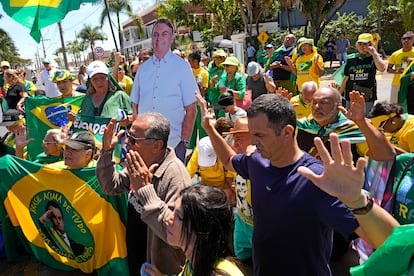
Although he was disqualified from running in 2023 in a separate case and cannot run until 2030, Bolsonaro wields significant political capital. He leads the opposition to President Lula. But the countdown to the verdict has accelerated the battle for succession within the family clan and the Brazilian right. Three governors slated for a presidential run in 2026 have already promised him a pardon if they win. Meanwhile, Bolsonaro’s supporters are maneuvering to get Congress to approve an amnesty for those convicted of the coup attempt and the assault on Brasília. More than 1,200 people — the perpetrators of the invasion — have been tried and sentenced to prison terms of up to 17 years.
Sign up for our weekly newsletter to get more English-language news coverage from EL PAÍS USA Edition









































