
Spinners, washerwomen and pig slaughters: The Spanish village of Ochagavía goes back to 1925
For over two decades now, at the end of each summer, the Navarrese location’s residents go to great pains to faithfully recreate old traditions and trades
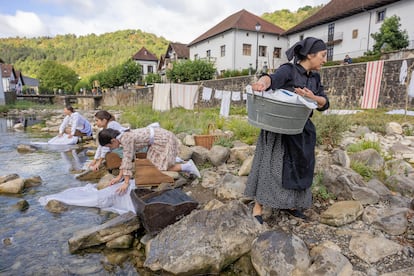

For more than two decades, at the end of summer, the village of Ochagavía in Spain’s northern region of Navarre has been turning the calendar back to the early 1900s. Traffic signs, ATMs and storefront signs are hidden under heavy fabrics. The 21st century is only noticeable through the payment terminals at some of the craft stalls, and on the cell phones of the nearly 3,000 people who visit this municipality in the Salazar Valley each year to enjoy Orhipean (in the Basque language, it means “beneath Ori,” the mountain that guards the village). This festival recreates the forgotten trades and traditions of more than a century ago. Just before the start of September, the approximately 500 local residents — plus some of those who moved away but returned in time for this event — take part in the festivities.
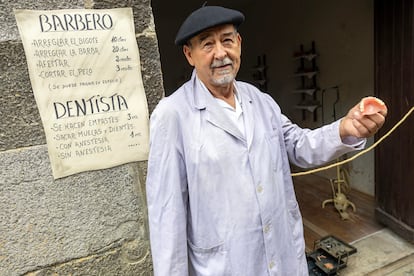
For a weekend, they dress up in the outfits of the era and pretend to turn into washerwomen, spinners, bakers and even a barber-dentist who stands in front of a price list: 10 cents for trimming a mustache and 20 cents for a beard. And if the problem is a badly-rooted tooth, the fussy ones who need anesthesia to pull it out will have to pay one peseta (the Spanish currency before Spain adopted the euro). The brave ones get the service for free.
The idea of going back in time arose more than two decades ago, when organizers of Orhipean saw the need to turn the festival around. “There used to be concerts, but they were too expensive,” recalls Jone Villanueva, 68, a local researcher and one of the festival organizers. It wouldn’t have been possible to turn the festival into what it is today, she acknowledges, without the village’s older residents. “The older people understood perfectly what we wanted to do, and they got the town fully involved.” They participated as extras and taught the younger ones. “No, no, you have to spin like this, and to wash in the river, like this,” Villanueva recalls.
The young people have grown up and continue to participate in the festival. This is the case of Amaia, 30. “At first, I played a role at the school, then at the seamstress’, and now at the bakery.” The beauty of the festival is that residents of all ages participate in it, Villanueva points out: “Even if you don’t see everyone people dressed up, many have let us use their homes, their shop spaces, or items that they’d stored away.” For example, the doctor’s office is located in the vestibule of a private house in the village, and the shoemaker displays shoes that once walked the stony sidewalks of Ochagavía several decades ago.
For the occasion, an old barn has even been recreated, “where people gathered their livestock in the summer,” and many houses in the village leave their main doors open, so visitors can appreciate the typical cobblestone paving that decorate their entrances.
Near the town hall, Casa Koleto — formerly called Casa Mancho — is also open. It’s a typical Pyrenees mansion that was rebuilt in the 18th century, after the French burned the village down during the War of the Convention. The town council acquired it in 2021, explains Villanueva, and only the bare minimum was restored. Nothing more was needed because its contents are, he says, “spectacular.” It’s the only one that still preserves troughs made from a single piece of wood, and it is furthermore noteworthy because none other than the Vatican’s envoy Ildebrando Antoniutti stayed there once in 1957. In one of its spaces, the old school has been recreated, with separate schedules for boys and girls. On the door hangs a job advertisement for a teacher, with very specific conditions: “Do not marry,” “do not be in the company of men,” “do not dye your hair,” and “wear at least two petticoats.”
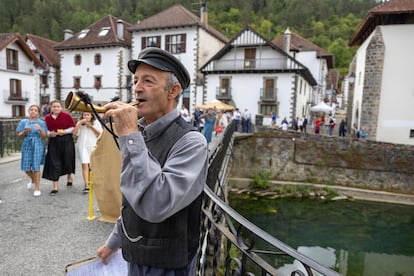
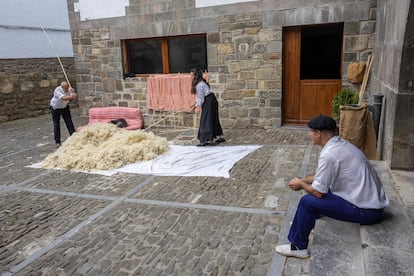
The scenery is carefully designed, as are the extras’ clothing. However, what truly adds realism to the scene is the “spontaneity of the people,” says Villanueva. The washerwomen kneel in the river to wash the sheets, the bailiff walks through the town sharing the latest announcements, and the thread spinners, “especially the older ones, are people who continue spinning because they learned it from their parents.” Livestock is also present. At the town hall entrance, a shepherd grabs one of the sheep waiting patiently in a small wooden corral and begins to shear it. He does it as people used to do, “with scissors and without tying the sheep.”
The wool is then piled up in the other corner of the square for the “axotado.” “Almost always, the one who does things best is the one who has really held the trade,” says Villanueva, so it’s the shepherds who shear the animals and simulate the crossing of the cattle along the town’s main street. There are also farmers walking their donkeys and feeding the cows and goats that wait patiently in small pens near the river. There is a special event: the “mata-txerri,” the pig slaughter. An animal is slaughtered in the street, and several neighbors grind the meat, stuff the casings to make chorizo, and cook the different parts.
Not all the extras are professionals. José Luis pretends to be the local dentist/barber, but, he admits with a smile, he’s actually an electrician. He’s been participating in this event since the beginning and assures it’s worth it, despite the hard work involved. “All the equipment comes from different houses in the village, from the hairdresser who was there before, from a dentist who was there before, and it’s a lot of setup work.” Just then, the priest shows up, and the fake barber laughingly promises that he hasn’t sliced anyone’s throat yet. What remains unclear is whether this is the real priest or the actor posing as one: the two have been seen walking separately through the town’s streets.
The reenactment also extends to the church. There, a local woman prays. She does so wearing a mantilla, a traditional shawl, and in front of her, there’s a display of old wax candles that the families of the deceased had to bring to Mass in the old days. There is also space for the angélicas, a now-lost tradition, says Villanueva. “They were the first communion girls who, during the month of May, offered flowers to the Virgin Mary. They did this in Ochagavía and at the nearby Muskilda shrine, one Sunday in each place.”
The years pass, but the celebration continues. The newspaper, which is updated each year, shows 1925, and thanks to it, we know that 29 children were born that year, with names like Jacoba and Primitivo, and that 16 residents died. We also know that three-fifths of those who were born that year were considered fugitives for not having enlisted for military service, but that six others, including Gumersindo and Felipe, were deemed fit. Weddings were also held, of course. Some took place early: Aquilino and Ignacia said “I do” on February 18, 1925, at 6 a.m. in the Parish of San Juan Evangelista in Ochagavía.
Sign up for our weekly newsletter to get more English-language news coverage from EL PAÍS USA Edition









































