
How ‘Babe’ altered our view of farm animals
Produced by the creator of Mad Max, George Miller, the movie about a pig got seven Oscar nominations. Its success also had an impact on meat consumption

It was perfectly clear to children of the 1990s that animals could be anything they wanted. In Air Bud (1997), the golden retriever became a sports hero after referees concluded there was no rule against a dog playing basketball. This followed Babe (1995), a pig who surprised the world with his skill in herding sheep.
But Babe not only triumphed at the sheep trials. The film also got excellent reviews, earned the equivalent of $550 million and received seven Oscar nominations, including best picture, and best special effects. “We had an animatronic sheep in the middle of real sheep — which doesn’t stick out. The crew used to bet on which one of the flock was fake,” actor James Cromwell recently said in The Guardian for the 30th anniversary of the movie.
Three decades after its release, the Australian film continues to appeal, and not only because of the realism of the fake animals in Jim Henson’s workshop. A modern fable confronting social hierarchical roles through prejudice-free eyes, Babe’s impact went beyond the cinematographic. The 85-year-old Cromwell himself, who earned his first and only Oscar nomination for his portrayal of the laconic farmer Arthur Hoggett, became a vegan: “On the second day of filming, I broke for lunch before everybody else. All the animals I’d worked with that morning were on the table, cut up, fricasseed, roasted and seared. That was when I decided to become a vegan,” he told The Guardian. Director Chris Noonan never ate pork again. For his part, George Miller, creator of Mad Max (1979) and co-producer and co-writer of Babe, is a long-time vegetarian. But, after the film, there was what some called the “Babe Effect,” when many minors (especially girls) stopped eating animals. The U.S. Department of Agriculture reported consumption was down and pig farmers mobilized to stop negative news about their industry.
Based on the children’s book The Sheep-Pig (1983), by Dick King-Smith, Babe tells the story of a young pig who, separated from his mother and siblings on an industrial farm, ends up in a rural smallholding. There, he interacts with different animals, including a duck that pretends to be a rooster to save itself from being eaten. Babe learns that each species has a function on the farm and his is to provide the family with Christmas dinner. However, his behavior impresses the farmer. He observes Babe’s ability to round up sheep, prompting him to register Babe in the annual sheep trials. The story is not unlike that of the pig in Charlotte’s Web but was even more popular.
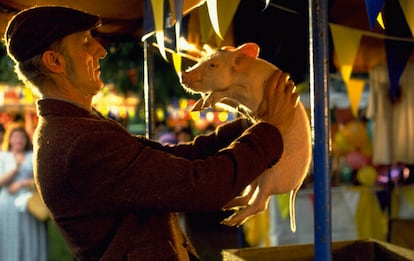
Charlotte’s Web was about accepting death as natural and inevitable. Babe, on the other hand, questions the normalization of the slaughter of certain animals or the hierarchical differences in treatment known as speciesism. “Would Babe have deserved to die if he had failed as a sheep pig? The answer is no. Animals are more than what we decide they are,” Matthew Chalmers, an animal rights activist who runs the history channel The Liberator, on YouTube, tells EL PAÍS. “Whether one animal is bred for food and another as a pet is merely a decision. Babe challenges us to consider whether the system of animal breeding and mistreatment makes rational or moral sense, given that no animal wants to be our food.”
Beyond the fanciful component of the fable, Chalmers points out that the film does a good job of reflecting what pigs are like. “They can be trained to perform tricks, they are smart enough to learn how to open latches with their snouts or even select symbols on a screen,” he explains. Extensive studies have illustrated that pigs are among the most intelligent animals on the planet, with greater problem-solving skills than dogs, cats, or chimpanzees, as well as having emotions and empathy. “They might not be able to become herding pigs, but perhaps the most powerful lesson from Babe is that if we gave animals a chance, we would still discover that they are full of wonderful surprises.”
“That’ll do, pig”
Because of the rapid growth of pigs, as many as 47 pigs, apart from an animatronic, were used to play the main character. Despite the urban myth that they were all sent to be slaughtered at the end of filming, the person responsible for the coordination of the action with animals told The Chicago Tribune in 1995 that they had in fact gone to farms or agricultural institutes, each with signed documents indicating that they should not be used for food or dissection. The film involved a year and a half of animal training, six months of filming and another year of post-production. Creative tensions between director Chris Noonan and producer George Miller didn’t make the process any easier. Miller rejected the idea that the story should be confined to the animals.
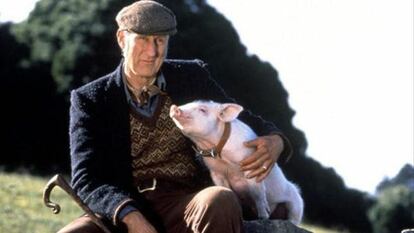
In fact, although the human angle is less prominent, it provides an essential backdrop. For example, we are briefly introduced to a son who reproaches the farmer for his lack of efficiency in managing the farm and gives him a fax machine so that he does not have to spend time on the phone. Hoggett’s sensitivity — the result of observation and contact with nature — is contrasted with the industrial progress going on around him. This is shown in the prologue in a scene of pigs kept in an overcrowded environment without ever seeing the light of day — the intensive model under which, currently, most of the 1.5 billion pigs slaughtered per year in the world live and die.
Professor Kylie Crane, from the University of Rostock (Germany), who has a PhD in English literature and specializes in cultural studies, finds it interesting that we hear so little from people in the film — Cromwell only utters 16 lines — while we listen to the animals. “When more voices are understood, the dialogue becomes more polyphonic,” she tells EL PAÍS. According to Crane, who published the essay When the Pigs Cry in 2014, the film is really about our relationship with food. She mentions another contemporary Australian production, Bluey (2018), which also “focuses on characters who use their naivety to question the structures around them.” Babe, who knows nothing, makes the audience explain from scratch their food system and speciesism. Babe is not only a sheep pig but also a Socratic figure.
The Great Potato
On its 30th anniversary, Babe has returned to cinemas. The anniversary was marked in red on the calendar of the Australian town of Robertson, in New South Wales, a place of just 2,000 inhabitants where the farm is located. On October 5, there will be a festival with screenings and multiple family activities. A farming community which once boasted a large cheese factory, Robertson is known primarily for potatoes, so much so that its most important landmark is called The Big Potato.
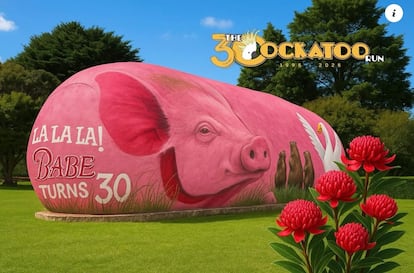
“It’s a metal structure built by a local potato grower in the late 1970s. You either love it or hate it,” says Michelle Hall, a spokeswoman for Robertson Events, contacted by EL PAÍS. This year the monument has been painted by local muralist Samuel Hall with images of the characters from the film and conveniently renamed: The Big Potato has become The Pig Potato.
So essential are these potatoes that the town holds an annual 400-meter race where contestants carry 50-kilo bags. With such a density of potatoes, Hall can guarantee that Robertson’s 10 restaurants all have vegetarian or vegan options. As for the film, they remember it fondly. “The family that owns the farm remains the same today and became practically a second family for the actors and crew. It still has some accessories,” says the organization’s spokeswoman, who says that, among the neighbors, it is common to hear people say things like, “Do you know that I did this voice in the film?” or “Do you know that I was an extra in the audience of the competition?”
Pig horror
Three years later, Miller made the sequel, Babe, Pig in the City (1998), which had a much higher budget and much lower box office success. One of the strangest children’s feature films ever, the farmer’s wife must fly with Babe for a lucrative sheep trial to save the farm from financial ruin. Before a stopover, the pig is detained on suspicion that it is carrying drugs. When they miss the flight, Babe and his owner stay in a hotel that houses animals clandestinely and the pig is kidnapped by monkeys, with whom he participates in a traveling mini-circus that gives performances to children with cancer. With threats of drowning, animal experimentation, hunger and depression, Babe experiences the coldness of city life. For some of its young viewers, it could well have been the first horror film of their lives.
Fact is stranger than fiction
In the wild, pigs would have a life expectancy of between 15 and 20 years; in captivity most pigs barely live a total of six months. Farrowing sows last three years in a continuous cycle of gestation and lactation. Almost 80% of pig farms in Spain are intensive. According to data from the Ministry of Agriculture, Fisheries and Food, last year 53.9 million pigs were slaughtered in Spain, more than the entire population of people. “Hoggett’s farm is actually a much better place to live than the vast majority of farms in Europe today, and even so, the film shows it as a harrowing place for animals, who live under the constant threat of violence,” says Matthew Chalmers. “The real Babes have no spacious barns or open fields in which to live, but concrete cages, squeezed together with other animals, places plagued by flies, feces, and death.”
Sign up for our weekly newsletter to get more English-language news coverage from EL PAÍS USA Edition









































