
NASA, the IRA and a nervous breakdown: The making of ‘Barry Lyndon,’ Stanley Kubrick’s most underrated film
The historical drama starring Ryan O’Neal and Marisa Berenson returns to theaters 50 years after an opening as tumultuous as its production

In the early 1970s, Stanley Kubrick had Hollywood at his feet. He had completed three highly influential works in succession: Dr. Strangelove or: How I Learned to Stop Worrying and Love the Bomb, 2001: A Space Odyssey, and A Clockwork Orange. His films, not without controversy, had impressed both critics and audiences. He was a different kind of auteur, a distinctive voice capable of generating interest just with his name, and Warner Bros. rubbed their hands in anticipation of his next project, which, as was usual due to his aversion to the press, remained a secret.
Kubrick had considered telling the story of Napoleon, but the failure of Waterloo, produced by Dino De Laurentiis and starring Rod Steiger and Orson Welles, frightened his producers, who withdrew funding. His next idea was to adapt William Makepeace Thackeray’s Vanity Fair, though he discarded it as too vast to fit into a single feature film.
The final choice combined elements of both ideas: the extensive research conducted for the Napoleon project and Thackeray’s work. But this time, it would be a lesser-known story, more suitable for a feature-length film: The Luck of Barry Lyndon, the tale of Redmond Barry, an ambitious opportunist in the 18th century. A fortune hunter who marries a wealthy widow to climb the social ladder. A timeless and universal story.
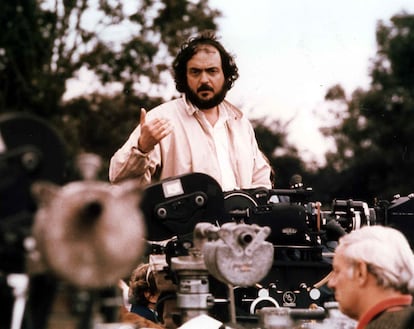
Knowing the director’s perfectionism, it was clear that Barry Lyndon would not be an easy movie to make, but it proved even harder than expected. Filming stretched over eight months, the budget tripled, the head of art direction suffered a nervous breakdown, the IRA forced a change of filming location, and finally, when that mammoth production reached theaters, Pauline Kael, the queen of New York critics, was merciless: “It’s a coffee-table movie; we might as well be at a three-hour slide show for art-history majors.”
It was not an isolated opinion. The general consensus was that it was as formally perfect as it was cold. Audiences were also unenthusiastic, and it flopped at the box office. Although it received seven Oscar nominations, it only won in technical categories often considered “minor” and lost the awards for Best Picture and Best Director to One Flew Over the Cuckoo’s Nest.
Fifty years later, the film is now seen in a completely different light. Barry Lyndon is now unanimously recognized as a masterpiece and, for many — including director Martin Scorsese, a devoted admirer — it is Kubrick’s best film. Recently restored in 4K, it has been re-released in cinemas in the United Kingdom, reigniting debate about its contribution to film history.
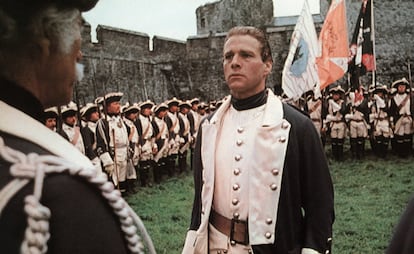
The first surprise came with the choice of the lead actor. Kubrick selected Ryan O’Neal. He perfectly embodied the image of the trendy blonde Californian of the 1970s. Esquire had dubbed him “The Sheikh of Malibu” in a scathing article that said what many thought: he was an actor whose interpretive abilities were barely appreciated, perhaps because he had been the heartthrob of the soap opera Peyton Place for over 500 episodes, and to half the world, he would always be the protagonist of the saccharine-tragic Love Story. Not even his role as a sort of modern Cary Grant in the delightful What’s Up, Doc? had stopped critics from raising their eyebrows at him. He was considered merely a pretty face — but Kubrick was certain.
“He was the best actor for the part,” the director told critic Michel Ciment. “He looked right and I was confident that he possessed much greater acting ability than he had been allowed to show in many of the films he had previously done. In retrospect, I think my confidence in him was fully justified by his performance, and I still can’t think of anyone who would have been better for the part.”
Warner Bros. also influenced the choice, being aware of the difficulty of selling a project unlike the historical films that were successful at the box office; they had insisted that he hire a bankable actor.
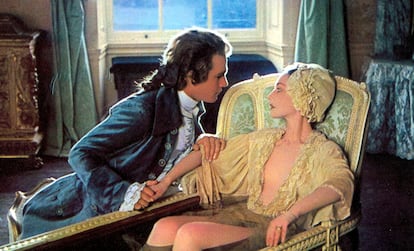
Equally surprising was the choice of Marisa Berenson as Lady Lyndon. She was a model and an aristocrat, the granddaughter of designer Elsa Schiaparelli and the sister of Berry Berenson, a model and actress who was married to actor Anthony Perkins.
Described by Yves Saint Laurent as “the girl of the 70s,” Berenson was a regular presence in Vogue and a familiar face on the dance floor at Studio 54. She had also showcased her ethereal beauty in two recent classic films: Death in Venice and Cabaret.
Kubrick discovered Berenson through Stanley Donen, a mutual friend. Donen, the director of Singin’ in the Rain, introduced them, and Kubrick offered her the role of Lady Lyndon. She accepted without hesitation.
“When a great director says to you ‘I want you to do a part’, you just say yes. You know that it is going to have his vision and that it will be extraordinary one way or the other,” she told The Independent.
It took her six months to meet Kubrick, enough time to read the novel and realize her character’s limited importance. At their first meeting, it was clear that Kubrick was more concerned with how the makeup and costumes looked on her than with a character he barely gave instructions for. She also noticed that he was a perfectionist, but having worked with Visconti and Bob Fosse, she was already seasoned in working with directors with their own vision.
“He was a perfectionist but every great director I’ve worked with has been a perfectionist. You have to be to make extraordinary films,” she said.
Berenson was most surprised by his personality. According to the actress, he was determinedly eccentric, driving very slowly, wearing a helmet in his bullet proof car and only leaving his home counties base when there was no other choice.
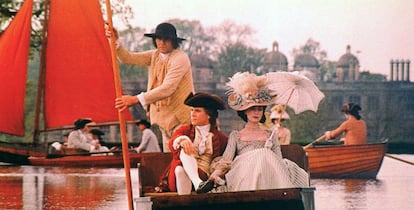
The shoot wasn’t conventional either. Berenson spent three months in Ireland “on call,” although she never filmed a single scene. Despite this, Kubrick wouldn’t let her go home for Christmas. When she asked him, the director was blunt: “No. I might need you tomorrow.”
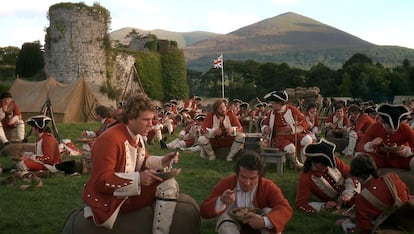
The shoot was influenced by Kubrick’s decision to film in natural light, the movie’s greatest achievement. “The lighting was so beautiful in that film,” Berenson recalled. “We were shooting in these big, cold castles with candles burning - so they had to be changed. He was shooting with this very sensitive lens that shot in the dark [...] I couldn’t really move very much because otherwise you would go out of focus. It was very constricting but for for my part, Lady Lyndon was a repressed woman anyway, it was perfect.”
The shoot was supposed to last six months, but ended up lasting over a year. “I just went into a bubble,” said Bernson — or rather, in a castle that her friend Peter Sellers had found for her so she could immerse herself in the film’s atmosphere. “I didn’t see the light. I didn’t see anything or anyone until I had finished the movie,” she told The Independent.
There were many circumstances that delayed filming, one of them particularly delicate. According to Berenson, one day production was canceled and they discovered Kubrick had gone to London in the middle of the night after being threatened by the IRA. He had been given 24 hours to leave the country. He wasn’t certain the threat was real, but a few months earlier they had already had to cancel filming due to the armed conflict. After nearly a year of work on locations and permits, some thought the film would fall apart — but it didn’t. Filming was moved to England, Scotland, and Germany.
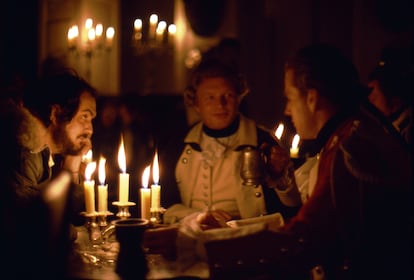
But nothing prolonged the shoot more than Kubrick’s decision to film as many sequences as possible without using electric light — the true distinguishing feature of Barry Lyndon. This forced production designer Ken Adam, who had previously worked with Kubrick on Dr. Strangelove, to find interiors faithful to the period, whose owners would allow filming by candlelight, and to ensure that nothing was damaged by fire or melted wax.
The candles were a headache — literally — for the actors, as there were so many that they consumed the oxygen. Additionally, Kubrick’s habit of shooting each scene multiple times meant the crew constantly had to replace the candles. But the worst part was that nothing had ever been filmed this way before, and no cameras were prepared for the effect Kubrick wanted.
After several failed experiments, they obtained an ultra-fast lens developed by Zeiss for NASA to use in the Apollo moon landings. A technical marvel, it made editing enormously complicated; so much so that, although Warner expected a Christmas release, the premiere had to be postponed by a year.
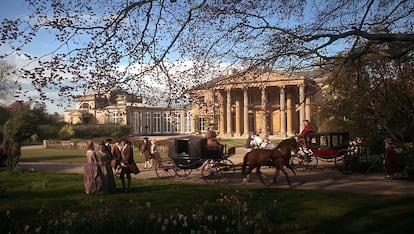
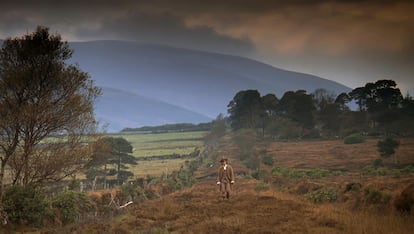
But the director was clear about the aesthetic he sought: an atmosphere evoking the landscape paintings of Antoine Watteau and Thomas Gainsborough, and the interiors of William Hogarth, Thackeray’s favorite painter. For more than a year, he had assembled a selection of a thousand paintings to serve as reference for the various art departments.
Kubrick also paid special attention to the soundtrack, which features Handel’s Sarabande; he did not want original music. “However good our best film composers may be, they are not a Beethoven, a Mozart or a Brahms. Why use music which is less good when there is such a multitude of great orchestral music available from the past and from our own time?” he declared.
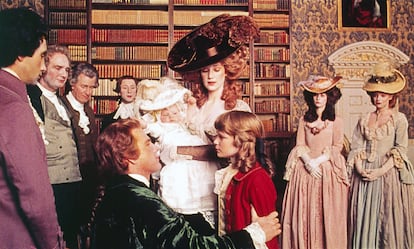
The technical marvel that is Barry Lyndon was rewarded by the Academy: cinematographer John Alcott won an Oscar, as did costume designer Milena Canonero; Ken Adam and Roy Walker were also honored for art direction, a particularly exhaustive effort. No sets were constructed; everything was filmed in real interiors, sometimes in castles open to the public where visitor access could not be restricted.
Ken Adam bore the brunt of Kubrick’s obsessions. The production designer knew from the start what challenges he would face because Kubrick wanted to scout locations without leaving his house. “So we set up in his garage a little war room, with Ordnance Survey maps on the walls and pins everywhere,” Adam recalled. “We had an army of young photographers to go looking at buildings and possible locations and every evening we looked at what they’d done. He would be enthusiastic about a particular bed or whatever in a slightly voyeuristic way. But we’d have big arguments because I would say: ‘No that’s Victorian but the film is set in Georgian times.’”
Adam continued: “Stanley was so competitive that he bought almost every book available on Georgian architecture so he could argue with me.”
The work was exhausting. “I spent weeks being chased through fields by bloody bulls. I was going crazy but this was Stanley’s character — with all his fears and anxieties he was relentless.”
The grueling workload took a physical and mental toll; Adam ended up hospitalized after a nervous breakdown. Kubrick called him every day, and when he returned home, Kubrick called to tell him he would be in charge of directing a second unit in Germany. “That gave me such a shock that the next day I was back in the clinic.” He never worked with Kubrick again.
Filming was airtight; no one knew what was happening in England. Secrecy was such that when Kubrick finally allowed Warner executives to see some of the footage, he required them to stay in a hotel for four days. “They weren’t allowed to do anything. He didn’t want them jet-lagged, he didn’t want them tired,” Berenson recalled.
Kubrick’s perfectionism did not end with the final clap of the slate. Before the release, he sent a personal note to every projectionist in every country where the film would be shown, giving very precise instructions on how his movie should be presented. To heighten the secrecy, he granted very few interviews.
“I suppose my excuse is that the picture was ready only a few weeks before it opened and I really had no time to do any interviews,” he admitted to Michel Ciment. “But if I’m to be completely honest, it’s probably due more to the fact that I don’t like doing interviews. There is always the problem of being misquoted or, what’s even worse, of being quoted exactly, and having to see what you’ve said in print.”
To the filmmaker’s dismay — he was, by all accounts, sensitive to criticism — the response from the British film press fell short of his efforts. Kubrick was also displeased with O’Neal’s attitude; the actor, disappointed with the final edit, criticized the film in the press.
Some suggest that the real reason was that Marisa Berenson, not he, graced the cover of Time magazine and received all the promotional attention. O’Neal spent years denouncing the film, claiming that his career never fully recovered from it. According to him, “Kubrick had changed the film entirely in editing, and had made him look like a clueless and opportunistic Shallow Hal of the 18th century.”
The truth is that the deliberately artificial performances of both leads are one of the main attractions of the adaptation.
Berenson, however, considers it the most important work of her career. “Not a day goes by without someone talking about it. It is truly the film that has had the greatest impact on me. Everyone associates me with Barry Lyndon.” Emerging from the cocoon in which the director had confined her had been a complex process. “Returning to the world after Barry Lyndon was strange. I had been isolated from everything for so long. Stanley sometimes saw me a bit melancholic because I hadn’t been home, and he would say, ‘You have no idea what this film is going to mean for you.’”
Berenson, however, considers it the most important work of her career. “there is not a day that goes by without someone talking about it. It is really the film that has marked me the most. Everybody associates me with Barry Lyndon.”
Her emergence from the cocoon in which the director had confined her had been complex. “Getting back into the world after Barry Lyndonwas a strange thing. I was cut off from everything for such a long time. Stanley would sometimes see me becoming a bit melancholy because I hadn’t gone home and he would say, ‘you have no idea what this film is going to do for you’"
Years later, Kubrick defended his work and dismissed the negative reviews. “From the very beginning, all of my films have divided the critics,” he stated, aware of the divisive nature of his work. “But subsequent critical opinion has always resulted in a very remarkable shift to the favorable. In one instance, the same critic who originally rapped the film has several years later put it on an all-time best list. But, of course, the lasting and ultimately most important reputation of a film is not based on reviews, but on what, if anything, people say about it over the years, and on how much affection for it they have.”
The fact that Barry Lyndon has returned to theaters 50 years later confirms what many have since realized: it is a masterpiece by one of the best directors in history.
Sign up for our weekly newsletter to get more English-language news coverage from EL PAÍS USA Edition









































