Kristen Stewart and Scarlett Johansson’s directorial debuts: Between obvious experimentation and sentimental classicism
‘The Chronology of Water’ and ‘Eleanor the Great,’ which are competing in the Un Certain Regard section, speak of trauma and loneliness from opposite perspectives


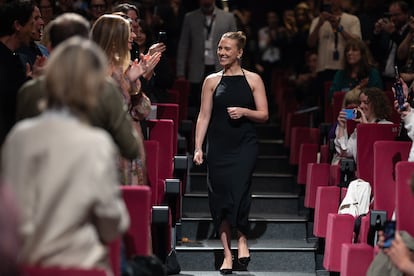
The directorial debuts of Kristen Stewart and Scarlett Johansson have confirmed that each has its own audience (young, fashionable, and queer for the former; more classic, mature, and sentimental for the latter); and also that their creative universes are directly antagonistic. While Stewart presented her directorial debut, The Chronology of Water, a few days ago with a nervous and seductive “and now let’s watch the fucking movie,” Johansson, with her imposing presence on Tuesday — and in the same Debussy room at the Cannes Film Festival — reminded us that her work deals with “friendship, pain, and forgiveness,” themes that, she added, “I wish mattered more these days.”
Both actresses did agree on one thing: premiering their debut films at Cannes is “a dream come true.” The Chronology of Water and Eleanor the Great are competing in the Un Certain Regard section, and both are nominated for the Camera d’Or. This is also the case with Urchin, the debut film by British actor Harris Dickinson about a homeless man on the streets of London, a film born from the actor’s own experience (the script is also his) as a volunteer in social work with homeless people and drug addicts.

Stewart’s film, produced by Ridley Scott, is an adaptation of Lidia Yuknavitch’s memoir about how her childhood, marked by her father’s sexual abuse and violence, led her to a spiral of self-destruction as an adult. Despite its achievements, its experimental form ends up feeling obvious and redundant in its fragmentation.
In total, it’s two hours of suffering in which we see its protagonist (played by Imogen Poots) trying to come to terms with the wounds of her tortuous childhood. The character’s relationship with swimming (she felt safe in the water as a child) is very interesting, and the film has an intensity that works at times. But there’s too much self-indulgence in its stream of images, sensations, phrases, and memories, and in the end, the list of misfortunes (rape, spanking, a stillborn baby, sadomasochism, heroin addiction, etc.) ends up numbing the viewer’s emotions. Poots is very good, and seeing Kim Gordon (of Sonic Youth) crack the whip has its morbidity. Although the best character in the film is the teacher and writer played by Jim Belushi.
Eleanor the Great, Johansson’s feature debut, written by Tory Kamen, is a formally opposite film with an equally polar opposite protagonist. Eleanor is played by June Squibb, who, at 95, creates a character that develops from a friendly, grumpy grandmother into something much more painful and profound. The amusing yet sentimental film deals with Eleanor’s grief over her best friend Bessie, with whom she’s lived in Florida since they were both widowed, and her friendship with a young journalism student (Erin Kellyman) who has just lost her mother.
When Eleanor is forced to return to New York with her daughter and only grandson (“this film is also a love letter to that city,” Johansson said), she ends up becoming an Enric Marco-esque impostor who uses the memory of the Holocaust (Bessie was a survivor) to hide her grief and loneliness. Her friendship with the young student will be built on that lie. Squibb’s fabulous performance and the enormous tenderness towards her character make Johansson’s debut, more conventional than Stewart’s but more open to all audiences, an interesting venture. If Stewart displays an authorial will à la Terrence Malick, Johansson moves more in the realm of a gentle but intelligent sentimental comedy.
Sign up for our weekly newsletter to get more English-language news coverage from EL PAÍS USA Edition