
Bono: ‘We have to fight against this general feeling that the world is screwed’
The musician presented ‘Bono: Stories of Surrender’ at the Cannes Film Festival, a screen version of his memoir and subsequent theatrical tour
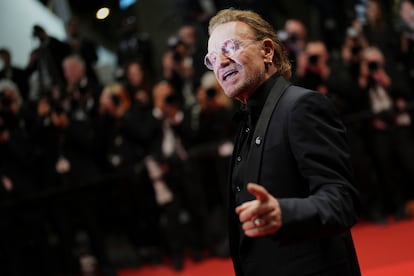

What is there left to say about Paul David Hewson, 65, better known as Bono, the singer (not the leader, he insists) of U2? Having seen the documentary Bono: Stories of Surrender, which premiered this Friday night in Cannes, there seems to be quite a bit still. Although the film, which Apple TV+ is releasing on May 30 in both standard and immersive formats, is based on the musician’s memoirs (Surrender: 40 Songs, One Story) and the tour that accompanied it, there’s a feeling that Bono needed this film to leave behind the fears, contradictions, and thoughts that have marked his life.
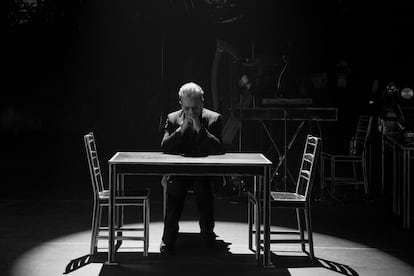
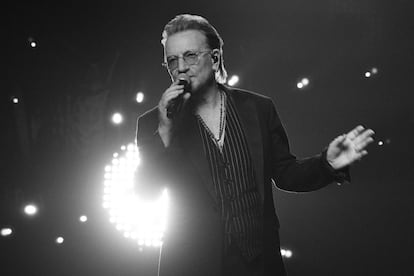
The documentary opens on a pseudo-operating table, where Bono, imitating the doctors, recalls how he nearly died in December 2016 in New York due to a congenital heart defect. He was saved by “a mixture of science and carnage.” From there, he moves on to the story of U2, his troubled relationship with his father, the death of his mother when he was 14, his doubts and reflections, all punctuated by his band’s most memorable songs on the stage of New York’s Beacon Theatre, although it ends in a theater in Naples (due to Bono’s father’s passion for Luciano Pavarotti).
In Cannes, Bono stands up to greet this reporter, opening with a joke about the Spanish actor Javier Bardem and praising actress Penélope Cruz, while never deviating his gaze, as though focusing intently on the questions. Physically, he is very thin; mentally, he is buzzing. For someone who has been dealing with press promotions for 40 years, he still seems to enjoy the process.
Question. In the film, you talk about faith and religion in separate ways, noting that one rarely has anything to do with the other. What do you believe in?
Answer. That’s a strong start [laughs]. But I like it, because these days it’s become complicated to address these issues. There’s also this very American thing about wanting to define and fit concepts together, which doesn’t suit me. I like to think I have faith in music, that I respect it, that I approach it with respect. And what do I look for in music? Well, the same as from cinema: that it transports me to another place, like when I went to church and received a message meant for me that arrived in communion with other strangers. Music is the tool with which I best communicate myself. When you compose, you know you’re giving something of yourself. In some ways, I’m Catholic; in others, I seem Protestant. I love science, it interests me a lot, and at the same time, I believe in going further, in charitable works, in helping... We have to fight against this general feeling that the world is screwed.
Q. When you talk about your mother dying right after your grandfather’s funeral, when you talk about your problems with your father, you seem to enjoy a certain dichotomy: you are speaking about yourself, yet at the same time you understand that all families suffer their battles.
A. Exactly. When I got married, I discovered there wasn’t just one family. That I could also build my own. And that they all went through problems. I grew up in turbulent times, with clashes in the streets... Things happened to me that, when seen in retrospect, are terrible. Well, no one is unique. And maybe all those experiences made me such a clingy father [laughs].
Q. In September 1976, within the space of a week, you met Ali, your wife, as well as The Edge in your high school class, and you met the other two members of U2 through a “musicians wanted” ad. How do you remember those days?
A. I don’t know if it was the best week of my life, but it was the one in which things came together in the right way [laughs]. That’s where who I am came from. About my wife, I think it was Willie Nelson who said that a day as a husband is longer than a day in any other relationship. You have to work on it. Think about it: the universe is born from separation. Since the Big Bang, everything has been about cells breaking down and multiplying. That’s how our world is designed. That’s why taking the plunge into marriage is crazy, a challenge. What’s the essence of romance? The challenge. Because you’re going against what you’re designed for. And about high school... I liked my school because in class—and it was very rare in those years — we had Catholic and Protestant students. Mixed. And it was even co-ed! The Edge was like an alien, and I was the wild one. And both Ali and The Edge were the smartest kids in class. I don’t believe in destiny; I think you have to be open to whatever comes along, be attentive. That week went well for me.
Q. Why a movie after the book and the tour?
A. Because cinema is a democratic art. Tickets to the shows were very expensive. They proposed it to me, and I accepted. And I think it speaks well to my contradictions, to who I am. Do I look bad? Do I look good? It doesn’t matter... Look, when I was young, I was a die-hard fan of John Lennon. And he was the one who said he was always ready to seek peace. Even if that included making a fool of himself. Well, that’s it. That’s what art is. It’s being open to everything. And that’s why I’m here. As much for peace as for music.
Q. Just now Robert De Niro was speaking, with the Honorary Palme d’Or in his hand, about how artists are necessary today more than ever.
A. It’s fundamental. Consider that the first film festival in the world was in Venice, which Mussolini used to boast about in his propaganda. And why was Cannes born? Out of a quest to show free cinema, not one created by fascists or to praise the Nazi with the little mustache. I really like that this festival culture isn’t like the one Americans call a melting pot. Here we witness a mosaic with different identities, colors, beliefs, and concerns. That’s what interests me.
Q. Are you aware of how popular U2 is in Spain?
A. It’s incredible. After Ireland, it was the first country to accept us. Irish and Spanish people are similar. Probably because we talk more openly about our feelings. The French and Germans aren’t like us; they’re... withdrawn. We’re more into being out of control. And I insist: I can never thank the Spanish enough for how quickly they accepted us.
Sign up for our weekly newsletterto get more English-language news coverage from EL PAÍS USA Edition









































