
700 threatening calls and a family plan for home intrusions: US judges face growing intimidation
Several judges, including Supreme Court justices, who are handling high-profile cases or challenges to controversial measures by Donald Trump, say they are facing escalating harassment
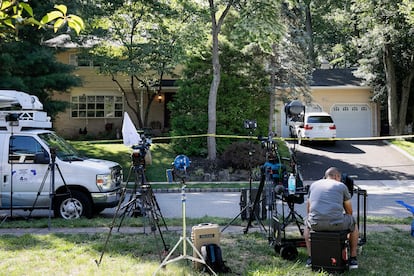

An anonymous caller alerted police one night last May to reports of gunfire inside the home of Supreme Court Justice Amy Coney Barrett. But when officers arrived at the residence in Fairfax, outside Washington, D.C., they found everything in order. The person who contacted authorities was most likely attempting to intimidate Barrett through a tactic known as swatting, in which a false emergency report is used to trigger a major law enforcement response that can spiral into chaos and violence. Barrett later recounted that, that evening, one of her children opened the front door to leave with friends and found the street “full of police cars.”
“I was very, very grateful that I had Supreme Court police outside my home because they were able to stop and meet with and explain to the county police that it had been a false alarm, and so the police did not actually attempt to enter our home,” Barrett said in July during a House committee hearing evaluating the court’s budget.
She continued: “Many of us, me included, have received threatening anonymous deliveries designed to intimidate and harass us. They are often sent in the name of Judge [Esther] Salas’s son [...] who is deceased because he was killed by a disgruntled lawyer who showed up to Judge Salas’s home intending to kill her. But her son, [Daniel Anderl], 20 years old at the time, opened the door and took the bullet instead. Her husband, standing behind, was seriously injured. So I think the message [...] is clear.”
What happened at Barrett’s home is one of dozens of security incidents involving judges that have intensified in recent years, particularly following controversial rulings or during high-profile cases. A report by the Administrative Office of the U.S. Courts showed a 57% increase in significant security incidents recorded by the U.S. Marshals Service during fiscal year 2025, with a similar trend continuing into the current year.
In recent years, those incidents have included swatting; pizza doxxing, as the anonymous food deliveries described by Barrett are known because they are meant to signal to judges that their home address is known; threats through phone calls and social media; and even, in the case of Supreme Court Justice Brett Kavanaugh, a plot to assassinate him after the 2022 leak of the decision overturning the federal constitutional right to abortion.
A recent report by the nonpartisan Brennan Center for Justice sheds light on how these threats are playing out across nearly every judicial district in the United States and affecting judges appointed by both Democratic and Republican presidents. Researchers at the center interviewed more than 30 sitting and retired judges to gather their experiences and concerns.
One federal judge, for example, reported receiving more than 700 phone calls after handling an immigration-related case, one of the most contentious issues of President Donald Trump’s second term. The judge asked not to be identified because the harassment escalated to the point that blueprints of the family home were posted online. The judge and family have had to rehearse what to do if someone breaks into the house. They never leave home together and do not take the same routes.
“When someone gets behind me, I just pull over and let them pass,” the judge told the Brennan Center. “My [child’s] school has been made aware, as well as the local police.”
Judges attacked by the White House
One aim of the study was to identify the factors driving the recent surge in harassment and threats against judges. The Brennan Center interviewed 17 sitting judges, most of whom pointed to the growing number of high-profile cases, including prosecutions stemming from the January 6, 2021, attack on the Capitol and legal challenges to the policies of the Trump administration.
“More than 850 lawsuits challenging administration policies have been filed since the president returned to office in January 2025, and in more than 150 cases, courts have at least partially halted those policies,” the Brennan Center study noted. “Such litigation has often been the impetus for inflammatory political rhetoric against judges; yet even absent such rhetoric, the profile and visibility of these cases have frequently garnered public attention that has led to threats.”
According to the report, that rhetoric has at times originated in the White House itself, from President Trump to close advisers such as Stephen Miller, one of the chief architects of the administration’s hard-line immigration agenda, as well as allies including billionaire Elon Musk. The study pointed to the impact of their statements “condemning individual judges, accusing them of bias without factual basis, and in some cases calling for their impeachment based on disagreement with their rulings.”
Trump did precisely that after Judge James Boasberg halted flights in March last year that were deporting Venezuelan migrants to a prison in El Salvador under a wartime law, after the administration had labeled them suspected gang members without presenting evidence.
On his social media account Truth Social, Trump posted: “This judge, like many of the Crooked Judges’ I am forced to appear before, should be IMPEACHED!!! WE DON’T WANT VICIOUS, VIOLENT, AND DEMENTED CRIMINALS, MANY OF THEM DERANGED MURDERERS, IN OUR COUNTRY. MAKE AMERICA GREAT AGAIN!!!
His remarks were later publicly rebuked by Chief Justice John Roberts.
The judges interviewed in the Brennan Center study expressed concern that the current climate threatens judicial independence, particularly in cases involving the federal government. They fear such litigation can lead to personal attacks, coordinated harassment and threats that reinforce the narrative that their decisions are illegitimate or politically motivated.
“I cannot deny I’ve felt pressure. I’ve wished cases weren’t mine... It would be so much easier to write decisions the way the vocal group likes — but why be on the bench at that point?” one judge said, adding that he would continue to rule based on the facts and the law.
Sign up for our weekly newsletter to get more English-language news coverage from EL PAÍS USA Edition









































