
What is the ‘public charge’ rule the government is using as a pretext to pause immigrant visa interviews?
The Trump administration has temporarily halted interviews at embassies and consulates while training its officials
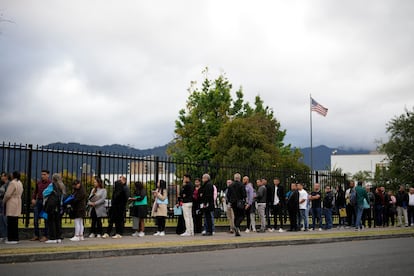

For thousands of people who have spent months or even years waiting to legally immigrate to the United States, the process has been put on hold just as they were approaching one of its final stages. The U.S. State Department ordered immigrant visa interviews at embassies and consulates around the world to be postponed while officials receive training on a stricter version of the so-called “public charge” rule.
The measure primarily affects people applying for visas from outside the United States to reunite with family members or immigrate through a sponsor. Although the government says the pause is intended to allow for a more thorough and consistent evaluation of applicants, it comes after federal courts blocked previous attempts to use the same criterion to halt applications from entire groups of people.
What is a “public charge”?
Public charge is not a new concept under U.S. immigration law. Federal law allows a visa or permanent residency to be denied when authorities determine that a person is likely to become a “public charge” “at any time.”
For those applying for an immigrant visa from abroad, the official does not necessarily assess whether the person is currently receiving benefits in the United States. Instead, the officer must try to determine whether the applicant could become dependent on the government after immigrating.
To do so, authorities can consider factors such as the applicant’s age, health, family situation, financial resources, education and skills. The State Department has also indicated that its officials will take a closer look at finances, education, employment prospects, English proficiency and health.
The Trump administration has argued that the goal is to prevent new immigrants from potentially coming to rely on assistance programs such as Medicaid, the Supplemental Nutrition Assistance Program (SNAP) and certain housing subsidies.
However, even after obtaining permanent residency, many immigrants must wait five years before gaining access to major federal means-tested programs, although exceptions exist and rules vary depending on the program and immigration status.
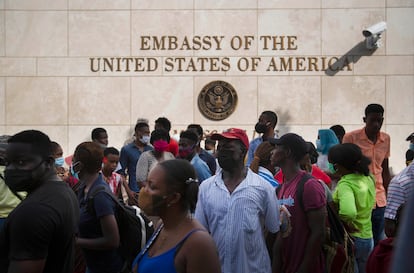
Why are the interviews being paused?
The State Department says its officials need additional training to apply the new guidelines. “In early August, we launched a global training initiative at all of our embassies and consulates worldwide. To accommodate this in-depth training, appointments for visa services will be adjusted,” a spokesperson said in a statement.
The agency also said the training is intended to ensure that officials can evaluate each applicant “comprehensively and consistently.”
The pause began in early August and, according to an official who spoke to Associated Press on condition of anonymity, is not expected to continue beyond early or mid-September. Affected interviews would be rescheduled for September, October and November.
However, the State Department has not publicly explained when rescheduling will begin or whether applicants will retain exactly the same place in line.
Who is affected?
Among those primarily affected are people seeking immigrant visas on family grounds: spouses, parents, children and siblings of U.S. citizens, as well as relatives of permanent residents. There are also visas available to certain workers sponsored by employers.
For many, the interview comes after paying fees, gathering years’ worth of documents and completing medical examinations. Some must even travel to another country to appear at the appropriate consulate. A last-minute cancellation can mean losing money on flights, lodging and medical appointments.
Visas for workers sponsored by employers would not be affected in the same way because these applicants can demonstrate income and therefore would not be considered a potential “public charge.”
The pause comes just days after several judicial setbacks for the administration. In January, the State Department had halted the issuance of immigrant visas to citizens of 75 countries considered to be at greater risk of relying on public benefits. The policy remained in place for seven months until a court struck it down.
On Aug. 21, U.S. District Judge Jeannette Vargas determined that Secretary of State Marco Rubio had exceeded his authority by categorically preventing officials from issuing visas based on applicants’ nationality. Four days later, another federal judge, Richard Leon, declared a “public charge”-related pause affecting certain Diversity Visa applicants unlawful.
However, those rulings did not eliminate the “public charge” criterion. The distinction drawn by the courts is between assessing applicants on an individual basis, which is permitted under the law, and barring entire categories of people without conducting such an assessment.
For now, applicants who had interviews scheduled are receiving emails notifying them of the postponement and must wait for further communication. The State Department has not yet set a firm date for a return to normal processing.
Sign up for our weekly newsletter to get more English-language news coverage from EL PAÍS USA Edition









































