
ICE’s corpses and the search for answers: ‘Let the truth come out. My son was killed by the guard’
Denny Adán González died in April at the Stewart Detention Center, two days after an argument with a facility officer. His family is seeking justice for the Cuban national, who is one more among the 54 migrants who have died under similar circumstances


At that point, the body had not yet begun to decompose and Sybil Ammons, a 68-year-old nurse who has spent 30 years as the coroner for rural Stewart County, Georgia, had not yet urgently requested that it be taken away. Around 3 p.m. on May 11, the first message from Ammons arrived, short and to the point. She would not release information about the case of Cuban national Denny Adán González unless the family consented. The family agreed, but two days later Ammons still had no final finding on the incident: “I’m working on it. I hope to have an answer today,” she says, hurriedly, like someone who saves her patience for the dead.
She has spent three decades deciphering lifeless, pale, cold bodies or, worse, answering families’ unanswerable question: why someone has ceased to exist forever. She has witnessed scenes that haunted her for weeks, even years, and she is convinced that her becoming Stewart’s forensic pathologist was almost a matter of destiny. “I am fully convinced God chose me for this work.”
In 1995, when she was the nurse in charge at the small Stewart-Webster Hospital in Richland, she received a young man who had died in a traffic accident while on his way to work. His wife and mother waited anxiously at the hospital. After a while, the coroner arrived wearing shorts, a sleeveless shirt and sandals, showing no hint of empathy for the relatives. Ammons turned to her sister, who was then the hospital’s director of nursing, and confessed in a low voice: “I’m going to run in the next election for coroner and, if I win, I will restore dignity to the Stewart County coroner’s office.”
She ran for the position and won, and ever since, she has made sure that every person who comes through her door is treated with at least a measure of dignity. “I treat each one exactly as I would like to be treated under the same circumstances.” She prays over the bodies that arrive in her office and embraces mothers — or fathers, or children, or grieving spouses. “Sometimes I cry with them,” she admits. She has known some of them her whole life; she has spent nearly her entire life in Stewart, a place so small that one person’s death is, in a sense, everyone’s loss. At other times, she has been called upon to care for people who were just passing through, tourists visiting the area whose journeys ended there. The most recent body to arrive at her office belonged to a migrant.
So far, she has not been able to meet or even speak with González’s family. González, a 33-year-old Cuban national, died at the Stewart Detention Center in April. His mother, Lourdes González, 62, lives in Cuba, while his brother, Dayán Hernández, 40, lives in Spain. González died in a way that was never supposed to happen, far from everything he had ever known, in a town surrounded by peanut and cotton fields, with only a Georgia coroner as his final companion.
González’s mother wants to know what happened to her son, a young man who was, she says, “beautiful inside and out,” humble and unfailingly respectful. “He was a lot like me. He was very family-oriented and always wanted to make sure we never lacked anything,” Lourdes says from her home in Camagüey, in central Cuba.
Hardly a day went by without González asking his mother whether she had food in the refrigerator. More than once, he even asked her forgiveness. “He told me that none of his achievements meant anything if he didn’t have his two children and me,” she says. But he could not return home. He had set out in pursuit of a dream, a long and difficult one, but one he considered his own: the American Dream.

“He wanted to achieve his goal, and he did,” says his brother, who helped raise him with their mother from a very young age. González arrived in the United States in 2019, was deported once in 2020, crossed Latin America again, and entered through the El Paso, Texas, border for a second time in 2022. He stayed in the country without legal status and experienced the hardships of life as an undocumented immigrant until he once again fell into the hands of immigration authorities. He owned a car, paid his rent, and worked right up until the end.
Now his body was in the custody of Ammons, somewhere in a forensic laboratory in the southern United States. The family needed to understand what had happened to González, and the coroner would soon provide that answer. For the time being, Ammons had placed an open Bible near the room where the young man’s body lay. “I pray that gives the family some comfort and peace,” she says. “I am the mother of two precious grown children, and I cannot imagine the devastation this news means for them.”
***
On May 13, Sybil Ammons sent the journalist a more definitive message: “The investigation has concluded,” she said. She added that the Georgia Bureau of Investigation (GBI) had also conducted a “very thorough” inquiry. Cause of death: self-inflicted hanging. Manner of death: suicide.
The finding confirmed the account contained in a report issued by U.S. Immigration and Customs Enforcement (ICE): that on April 28, 2026, at approximately 10:26 p.m., detention staff at the Stewart Detention Center, while conducting routine inspections, found González “hanging by a bedsheet in his cell.”
Guillermo Aguilar, a 44-year-old Mexican national, arrived in cell block A at the detention center in early February. The place was overcrowded, with barely enough room to find a spot on the floor to sleep. Hungry, he negotiated with another detainee to buy food for $60. As a newcomer, he had to learn how to survive in jail. His food was stolen, he had conflicts with some of the detained migrants, and he was placed in disciplinary segregation for seven days. When he was released, he became González’s cellmate in a space holding 80 people. Despite this, the Cuban managed to find a way to exercise. Aguilar recognized his accent.
“I said: ‘Cuba!’ We introduced ourselves. He told me: ‘If you need anything, tell me, champ.’ I told him the same. And he asked me: ‘Man, do you have spaghetti or rice? Sell me something, let me finish making some bracelets and I’ll pay you,’” Aguilar recalls.
González received very little commissary money to make up for the hunger due to the meager food provided in detention, so he began making bracelets. He carefully pulled white threads from the blankets and red or orange threads from the uniforms, weaving them into bracelets that he later sold for $20 each. “People who arrived there would leave with one of his bracelets. He made them beautifully,” says Aguilar, who still wears his on his wrist even now that he has been deported to Mexico.
At the end of April, a friend at the center told him that the guard who had had the altercation with González “threw all his threads” in the trash. “They are like that, they have no respect for us, they speak to us badly, they treat us worse than animals,” Aguilar says. González picked the threads back up. “They say he was making a little beanie that time.” Then the same guard threw them away again. “Cuba got angry and started telling him things in Spanish. They argued.” The altercation occurred on April 26, two days before his death.
From inside the detention center, another migrant detainee who secretly keeps a cell phone agreed to speak on condition that his name never be revealed. His version of events is different. Two officers were conducting an inspection when one noticed that a hinge was missing from González’s cell door. “One of the officers went to the office, filed a disciplinary report against Denny and told him they were going to put him in segregation because he had removed the hinge,” he says. According to this detainee, they argued for between five and 10 minutes, until González “slapped one of the officers very hard across the face; the officer immediately lost consciousness and fell backward onto the floor.”
The officer, who was bleeding from somewhere on his head, remained on the ground until backup arrived and transported him to a medical facility. “Two days later, people began saying Denny had died and that he had probably died by suicide. None of the officers gave us real information about what happened. To tell you the truth, I don’t know if it was a suicide or if they killed him,” the detainee says.
According to the ICE statement provided to EL PAÍS by immigration authorities, on April 26 a nurse evaluated González to determine whether he should be transferred “to a restrictive housing unit after assaulting a detention officer.” The nurse, authorities said, “documented a normal physical examination and mental health assessment, including no suicidal ideation, as reported by the detainee.”

In reality, González was the one encouraging others to make it through the confinement. On December 12, 2025, following an argument with his partner at their home in Charlotte, North Carolina, his mother-in-law called the authorities, and the Mecklenburg County Sheriff’s Office arrested him. In January 2026, he arrived at the Stewart Detention Center, one of the largest and most feared detention facilities in the United States. The center, which can hold up to 2,000 people, has been the subject of numerous complaints involving solitary confinement, medical neglect, the use of force against detainees, and sexual abuse.
Aguilar does not remember González as particularly depressed. Quite the opposite. “I had never exercised a day in my life, and I started because of him. He told me, ‘Hey, whenever you feel depressed, start working out.’” In the final weeks, when González learned that Aguilar was likely to be granted voluntary departure from the facility, he was hopeful. “He was happy. Whenever someone got out of there, people were happy, because that could mean they would deport you soon.”
The two had become friends and were making plans. González, who had construction experience, hoped to make it to Mexico and work alongside Aguilar renovating houses. “He asked me, ‘Would you really do that for me?’ I told him, ‘Not just for you, for me too,’” Aguilar recalls.
The day he learned González had died, Aguilar immediately contacted another detainee at the center. “‘Hey, what happened to Cuba?’ I asked.” He could not believe what he was being told, especially because he himself had spent time in the same segregation cell where, according to ICE, González hanged himself.
“When you are in the punishment cell, every five minutes the guard comes and checks you. It’s a tiny room; there’s no way to hang yourself from the ceiling. Where are you going to put the sheet? I think the guards went in and strangled him. But it’s your word against theirs,” Aguilar says.
Steven Owen, vice president of communications for CoreCivic, the company that runs the detention center, said in a statement to EL PAÍS that at about 10:26 p.m. a staff member “raised the alarm after finding an unconscious person in his housing area.” It was González. “On-duty medical personnel responded quickly, initiated resuscitation measures and requested the intervention of the emergency medical services (EMS) at the facility.”
At about 10:31 p.m., a nurse arrived at the cell and observed the body, which was already “lying on the floor, face up and unresponsive, with a weak pulse and shallow breathing,” according to ICE’s account. At 10:34 p.m., staff “placed a cervical collar, secured him to a spine board, transported him to the medical clinic and notified central control to call emergency medical services.” In the clinic, the nurse, seeing that González was unresponsive and without a pulse, “initiated cardiopulmonary resuscitation, provided bag-valve ventilation and oxygen, and administered naloxone.”
Although specialists performed resuscitation maneuvers, “the person’s death was certified before he was transported out of the facility,” CoreCivic says. They then “immediately notified ICE of the incident.”
On April 29, at about 7 p.m. in Spain, Dayán Hernández received a call from the United States. “I have bad news, they found your brother lifeless in the cell,” he heard on the other end of the phone. “I said: ‘It can’t be, it can’t be, who are you?’ He said: ‘I’m Officer Valdés, from Stewart detention center, where he was detained, and I’m calling to inform you he has died.’ I asked: ‘But how?’ He said: ‘We can’t give you any more information; give me your email and you will receive a letter.’”
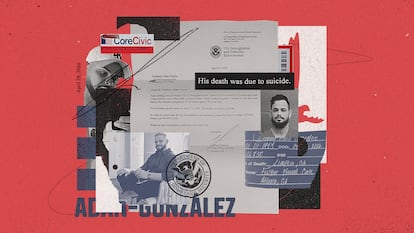
A week after his brother’s death, Hernández received a letter signed by LaDeon Francis, director of the Department of Homeland Security (DHS) Regional Office in Atlanta. “I regret to inform you of your brother’s death,” it read. “On behalf of our agency, I extend our most sincere condolences to you and your family for your loss. Your brother died on April 29, 2026. His death was due to suicide.” Although the official date of death in the letter is listed as April 29, the ICE statement refers to April 28. Francis left his number in case Hernández wanted to call for more information. “I tried to call and they never answered,” the brother says.
González was pronounced dead at approximately 11:11 p.m. by Webster County Emergency Medical Services. He became the 14th person to die at the Stewart Detention Center, the third death there in the previous two years, the 18th death in ICE detention facilities nationwide during the first four months of 2026, and the 49th person to die in detention since the second Donald Trump administration took office. As of today, 54 people have died while in immigration custody since January 2025.
Brian Root, senior adviser at the Digital Investigations Lab of Human Rights Watch (HRW), which recently published an investigation into deaths in detention, told EL PAÍS that during the first year of the Trump administration, when 39 deaths in detention were recorded, seven were classified as suicides. “All of them were by hanging; people were found unconscious with a ligature or cloth around their neck,” he explains, despite the fact that in six of the seven cases ICE had recorded no suicidal ideation during the detainees’ initial intake evaluations. Other common causes of death included cardiac arrest, heart failure, infections, and strokes. In many of these cases, “emergency care was requested too late.”


HRW investigators encountered, among other obstacles, a “lack of details or transparency in notices and reports,” Root says, noting they could only work with the limited information provided by ICE. “Because documentation was typically minimal in most cases, by itself it did not provide enough information to support a definitive clinical assessment of whether the deaths were preventable or to determine the exact cause of death.” The picture is bleak: the mortality rate of migrants in ICE custody is now at its highest level in more than a decade.
***
On May 14, coroner Ammons sent the journalist another message, this time a far more urgent one: “Have they found a funeral home yet?” Then she sent another: “Any updates? We need to take care of this body.” On May 26, nearly a month after González’s death, the coroner said: “You have to do something. The body is starting to decompose.”
The family did not know how to proceed. They do not speak English, they are far away, and they have very little money. They did not even know where González’s body was after it left the detention center, but activists helped locate it at the coroner’s office. His mother, Lourdes, pleaded that he not be cremated and that he be buried instead. It was the least she could ask for her son, whom she had raised alone and in poverty, but with immense love.
“I want them to do another autopsy, to reveal the truth. My son was killed by the guard,” the mother says. “I want justice, not only for my beautiful child but so that everyone in that horrible place no longer suffers and they release them, because they are not killers, they are children who leave their country to seek a better life.”
As the days passed, Ammons remained firm: González’s body was still in the morgue at the state crime laboratory, and “we need to resolve this as soon as possible.”
The costs were simply beyond his brother’s means. The funeral home charged more than $4,000 just to retrieve the body from the laboratory. A burial plot, as his mother wished, would add another $6,000 or so. That did not even include a wake, which they could not afford.
“It’s like $10,000, imagine. If he were alive, I would do the impossible to keep him alive. But he is dead; nobody is going to give him back to me,” Hernández says. “Everything runs on money. It takes a fortune to wage these battles. Even after death, this is a business. If in 30 days I don’t sort anything out, I’ll have him cremated and, when I can go to the United States, I’ll scatter his ashes at sea, which is what he liked; his hobby was fishing.”
Amílcar Valencia, executive director of El Refugio, an organization that assists families and migrants passing through Stewart Detention Center, initially contacted another organization about performing a second autopsy. But once they learned the body was decomposing, they concluded it would not be possible. “When the family finally gained access to the body, more than four weeks had passed since the death. They said that after that time it would be difficult to find information useful to the investigation.”
Meanwhile, attorney James M. Slater, who agreed to represent the family, requested that the detention center preserve all evidence, including surveillance footage from the 24-hour period before González’s death through the removal of his body from the facility, as well as records and text messages. The attorney confirmed to EL PAÍS that the investigation is ongoing.
On June 5, the coroner reported that González’s body had finally been removed from the crime laboratory. When Fisher Funeral Care and Cremation Services retrieved the body, Hernández asked for a video call to identify his brother. He was denied that possibility. “They told me at the funeral home that those WhatsApp calls had been suspended,” he says. He was told the body was “in very bad condition.” A viewing would not be possible. Instead, they offered identification through scars and marks left by childhood accidents from the years they grew up together in Camagüey.
Hernández asked the funeral home to check his brother’s heels. “When he was little, he stuck his foot in the spokes of a bicycle,” he remembers. Then he told them to look for a mark on his forehead. “He got hit with a rock playing with a friend as a child. That stayed with him forever.” The funeral home covered González’s face, leaving only his forehead exposed. They sent Hernández a photograph, and he was able to confirm that it was indeed his brother. He was dead. Then they showed his hands. “The body was very pale, and my brother had been tan.”
Dayán could take no more. He had neither the strength nor the money to return the body to his mother in Cuba, nor to bury him. “Let justice be in God’s hands,” he said. “This has made me sick, I’ve lost weight and I still have to live my life. It’s been almost two months and I can’t sleep.”
They could cremate him as soon as possible.
In mid-June, Ammons responded to another message. She appeared willing to have a more detailed conversation about the case.
The family still wanted answers to several unresolved questions: Why had the body begun to decompose if it had been preserved? Was there anything unusual about the condition of the body? What did the coroner think about the possibility of a second investigation?
On June 22, Ammons replied: “I understand this case is still under investigation, so I cannot provide further comments at this time,” she said. Two days later she asked the reporter to end the conversation: “Truthfully, right now I don’t feel comfortable talking about it. There are so many problems with politics at the moment. I’m very sorry. Maybe I can talk later.”
González’s ashes arrived through the mail. The urn is sky blue and bears the image of a white dove with its wings spread wide. It looks like a transfigured dove, one that came in pursuit of a dream and, at last, caught hold of it.
Sign up for our weekly newsletter to get more English-language news coverage from EL PAÍS USA Edition