
US shoots down Iranian drone approaching the aircraft carrier ‘Abraham Lincoln’
The White House confirms the incident but says that negotiations for an agreement with Tehran are ‘still scheduled’
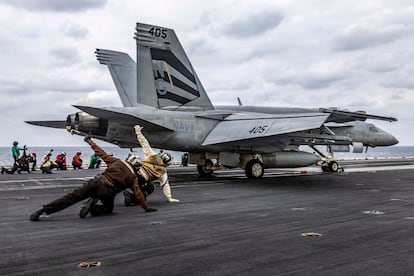
The U.S. military shot down an Iranian drone on Tuesday as it approached the aircraft carrier Abraham Lincoln, deployed in the Arabian Sea. The unmanned Iranian aircraft, a Shahed‑139 model, was flying toward the vessel and was downed by a U.S. F‑35 fighter jet, according to White House spokesperson Karoline Leavitt in an interview with the conservative U.S. network Fox News.
Talks with Iran are “still scheduled,” Leavitt later stressed, referring to the meeting expected to take place between Tehran and Washington — likely on Friday in Istanbul — to try to seal a new nuclear agreement.
This incident, the first armed confrontation between the two countries since June — when Israel and the U.S. bombed Iran — comes amid a military escalation between Tehran and Washington. Last Friday, Donald Trump sent what he described as an “armada” to waters near Iran. The flagship of that military deployment is precisely the USS Abraham Lincoln, the carrier the drone was approaching when it was shot down by the F‑35.
“We have a large armada, flotilla, call it whatever you want, heading toward Iran right now, even larger than what we had in Venezuela,” Trump told reporters in the Oval Office at the time. “If we do make a deal, that’s good. If we don’t make a deal, we’ll see what happens.”
The United States is demanding that Iran end its nuclear program and hand over the stockpile of highly enriched uranium held in the country. It is also calling for the Islamic Republic to halt its support for the network of militias known as the “Axis of Resistance” in the Middle East, as well as limits on Iran’s ballistic‑missile program.
Tensions between the two countries — which led many to believe a U.S. military strike was imminent last weekend — eased when Tehran signaled its willingness to negotiate with Washington. On Tuesday, Iran’s president, the moderate Masoud Pezeshkian, announced that he had instructed his diplomats to begin talks with the United States.
Two weeks ago, President Trump postponed what was widely seen as an imminent military assault. He justified the decision by claiming that the Islamic Republic had agreed not to execute 800 protesters detained in the latest wave of demonstrations against the regime — a claim later denied by Iran’s judiciary.
The U.S. president has been threatening to strike the Islamic Republic again since the start of those protests, which erupted in Tehran on December 28 and were met with unprecedented repression by Iranian security forces. At least 6,500 people have been killed in the demonstrations, according to the exiled Iranian NGO HRANA, which is investigating another 17,000 possible cases. Iranian authorities put the death toll at 3,117.
Earlier incidents
On Tuesday morning, before the drone was shot down, a group of six Iranian boats approached a U.S.-flagged oil tanker in the Strait of Hormuz, north of Oman — the artery through which 20% of the world’s crude oil trade passes. The Iranian vessels ordered the tanker, the Stena Imperative, to shut off its engine and prepare to be boarded. The crew chose to ignore the order and instead accelerated, according to the maritime security company Vanguard.
The tanker — whose operators say it had not entered Iranian territorial waters — was later escorted by a U.S. warship, according to the maritime risk‑management group.
The United Kingdom Maritime Trade Operations office had earlier reported that a group of armed vessels attempted to intercept a ship 16 nautical miles north of Oman, without identifying the tanker or the armed boats. The office said it was investigating the incident, which occurred at the entrance to the Strait of Hormuz.
The semi‑official Iranian news agency Fars, linked to the Revolutionary Guard, later cited anonymous Iranian officials saying that a vessel had entered Iranian territorial waters without the required permits, had been warned, and then left the area “without any special security measures being taken.”
The Strait of Hormuz connects the Persian Gulf with the Gulf of Oman and the Arabian Sea. It is the main — and almost only — route through which Saudi Arabia, Iran, the United Arab Emirates, Kuwait, and Iraq, all OPEC members, export most of their oil, primarily to Asia.
Iran has seized three tankers — two in 2023 and one in 2024 — near or inside the Strait of Hormuz. In some cases, those seizures were retaliation for similar actions by the United States against tankers linked to Iran, a country under severe international sanctions that particularly affect its oil exports.
Sign up for our weekly newsletter to get more English-language news coverage from EL PAÍS USA Edition









































