
Arming themselves against Trump’s authoritarianism: More progressives are acquiring weapons
The man killed by Border Patrol agents in Minneapolis was allegedly carrying a handgun. In recent months, there has been a reported increase in interest among people who identify as liberal in purchasing firearms
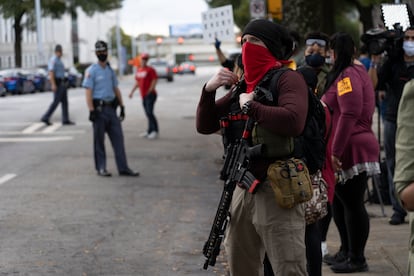

The Department of Homeland Security (DHS)’s justification for the killing of 37-year-old nurse Alex Pretti this past Saturday in Minneapolis was a gun. According to the Trump Administration’s version of events — almost entirely refuted by videos that instantly went viral — Pretti attempted to kill the agents who were beating him with a semiautomatic pistol before being shot multiple times by a federal immigration agent while he was on the ground.
Bearing arms is a fundamental right in the United States. This weekend, however, according to the U.S. administration, it was a man’s death sentence. The notion that arming oneself equates to being safer is back on the table in the United States, with more at stake than ever.
A few days earlier, images of men with long guns, dressed in black, some also wearing berets, traveled from the streets of Philadelphia to the palms of millions of people. These viral videos of the protests against the abuses of immigration agents following the killing of Renee Good in Minneapolis also brought back memories of another era, the turbulent 1960s, perhaps the only time in the past with levels of national tension similar to those of today. “If you think you about to come and brutalize the people while we’re standing here, f— around and find out,” says Paul Birdsong, who identifies himself as chairman of the Philadelphia chapter of the Black Panther Party for Self-Defense, speaking into the camera. “We’re the same Panther Party from back in the day, but we’re a little more aggressive now, you dig? We carry bigger guns, we don’t tolerate any bullshit,” adds the man who presents himself as the heir to the legacy of Bobby Seale and Huey P. Newton, who founded the original party in 1966 and armed themselves to confront police brutality against African Americans in the midst of the turbulent struggle for civil rights.
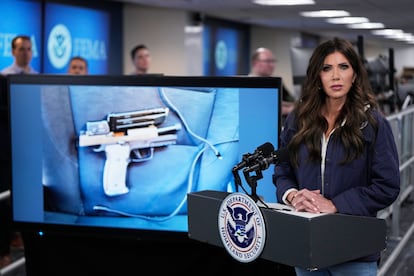
The true connection to the party, officially dissolved in 1982, is unclear. But the image, like the sequence of events that ended in Pretti’s murder this Saturday, is evidence of a broader phenomenon. In the last year, and especially in recent months, there has been a reported increase in interest in the United States among those who identify as progressive or left-leaning in purchasing firearms, amid the growing authoritarianism of the Donald Trump administration and fears of the emboldening of far-right militias in the country.
There are no concrete figures, as political affiliation isn’t required to buy a handgun or semiautomatic rifle in the United States, but progressive shooting groups across the country have expressed their astonishment at the surge in their memberships. The Liberal Gun Club, for example, which has a presence in 30 states and offers training, has reported a fivefold increase in membership since November, from 2,700 to 4,500, and that training requests have multiplied. Many other similar groups, some more politically oriented or focused on the LGBTQ+ community, have also reported increases; and at more traditional shooting ranges, users are talking about new faces who don’t fit the typical profile of gun enthusiasts, who are almost always conservative.
Our interview with Chairman Paul Birdsong from the Black Panther Party for Self Defense, at an ICE protest in Philadelphia:
— Neophyte News (@neophyte_news) January 15, 2026
“Won’t no ICE Agent ever run up on me! I’ll put a hole in their chest the size of a window.” pic.twitter.com/aXr2WvpAJt
Luis, a 30-year-old man from Ohio who prefers not to be identified due to the current climate in the country, had never considered buying a gun before. He didn’t grow up in a gun-owning household, and active shooter drills at his school left a lasting impression on him. “It’s hard for me to imagine owning something designed to be lethal,” he admits. “That said, I’ve been seriously considering it since the ICE situation started. I followed the election closely and was one of those people in my circle who was warning that the situation would escalate to this, but I was simply called an alarmist or a conspiracy theorist,” he adds. He says he’s still “hoping it will all stop,” but it “seems unlikely now.” “Renee Good’s death certainly had an extreme impact, and that’s what led me to seek information about buying a gun,” he explains via text message.
Luis is a history buff, and living under a fascist regime has always been a real fear he’s had. He believes the present is making that fear a reality. “Before the election, I certainly felt uneasy around far-right organizations, but with the militarization of ICE and its frantic race to hire as many agents as possible, I think ICE is, in practice, bringing these groups together under one umbrella as a federal agency,” he says. “They have federal funding and the support of the Administration, so why wouldn’t they unite?”
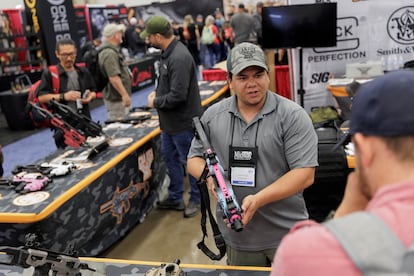
Faced with this threat, many progressives seem to be abandoning their traditional aversion to guns and instead embracing the Second Amendment, which guarantees the right to keep and bear arms. Especially since the rise in mass shootings, so often in schools, the Second Amendment has been a deep point of contention in the United States, often mirroring the country’s political divide: conservatives oppose any restrictions on guns, while progressives favor placing clear limits on who can buy guns and which ones.
Now, however, testimonies have begun to proliferate from people who consider themselves to be left-wing or liberal and who see guns as the last refuge of their own freedoms in the face of an increasingly authoritarian government. And images of armed civilians at daily protests against the Trump administration’s immigration offensive—which has deployed masked federal agents to the streets to detain people simply for being dark-skinned or speaking languages other than English—are becoming increasingly common.
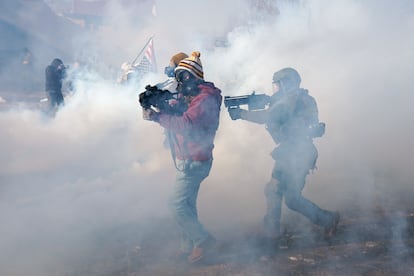
In a country with between 400 and 500 million guns, according to estimates by the specialized publication Ammo based on publicly available data due to the lack of an official national registry, the argument is that not owning a gun makes you an easy target for an authoritarian government or criminals. And the recent number of annual sales, which peaked during the Covid pandemic with more than 20 million new guns purchased, is double the average of two decades ago.
On the other hand, the fear is that with more guns in circulation, the risk of an uncontrollable escalation of violence will increase. The words “civil war” are not whispered; they have represented a real possibility for citizens for years. After Trump’s first election, Foreign Policy magazine asked a group of national security experts to assess the likelihood of a civil war in the next 10 to 15 years. The consensus was 35%. In 2019, a Georgetown University poll asked registered voters how close they saw the country on the brink of civil war, on a scale of 0 to 100: the average of their responses was 67.23. And last November, the Leadership Conference on Civil and Human Rights, the nation’s oldest and largest civil rights advocacy group, found that 57% of Americans fear they are headed for a civil war.
In the current political and social climate, this is a realistic scenario. In fact, an exercise conducted by the Center for Ethics and Rule of Law at the University of Pennsylvania closely resembles the current confrontation between the leaders of the state of Minnesota and the federal government. In that exercise, which involved several military veterans and retired government officials, the president carried out a highly unpopular police operation in Philadelphia and attempted to seize control of the Pennsylvania National Guard. When the governor resisted and the guard remained loyal to the state, the president deployed active-duty troops, leading to an armed conflict between state and federal forces. So far, everything but the latter has happened in Minneapolis, although 1,500 troops are on standby in case of an escalation.
"This is my neighborhood, " man with a rifle stands outside a home in St. Paul after multiple ICE sightings in the area.
— Oliya Scootercaster 🛴 (@ScooterCasterNY) January 18, 2026
Video by @noturtlesoup17 @FreedomNTV Desk@freedomnews.tv to license pic.twitter.com/EiQPA70iy2
In such a scenario, it’s difficult to predict what role the millions of armed civilians in the country would play. But increasingly, public voices on the left are claiming—as was almost exclusively the case until recently with conservatives—that their security ultimately depends on having their finger on a trigger, ready to fire.
“This isn’t about school shootings or mass shootings; this is about the federal government actively and militarily infringing on our rights and depriving of rights anyone it decides deserves it,” says Luis, in Ohio. “I find it confusing to see Second Amendment advocates suddenly bowing their heads and supporting what’s happening, when this is precisely the kind of situation in which they all claimed we should protect our right to keep and bear arms. And as much as I never would have wanted to see or experience anything like this, we have the right and the duty to protect and defend ourselves against a tyrannical government.”
The Black Panthers’ Paul Birdsong, reporting from the streets of Philadelphia, is even more blunt. “Those ICE agents aren’t going to act like that if there are a bunch of people with assault rifles and shotguns. If you are going to legally arm yourself, arm yourself with something bigger than what they got.”
Sign up for our weekly newsletter to get more English-language news coverage from EL PAÍS USA Edition









































