
Trump traveled on Epstein’s plane ‘many more times’ than previously thought, according to new documents
The US president is mentioned multiple times in the new batch of declassified documents regarding the convicted pedophile
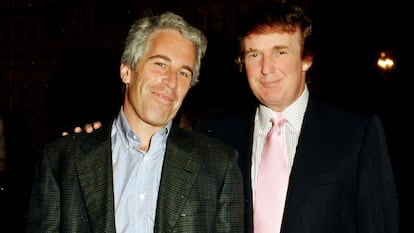

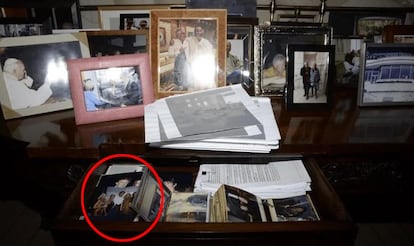
The United States Department of Justice released new documents related to the case of convicted pedophile Jeffrey Epstein late Monday night. In the new batch, accessible here, there are around 11,000 files, including emails, photos, court documents, and multiple references to President Donald Trump, who was practically absent from the first declassification last Friday. Also noteworthy is an image of a fake passport belonging to the financier. It is Austrian, and in it he calls himself Marius Robert.
Pending a detailed examination of the entire set — which, once again, is heavily redacted — one item stands out: an email sent by the U.S. Attorney for the Southern District of New York on January 7, 2020. It is titled “Epstein Flight Records.” It can be read here and states: “For your situational awareness, wanted to let you know that the flight records we received yesterday reflect that Donald Trump traveled on Epstein’s private jet many more times than previously has been reported (or that we were aware), including during the period we would expect to charge in a Maxwell case.”
Maxwell refers to Ghislaine Maxwell, Epstein’s closest friend, who was sentenced in 2020 to 20 years in prison and is serving her sentence in a minimum-security prison in Texas. She was found guilty of complicity in Epstein’s sex-trafficking network involving hundreds of underage victims.
That email also specifies that Trump “is listed as a passenger on at least eight flights between 1993 and 1996, including at least four flights on which Maxwell was also present.” It further notes that he traveled with several members of his family: Marla Maples, his second wife; their daughter, Tiffany; and Eric, from Trump’s first marriage.
One of those records states that on a flight in 1993, “he and Epstein are the only listed passengers.” In another flight, the two friends are accompanied by a 20-year-old woman whose identity has been redacted.” There are two additional flights listing “women who would be possible witnesses in a Maxwell case.”
The end of friendship
Trump and Epstein were friends for about 15 years. Their relationship ended, according to the president of the United States, in 2004, after — again according to his account — he expelled Epstein from his club-residence Mar-a-Lago in Palm Beach, Florida, because the financier behaved like a “creep” toward some employees. Over the years, it has never been possible to prove that Trump participated in Epstein’s crimes or that he had knowledge of them. The latest papers released by the Department of Justice do not prove anything in that regard either.
This is the third set of case documents made public, following those released on Friday and a smaller batch on Saturday. They were first published Monday afternoon, only to disappear without explanation from the website where the government is required to post them under a law passed by an overwhelming majority of Congress. Finally, the 11,000 documents — nearly 30,000 pages in total — reappeared a few hours later. This was yet another sign of the chaos that has been governing the Department of Justice’s actions in recent days.
Among the new papers, another document also stands out: it shows that in 2021 a subpoena was sent to Mar-a-Lago — apparently at the FBI’s request — seeking documents related to the Maxwell case. The Washington Post, for its part, reported that the FBI collected leads about Trump attending parties with Epstein in the early 2000s. The documents do not reveal whether any follow-up investigations were carried out or whether any of those tips were corroborated.
The Department of Justice has officially released nearly 30,000 more pages of documents related to Jeffrey Epstein.
— U.S. Department of Justice (@TheJusticeDept) December 23, 2025
Some of these documents contain untrue and sensationalist claims made against President Trump that were submitted to the FBI right before the 2020 election. To be…
At around 7:30 a.m., the Department of Justice posted a message on its X account with a warning: “Some of these documents contain untrue and sensationalist claims made against President Trump that were submitted to the FBI right before the 2020 election [which was won by Democrat Joe Biden]. To be clear: the claims are unfounded and false, and if they had a shred of credibility […] Nevertheless, out of our commitment to the law and transparency, the DOJ is releasing these documents with the legally required protections for Epstein’s victims."
On Monday, during a press appearance at Mar-a-Lago, Trump said that last week’s publication of thousands of photographs of the Epstein papers risked implicating “highly respected” people with no connection to the financier’s crimes. Epstein died in a New York jail cell in 2019 in what the medical examiner ruled was a suicide. The press specifically asked the Republican about the compromising images of former president Bill Clinton, which were the real focus of that first declassification. Trump described their release as “terrible.”
“I don’t like the pictures of Bill Clinton being shown. I don’t like the pictures of other people being shown – I think it’s a terrible thing,” Trump said. “I think Bill Clinton’s a big boy, he can handle it, but you probably have pictures being exposed of other people that innocently met Jeffrey Epstein years ago and they’re highly respected bankers and lawyers and others.”
Trump added that Epstein “was all over Palm Beach,” the exclusive Florida town where the convicted pedophile owned a home and where Mar-a-Lago is located.
Clinton, who — like Trump — has never been charged with any crime, sent a message on Monday through his representative, Ángel Ureña. “We call on President Trump to direct Attorney General [Pam] Bondi to immediately release any remaining materials referring to, mentioning, or containing a photograph of Bill Clinton.” In his statement, Ureña also accused the Department of Justice of protecting someone in its handling of the Epstein document release. “We do not know whom, what or why. But we do know this: We need no such protection,” he said.
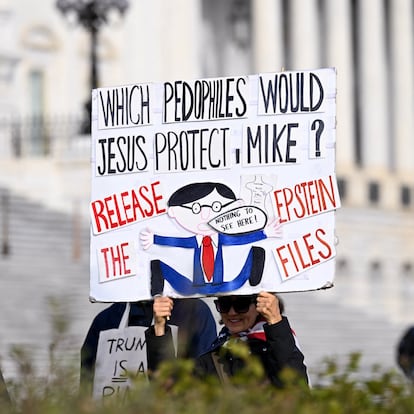
By releasing a vast number of documents, Bondi is complying with the obligation imposed on her by Congress under the Epstein Files Transparency Act. That law gave her 30 days to do so (a deadline that expired last Friday) and required the disclosure of “all” the papers in the possession of the Department of Justice. The initial partial release did not meet that requirement.
And criticism has not come only from Clinton, who appears in about 25 images (in a hot tub with a young woman whose face is obscured, or in a swimming pool with Maxwell and another woman, also with her face obscured). Victims have spoken in recent days of a “cover-up,” because the papers contain extensive redactions — more than 500 pages in the first batch.
Bondi, who spent months refusing to release the files, was authorized by law to make those redactions in order to protect victims, although politicians from both parties who passed the law accuse her of going too far and of failing to meet the transparency requirement.
The publication and subsequent removal of the only photo showing Trump in that first set — depicting him accompanied by four women — also sparked controversy. A day later, the Department of Justice reposted it on the microsite created specifically for the release of materials from the Epstein and Maxwell cases.
Last weekend, Deputy Attorney General Todd Blanche estimated that the Department of Justice holds close to one million pages in total, which it will release, he warned, in the coming weeks. It is not possible to determine the percentage of documents that have already been made public, which in any case add to the various partial declassifications of recent years.
Blanche also reported that a team of 200 officials reviewing and redacting the documents identified 1,200 Epstein victims — a higher number than previously reported.
Sign up for our weekly newsletter to get more English-language news coverage from EL PAÍS USA Edition









































