
Being trans or gay in a migrant detention center: ‘They call me faggot, queer, bitch’
Detained LGBTQ+ migrants denounce harassment, isolation and other abusive practices. With the rapid expansion of centers and the elimination of oversight mechanisms under Trump, this dangerous system is worsening exponentially
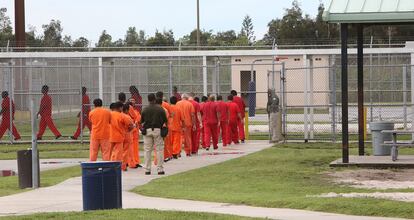

There are terrible guards, but also some “good” ones at the Krome Detention Center in Miami. One of them handed Juan Girón a letter written by Kimberly, the trans woman he met when he was going to the bathroom and who called out to him, “Hey, girl, pssst, hi.” Now you might say that he and Kimberly are friends. He gave her a devotional scapular, and they get emotional when they see each other in the yard during the hour of sunlight they’re allowed each day, or when they write to each other as though they’d known each other forever, aware of how lucky they were to find each other.
In the isolation cell where he’s been detained for the past few days, Girón received the letter. “I hope you’re well and that you’ve rested,” wrote Kimberly, whom Girón doesn’t know very well, but who came from Colombia for the same reason he himself left Nicaragua three years ago: the violence. His friend’s news isn’t good. A police officer beat her, and she had to undergo surgery. “I had surgery because the police officer who hit me broke two of my ribs and punctured my lung,” Kimberly writes. She doesn’t tell him much more and says goodbye: “I’m still here, but it’s very hard because the men treat you very badly. Sometimes I get very depressed, but I have to keep going, life goes on.”
Girón sent back some words of comfort. He has a notebook that his psychologists have allowed him to keep for distraction, as they have heard him say he wants to commit suicide. They have instructed him to sleep on the bottom bunk because of the nightmares he has at night. They have prescribed antidepressants. Girón, 31, managed to leave his country, but he has not been able to escape the violence in all the places he has been.
He was 13 years old when his mother died, and he was left in his father’s care. He was walking at night across a bridge near the Schick neighborhood in Managua, Nicaragua when a gang member grabbed him, covered his mouth, and raped him. It wasn’t until much later that he was able to tell his father. “I kept quiet because the man threatened to kill me if I said anything. That has scarred me for life.” He was always effeminate. People always said “nasty things” to him. They always laughed in his face and yelled “faggot” at him. In 2022, he left home one night, penniless. “I feared for my life, and I told my dad I couldn’t take it anymore.” He began his journey to the United States. One day, in Honduras, he was raped in a park. “It was terrible. I just begged them not to hurt me.” In Tuxtla Gutiérrez, Mexico, a stranger approached him in an alley and assaulted him.
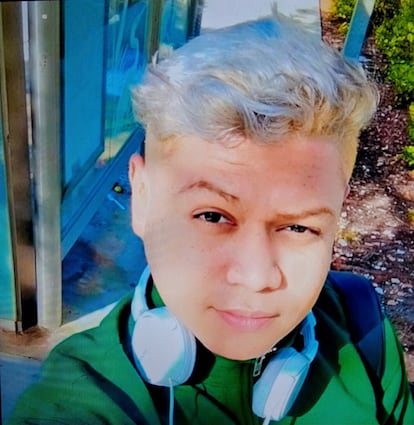
Now, in Krome, they yell “faggot” at him. He’s afraid to take showers because a Haitian migrant keeps walking past him, giving him sidelong glances, and hurling insults. “He threatened to kill me, told me he wanted to kill me. I told him it wasn’t my fault they brought me here with them. He calls me faggot, queer, bitch. I ignored him until one day I told him to stop.” Girón reported the situation to the Immigration and Customs Enforcement (ICE) agents in charge of the center and they spoke with the Haitian man, who is now calmer.
Girón hasn’t forgotten that night last July when he had a heated argument with his partner. It was a neighbor in Little Havana who alerted the police. The officers ended up arresting him, an undocumented immigrant, and not his boyfriend, a U.S. citizen. Once in custody, they took him to a room and threw him to the floor. “That wasn’t enough for them, and they forcibly stripped me, tearing my clothes with scissors. There were about 30 officers, filming me with a camera. It was traumatic,” Girón recalls.
Then one of the agents told him they were going to send him to a better place. It was the Alligator Alcatraz detention center, a site notorious for its constant human rights violations. It was the first stop before arriving at Krome, the center where the most deaths have occurred this year in ICE custody.
The mistreatment of LGBTQ+ people in detention centers did not begin with Donald Trump. However, on his first day as president, he signed executive orders that have further harmed the community. Among them was one that directed all federal agencies to eliminate references to “gender ideology,” meaning that people should henceforth be defined by the sex assigned at birth. He also revoked the 2015 Transgender Care Memorandum, which addressed the systemic problems affecting transgender people in immigration detention.
“With the rapid expansion of immigration detention centers and the elimination of oversight mechanisms under the Trump administration, this dangerous system is worsening exponentially,” Bridget Crawford, director of law and policy at Immigration Equality, the national advocacy organization for the rights of LGBTQ+ and HIV-positive immigrants, told EL PAÍS.
Immigration Equality was denied access to the area where transgender people are being held at a detention center in Aurora, Colorado, “allegedly due to unspecified security concerns,” Crawford said.
In recent months, the organization has detected a “significant increase” in calls to its hotline from detention centers. “Reports have included sexual assaults that were neither investigated nor seriously addressed by center staff, physical assaults and threats of violence, denial or delays in HIV medical care, unsanitary conditions, prolonged isolation, lack of food, as well as difficulty accessing legal advice and preparing their legal cases.”
Mocked and abused
At his home in Táchira, Venezuela, where he now lives with his parents, the stylist Andry Hernández Romero recalls how, at the Otay Mesa detention center in San Diego, the other detainees constantly criticized him for having had buttock augmentation surgery. “They told me I had a big ass, that I was a woman, that I should get breast implants. They used that to discriminate against me. They looked at me strangely because I’m somewhat effeminate.”
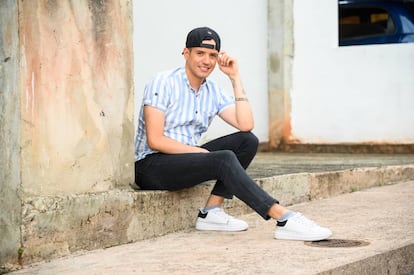
The Venezuelan man entered the United States last year through an appointment scheduled on the CBP One app and was immediately taken into ICE custody. “At all times, a person’s sexual orientation is a focal point in a detention center or jail,” he says. “They told me I had to behave; I was the only gay man in a cell of more than 100 people. I was mixed in with real criminals.”
More than once he wondered what he was doing there: “There were serious criminals in there. I kept thinking, ‘What am I doing here if I haven’t committed any crime?’” But to the U.S. government, Romero was a member of the Tren de Aragua gang, and one of the more than 200 Venezuelans that was sent to El Salvador in mid-March, overriding a judge’s order and invoking the 1798 Enemy Aliens Act. At the dreaded Terrorism Detention Center, CECOT, things were much worse. “The guards themselves told me I had to marry one of them to get Salvadoran citizenship. They discriminated against me even more than before.”
A month after arriving at the mega-prison, he was sexually assaulted by one of the guards, an incident Romero finds difficult to discuss. Even so, he couldn’t hide his true identity from the other inmates at CECOT for long. He told them once, “Excuse me, but I need to joke around, to laugh at anything silly.” They accepted it, and there were no problems. “Sometimes I made them laugh, when they weren’t beating us. That made the burden more bearable, because being there wasn’t easy.”
The most excluded migrants
ICE began excluding data on transgender people in detention centers from its bi-weekly reports in February. Therefore, it is only known that at least 47 transgender people were in custody as of January, an undercount considering that many prefer to conceal their identity for protection. This has been part of the Administration’s ongoing attack on the community.
On his first day in the White House, Trump ordered that people in detention centers be housed in facilities based on their sex assigned at birth, not their gender identity. This is how Shakira Galíndez, a Venezuelan trans woman detained by ICE in New York, ended up at LaSalle, Louisiana, a men’s detention center, where she is treated like any other man.
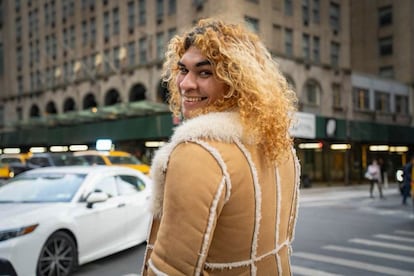
She arrived in the United States last year and was detained in September by ICE agents at Federal Plaza, the building that has become a hotbed of migrant arrests in Manhattan. “Currently, Shakira is facing an expedited trial process,” says Yonatan Matheus, who is handling the woman’s case from New York with his organization, América Diversa. Matheus asserts that if Galíndez is deported, “a forced return to Venezuela would expose her to serious human rights violations, given that the Venezuelan state does not guarantee her right to life, personal integrity, or recognition of her gender identity.”
Immigration Equality warns of the impact the administration’s policies have had on asylum cases for LGBTQ+ people, many of which have been denied. “This has resulted in the deportation of people to countries where their lives are in danger,” says Crawford, who recounted the story of one of her trans clients: “She was awaiting the final processing of her refugee case when Trump ended the program. She was murdered. The possibility of applying for asylum and refugee status is truly a matter of life or death for many LGBTQ+ people.”
Finding lawyers to represent detained migrants is also proving difficult. The Republican administration has cut funding to these types of organizations and laid off nearly all the staff at the Office for Civil Rights and Civil Liberties (CRCL) and the The Office of the Immigration Detention Ombudsman (OIDO).
Andrei Ushakov and Aleksandr Skitsan, a couple who arrived from Russia last year, don’t have enough money to hire lawyers, which would cost them between $8,000 and $12,000. They fled the Russian government, says Matheus, who is also handling the case. “Aleksandr received direct threats at his workplace, which forced them to escape to protect their lives.”
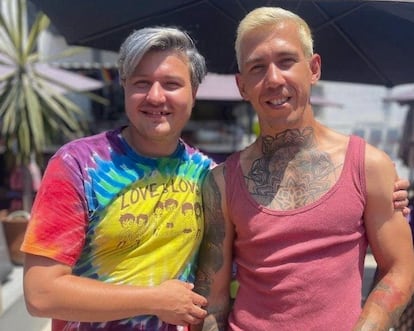
They entered the United States through CBP One and were arrested. They were first held at a facility in Calexico, California. In September, they were transferred to another facility in Arizona, where they are only allowed to communicate for 30 minutes once a week. They have never been able to be together despite being legally married.
Ushakov, who suffers from a chronic illness they prefer not to disclose, has had limited access to medical care and has had to live in hiding. “They’ve been hiding; they have to conceal their sexual orientation and their medical conditions because of what it means to be in a place like this,” Matheus points out.
He also insists that there is “a heavy burden of state-sponsored homophobia” in such treatment: “These practices should not be understood as isolated incidents, but as part of a system that reproduces exclusion, punishment and dehumanization towards those seeking protection.”
Sign up for our weekly newsletter to get more English-language news coverage from EL PAÍS USA Edition









































