
Water dispute adds pressure to Mexico’s complex bilateral agenda with the United States
The country starts deliveries on Monday to address its deficit with the US, after Trump threatened tariffs over noncompliance with the 1944 treaty
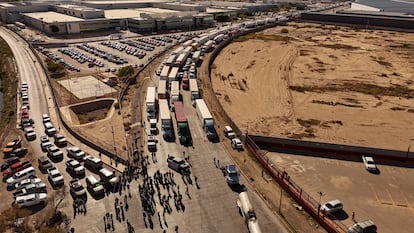

The governments of Mexico and the United States are adding water to an already packed bilateral agenda that includes combatting drug trafficking, security, migration, and trade wars. The longstanding conflict threatens to increase pressure on a relationship that in 2026 will be shaped by the FIFA World Cup, co-hosted with Canada, and the renegotiation of the United States–Mexico–Canada Agreement (USMCA). As a sign of willingness, the Mexican government will begin on Monday to pay the debt mandated by the 1944 Water Treaty, which amounts to 986 million cubic meters. The commitment was made on Friday night, just days after U.S. President Donald Trump threatened to impose a 5% tariff if the water deliveries were not made.
The Republican administration welcomed the agreement, under which Mexico is set to release 249 million cubic meters starting this week. “President Trump continues to put American farmers first and is finally holding our international partners accountable to their obligations and commitments. Once again, America is being treated fairly,” said U.S. Secretary of Agriculture Brooke L. Rollins on Friday. Rollins who had visited Mexico in early November to meet with Mexican President Sheinbaum and discuss this and other issues.
The releases are expected to relieve hundreds of ranchers and farmers in the Rio Grande Valley of Texas, who have seen their crops and local economy suffer due to the water shortage. Republican politicians in Texas, the party’s most important stronghold, had long demanded that Washington take a tougher stand with Mexico to ensure it met its deficit obligations.
Texas Senator John Cornyn, who faces re-election in next year’s midterms, proposed cutting international aid to Mexico until it complied. “The Biden administration didn’t care. In characteristic ineptitude on the world stage, president Biden and secretary Blinken did nothing to hold Mexico accountable,” Cornyn wrote in an op-ed published in May.
The 1944 Water Treaty stipulates that Mexico must provide the United States, over a five-year period, with one-third of the surplus from six rivers that feed the Rio Grande. The total cannot be less than 2.158 billion cubic meters. To stay on track, Mexico must deliver approximately 431 million cubic meters annually.
In exchange, Mexico receives 1.85 billion cubic meters of water annually from the Colorado River. Roberto Velasco, Mexico’s acting foreign minister and the official in charge of North American affairs, explained last week that the country receives more water than it gives. He emphasized that the treaty also stipulates that water shortfalls not covered within a five-year period due to extraordinary drought can be made up in the following cycle. “That is what is happening right now,” Velasco said, noting that runoff in years three and four led to very small water deliveries. However, this year’s heavy rains allowed the water releases to increase, compensating for the debt carried over from the 2020–2021 cycle.
Given its favorable terms, President Sheinbaum has ruled out renegotiating the treaty, which will turn 82 next February. She assured that the deficit would be covered while safeguarding the country’s interests. “Obviously, we are not going to jeopardize the water supply for human consumption, and we are going to ensure that farmers have access to water in a fair manner,” Sheinbaum said on Wednesday. Her administration explained that the water deliveries to the north come primarily from two dams, Falcon and La Amistad, which are at 4% and 9% of their capacity, respectively, and on which the water supply for 13 border cities on the Mexican side depends.
The two countries have negotiated throughout the year in four bilateral meetings that began in April. The most recent was on December 4. The joint statement released Friday night indicates that the countries must finalize a plan by January 31, 2026.
However, the diplomatic phrasing was overshadowed by Trump’s warning, which completely wiped out the goodwill generated just days earlier by the first meeting of North American leaders during the 2026 World Cup draw held in Washington.
On Tuesday, a day after Trump made his threat on Truth Social, Sheinbaum stated that it was “physically impossible” (due to the size of the pipelines) to immediately deliver the amount of water the White House was demanding. “The U.S. government knows this,” the Mexican president said. Three days later, her government announced that it would begin the deliveries in the requested amount.
The state of water for irrigation will be vital for both countries in 2026. In the United States, it’s crucial for keeping an important Trump voter base happy ahead of the midterm elections, which could pose a threat to Trump’s control of Congress. And in Mexico, compliance with regulations increases the complexity of water resource management. This comes after the recently approved Water Law, which enacts a nationwide reorganization. The Water Advisory Council is already predicting “more complex” scenarios due to reduced water availability, increasingly frequent droughts, and a lack of investment in infrastructure.
Meanwhile, Mexico is still facing the threat of tariffs. “Although this is a step in the right direction, President Trump has been very clear: if Mexico continues to violate its commitments, the United States reserves the right and will impose 5% tariffs on Mexican products,” said Secretary Rollins.
Sign up for our weekly newsletter to get more English-language news coverage from EL PAÍS USA Edition









































