
House approves bill demanding Trump release Epstein files with only one dissenting vote
The legislation now needs to be approved by the Senate and signed by the president, who has spent months opposing the release of the materials concerning his former friend


The question wasn’t whether The Epstein Files Transparency Act would pass the U.S. House of Representatives on Tuesday, but rather how much Republican support the measure would receive. The bill requires the Department of Justice to declassify documents related to the case of the disgraced billionaire — a move Donald Trump and his administration have opposed for months. Another unresolved question, now that the first hurdle has been cleared, is how many obstacles the bill will face on its way through the Senate before reaching the desk of the president of the United States, who has promised to sign it.
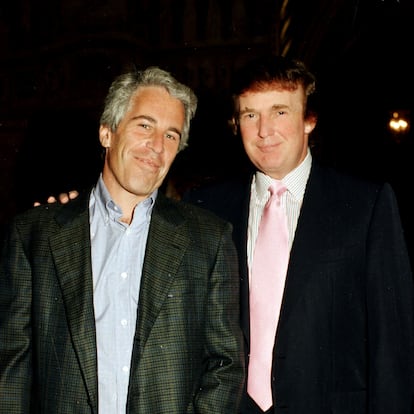
The answer to the first question was: all but one — Clay Higgins, representative from Louisiana. What explains this overwhelming support? After weeks of opposing pressure, Trump — who had been friends with Epstein for 15 years — gave House Republicans permission on Sunday to vote in favor of the bill. He did not go quite as far as he could have: he has the power to order the disclosure of these files without Congress’s permission. The documents could reveal the involvement in Epstein’s sexual trafficking network of dozens of wealthy and influential men, as well as the complicity of financial institutions, judicial bodies, and failures by authorities that allowed him to act with impunity.
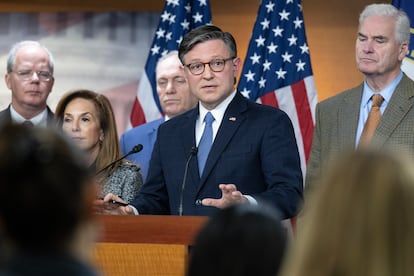
As for the second question, it is still too early to answer. Although House Speaker Mike Johnson, whose decision to keep the bill in recess for 54 days delayed the legislative process during the longest government shutdown in U.S. history, suggested Tuesday morning that the Senate would likely introduce amendments to the legislation, which he described as “deeply flawed.” Johnson raised objections to the measure because, he said, it contains no provisions to protect the identity of the victims, even though dozens of them came to the Capitol on Tuesday to pressure him and his colleagues to approve it.
Johnson is also concerned that the reputations of those who were part of Epstein’s circle of influence — who committed their crimes between the early 1990s and Epstein’s death (a suicide, according to the medical examiner) in 2019 while in a maximum-security Manhattan jail awaiting trial as the ringleader of an international sexual trafficking network of minors — could be harmed by the publication of these materials, in case they ultimately prove not to be guilty.
If House Republicans choose to amend the text, it could delay the process — possibly until early next year — a journey that began after Attorney General Pam Bondi announced last July that she would not release Epstein’s files, despite having promised to do so for months.
That change of course, which followed a White House meeting in which Bondi warned Trump that his name appeared “everywhere” in the Epstein papers, set the House Oversight Committee in motion. The committee has received around 65,000 pages of documents — the latest batch, approximately 20,000 emails, arrived last week — through judicial requests to Epstein’s family. Members have also requested materials from the Department of Justice, which holds an enormous amount of content, estimated in the millions of pages, but the Trump administration has repeatedly refused to cooperate with their investigation.
Bipartisan support
The news that the Trump administration would not release the files also forged an alliance between representatives from both parties, Ro Khanna (a Democrat from California) and Thomas Massie (a Republican from Kentucky), to draft the bill. The initiative received the support of all Democrats and four Republicans: Massie, who said on Tuesday that he was “embarrassed by my own party,” Representatives Lauren Boebert (Colorado), Nancy Mace (South Carolina), and Marjorie Taylor Greene (Georgia).
Boebert was summoned to the White House last Wednesday in an unsuccessful attempt to pressure her not to sign the petition that advanced the bill after the administration reopened. “We have had to fight against intimidation for months,” Greene said shortly before 1:00 p.m. local time. She spoke from the Democratic side in a chamber where only a handful of representatives were present.
The congresswoman had once been one of the most prominent faces of the MAGA movement in the Capitol, but her defense of Epstein’s victims has put her at odds with Trump, who last week denounced her in a series of aggressive messages calling her a “traitor,” which, according to her, led to threats and other intimidation tactics by supporters of the president.
Hours earlier, Greene had spoken at an event alongside dozens of Epstein survivors. It was a defiant press conference in which many of the victims — just a few among the hundreds abused by the convicted sex offender — spoke after displaying photos of themselves from when they first met Epstein, “some as young as 14,” as Mace recalled when it was her turn to speak on the House floor.
One of them, Haley Robson, spoke for all of them when she addressed Trump on the Capitol steps: “I am traumatized, I am not stupid.” The women who spoke after her repeated their messages to the president of the United States, urging him not to “play politics” with their suffering. They also asked him to stop referring to the attempt to declassify Epstein’s documents as a “Democratic hoax.” During the debate on the bill, that group of survivors interrupted with applause from the visitors’ gallery whenever Democrats spoke.
“What is Trump hiding? What is -[Attorney General Pam] Bondi hiding?” asked Congressman Robert Garcia in a passionate speech. Garcia is the highest-ranking Democrat on the House Oversight Committee.
On the Republican side, Jim Jordan (Ohio) demanded to know why the documents weren’t released during the Biden administration either. Democrat Jamie Raskin (Maryland) responded by reminding his colleagues that for part of those four years, there was an active case underway — the prosecution of Epstein’s accomplice and recruiter, Ghislaine Maxwell. She is now serving a 20-year sentence in a minimum-security prison, a status she obtained after meeting in July with a Justice Department envoy, Todd Blanche, for nine hours over two separate days.
U.S. law prohibits the release of trial materials while a case remains open, and Democrats fear that the Trump administration will cling to that rule to continue refusing to publish the files. Last Friday, in a move that violates the separation of powers, Trump asked Bondi to open investigations only into prominent Democrats whose names have appeared in successive document releases. He cited three: former president Bill Clinton, former Harvard president Larry Summers, and mega-donor Reid Hoffman.
Bondi put a New York prosecutor on the case. If those investigations go forward, the Justice Department could use them as an excuse not to disclose the papers that members of both parties — along with dozens of victims of what one judge once described as “the most infamous pedophile in American history” — demanded on Tuesday.
Sign up for our weekly newsletter to get more English-language news coverage from EL PAÍS USA Edition









































