
ICE adopts new measures to meet Trump administration’s goals
To achieve a historic level of recruitment, the agency has lowered the application requirements, cut training times, and around 450 agents have received advanced training for ‘high-risk’ situations
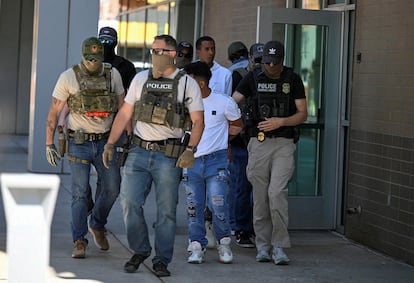

Immigration and Customs Enforcement (ICE) is undergoing its largest expansion to date, with the goal of carrying out U.S. President Donald Trump’s ambitious deportation agenda. Backed by $76.5 billion in new funding approved by Congress — nearly ten times its previous annual budget — ICE is working on new contracts, shortening training times, and delivering combat gear to new agents. At the same time, concerns are growing about its tactics for detaining and transporting people accused of being undocumented immigrants.
Hiring thousands of new agents
ICE has maintained a staff of about 6,500 deportation agents in recent years. Acting Director Todd Lyons said the agency now plans to add 10,000 more by the end of the year. Recruitment initiatives include hiring bonuses of up to $50,000, student loan repayment programs, and the rehiring of retirees as part of “Operation Return to Duty,” which allows former agents to retain their retirement benefits while receiving a new salary.
According to ICE officials, the hiring campaign has attracted more than 121,000 applications. New eligibility rules have expanded the pool of candidates, as previous age limits and college degree requirements have been eliminated. Applicants between the ages of 18 and 60 are now considered, provided they pass physical exams.
Adjustments to the lineup
To speed up the process, ICE has shortened training at the academy. At the Federal Law Enforcement Training Centers (FLETC) in southern Georgia, recruits used to spend about 16 weeks in residence. That program has been reduced to eight weeks, with additional virtual courses that are completed before and after.
Spanish language instruction, which was previously a five-week requirement, has been eliminated and replaced with live translation devices. Firearms training and other modules have been shortened, while recruits are expected to gain more hands-on experience at their assigned field offices.
Physical and tactical requirements are still part of the curriculum. Recruits must complete an obstacle course that includes climbing walls, jumping through windows, and dragging a 77-kilogram mannequin within a set time. They are also trained in defensive tactics, high-speed driving, and immigration laws. In addition, recent changes include guidance on how to respond to crowds throwing stones at vehicles used during operations.
Preparation for violent confrontations
ICE officials say their operations have become increasingly dangerous. The agency reported 121 assaults on agents between January and early August, compared with 11 during the same period in 2024.
Because of this, all new recruits are provided with helmets, gas masks, and other protective equipment. Lyons told the Associated Press that security teams are now deployed to accompany agents making arrests, especially in cities where protests have occurred. “We’re not going to allow people to continue throwing rocks,” he said.
Special response teams, equivalent to ICE’s SWAT units, will also be expanded. About 450 deportation agents nationwide have received advanced training for “high-risk” situations, such as raids on armed suspects or the transport of dangerous detainees. Lyons mentioned that more equipment and armored vehicles have been added, but did not give specific figures.
Legal limits and rapid growth
Despite changes in training and equipment, ICE officials say recruits continue to receive instruction on constitutional limits. They note that agents are taught the difference between administrative and criminal warrants, as well as the restrictions that apply when entering private homes.
ICE maintains that agents have the authority to make arrests in vehicles, although immigrant advocates question this practice. In complex cases, the agency said it consults with lawyers before taking action.
However, the scale and speed of the hiring campaign have raised concerns among immigrant rights advocates. Some warn that reducing training requirements could result in insufficiently prepared agents being deployed in the field.
One example is the case of Customs and Border Protection (CBP), where a similar rapid expansion following the September 11 attacks led to an increase in misconduct and corruption rates. ICE leaders insist that those mistakes will not be repeated. “If a new recruit comes out and just doesn’t get it, we’re not going to throw them into the field,” Lyons said. However, the White House has set aggressive targets for ICE, including tripling the daily number of arrests and reaching 1 million deportations during Trump’s first year in office.
Meanwhile, videos showing agents breaking car windows to remove suspects, or wearing masks and hiding their badges during arrests, have sparked public criticism. Lyons said covering one’s face is allowed because more and more agents have been assaulted or attacked online, and he denied that ICE allows its agents to act without showing identification.
Sign up for our weekly newsletter to get more English-language news coverage from EL PAÍS USA Edition









































