
New attack on the Dreamers: Trump administration encourages DACA recipients to ‘self-deport’
Although Trump declared before returning to the White House that he intended for them to be able to ‘stay in the country,’ his administration has begun taking steps to weaken the program
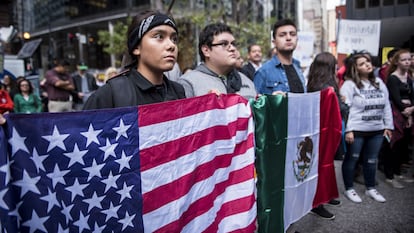

The day Mariana returned to Mexico for the first time in 2022 after 26 years, she sat down with her father and explained why it was so hard for her to recognize herself in the place where she was born — why she was no longer the same person who had been taken to the United States at age seven.
“I had that conversation with my dad and told him: ‘I don’t think I’d make it here anymore. I don’t feel my Spanish is good enough, that I can carry myself the same way I do over there.’”
She was happy to see her homeland again, to introduce her family to the son she had during that time, but the visit confirmed what had kept her up at night: if one day she loses her protection under the Deferred Action for Childhood Arrivals program (DACA), she has no idea what she’ll do — how she would explain to her son that they’d have to leave for a place she’s from, but he is not.
“It would be a culture shock to have to go there. My son’s life is here, he plans to go to college, and it would be very difficult,” says 36-year-old Mariana, switching between English and Spanish, who requested her name be changed out of the same fear shared by many others: fear of deportation. It’s not an unfounded fear. The Trump administration has reiterated that the more than 500,000 DACA recipients are not exempt from deportation. Now, it’s gone even further, urging them to “self-deport.”
“DACA does not confer any form of legal status in this country,” Tricia McLaughlin, assistant press secretary for the Department of Homeland Security (DHS), recently told NPR. She added: “We encourage every person here illegally to take advantage of this offer and reserve the chance to come back to the U.S. the right legal way.”
These statements have shocked a community that, since the program was introduced in 2012 under the Obama administration, has lived with no clear path to permanent legal status or naturalization. Thirteen years later, most DACA recipients are now adults (with an average age of 32), have built families (nearly half are married and 50% have at least one child, according to the organization FWD.us), and contribute roughly $16 billion annually to the U.S. economy. But Dreamers still must renew their protection every two years and live with the uncertainty of what the next administration may bring.
In recent months, amid the White House’s immigration crackdown, some DACA recipients — who had previously been shielded from raids and deportation — have also been arrested by Immigration and Customs Enforcement (ICE) agents. One recent case was that of Javier Díaz Santana, a 32-year-old Mexican DACA recipient who was detained while working at a car wash in Los Angeles and spent a month in a Texas detention center.
Another case was that of Evenezer Cortez Martínez, a father of three who traveled to Mexico to visit his grandfather’s grave. Upon his return, authorities arrested him at the Kansas airport and deported him to the country he had left at age four. After a legal battle, he was able to reunite with his family.
There were even reports of a DACA recipient who, after missing a court date for driving with a suspended license, became one of the first to be sent to the notorious Alligator Alcatraz detention center in Florida.

“There are attacks coming from all sides,” says Deya, who leads campaigns at the migrant advocacy organization United We Dream and asked to be identified only by her first name. “Self-deportation is not an option for them. How do you leave everything you’ve built? Many people with DACA, on average, arrived here before the age of six and have built their lives. Even though the [Trump] administration has said this, we know that self-deportation is not viable. We know that 250,000 citizen children have parents with DACA. That destroys families, and that’s why DACA is something that concerns us all. They are our loved ones, our community.”
“We had to fight hard to keep DACA”
When then-president Barack Obama addressed the DACA program in a 2012 speech, he told the nation: “Put yourself in their shoes. Imagine you’ve done everything right your entire life — studied hard, worked hard, maybe even graduated at the top of your class — only to suddenly face the threat of deportation to a country that you know nothing about, with a language that you may not even speak.” That day, he introduced a policy that would go on to protect 700,000 people across the U.S.
At the time, Mariana — who was 24 then — didn’t apply. She was afraid of how the government might use the personal information she’d be providing. “I wasn’t sure. It was the first time I was going to expose myself like that,” she says.
However, her two brothers — who had also crossed the Mexico–U.S. border as children and later settled in Texas — did apply and received DACA protections. Mariana finally applied in 2015, at age 26. Many things changed for her then: with a work permit, she could use her science degree professionally, obtain a driver’s license, travel within the U.S., and board a plane for the first time to visit Mexico and reunite with her family.
The protection she now had helped ease her fear of immigration authorities — especially remembering how, around 2012, deportations were very common. “Back then, my mom gave me a little book with our aunt and uncle’s phone numbers and told me that if she ever didn’t come home, I should call them so they could help us.”
It was a difficult time for the family. The Obama administration — which deported more than three million people during its two terms, more than any other president in the country’s history — also expelled Mariana’s father to Mexico. The same president who sent her father back paved the way for her to obtain temporary protection in the United States.
Then came Donald Trump in 2017 and, with his administration, efforts to dismantle DACA. His attorney general at the time, Jeff Sessions, called the program “an unconstitutional exercise by the executive branch.” Despite numerous proposals to abolish DACA, the Supreme Court blocked the administration’s attempts to terminate it.
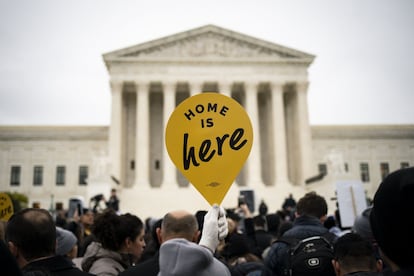
Mariana remembers the massive march she joined in 2019, starting in New York and ending in Washington — a sea of Dreamers demanding their right to remain in the country. “We had to fight hard to keep DACA,” she recalls.
Trump’s threats
Although at the end of last year, before returning to the White House, Trump said that he wanted DACA recipients to be allowed to “stay in the country,” the reality is that his administration has already begun taking steps to weaken a program that, until now, has required its beneficiaries to regularize their status.
This month, the Office for Civil Rights (OCR) within the Department of Education opened a “national origin discrimination” investigation at five U.S. universities that offer scholarships to DACA recipients.
In June, the Department of Health and Human Services announced that Dreamers would not be eligible for the federal health insurance marketplace.
The community is also anxiously awaiting a decision from the Fifth Circuit Court of Appeals in Texas, where the program was previously declared illegal or unconstitutional — a ruling that could affect 17% of all DACA recipients, as Texas is the second-largest state in terms of DACA participants after California (28%).
“It’s not just about migrant detentions, but also about education, medical care, and work permits,” says Deya from United We Dream.
According to government figures, 99% of DACA recipients — from 150 countries around the world, mostly from Mexico, El Salvador, and Guatemala — have graduated from high school, and approximately 49% have completed at least some college program.
“We know this is going to destroy families, the community, and the economy,” says Deya. “These are people who are teachers, nurses, fathers, mothers, who take care of their families... There are DACA recipients contributing to this country everywhere.”
Like in most families with DACA recipients, Mariana’s family includes U.S. citizens, like her son, but also undocumented relatives, like her mother. Now that fear is creeping back in, her siblings call each other frequently to warn about potential immigration raids in the neighborhood, looking out for one another. “This is a persecution, and we need to be more united,” says Mariana.
Still, Mariana — who has helped many others apply to the program over the years — continues to believe that DACA will survive, as it always has. “We were the ones who won DACA in the first place, who pressured the president back then,” she says. “I feel angry because we exposed ourselves — gave the government our information — and now we feel vulnerable, knowing they know where we live, even who our family members are.” That’s frustrating, she says, “but we know we have to keep fighting. I know the strength is in the community.”
Sign up for our weekly newsletter to get more English-language news coverage from EL PAÍS USA Edition









































