
Trump launches his revenge against Washington: Welcome to ‘MAGA, D.C.’
The president is targeting the US capital, a Democratic city whose residents are suffering from mass layoffs of public officials and attacks on the independence of its cultural institutions and media


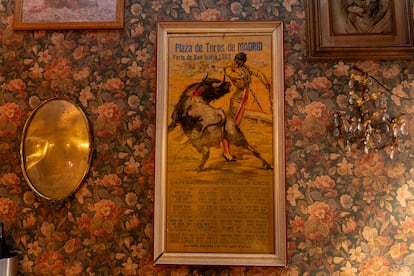
One of the highlights of the décor at Butterworth’s, a mix of French bistro and English lounge, crossed with New Orleans, is an original poster from the San Isidro fair of 1967 in Madrid, where Antoñete, Paquirri and Curro Romero took part in bullfights. “It’s there because of what the figure of the matador symbolizes: the spirit of risk and reward,” explains Raheem Kassam, co-owner of the restaurant, which opened its doors in October in Capitol Hill, a neighborhood in Washington to the south of Congress. “But above all,” he adds, “it’s a tribute to the traditions that this place honors.”
Kassam, a 38-year-old Briton and long-time collaborator of Trumpist ideologue Steve Bannon, with whom he hosted a podcast, The War Room, is a celebrity among the American alt-right. So it is not surprising that Butterworth’s, named after its majority partner, an Australian lawyer who works for Uber, has become a meeting place in the MAGA capital of the world since the return of its leader, Donald Trump, to the Oval Office. Although on its menu, where bone marrow and steak tartare invite one to think of a more refined version of the Trumpist cult, there is no trace ― “consciously,” says the third partner, Bart Hutchins ― of the president’s favorite (children’s) menu: a hamburger and Diet Coke. “We only serve good café food,” says Hutchins.
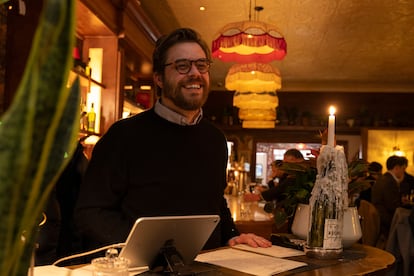
On any given night you might find, among the neighborhood’s usual slate of politicians and congressional workers, Natalie Winters, a young reporter for The War Room, or Kash Patel, whose loyalty to Trump has taken him to the head of the FBI. On special occasions, like the open-bar party Bannon threw last week, the two floors of Butterworth’s offer an even more unusual atmosphere in this staunchly Democratic city: red caps and bumper stickers calling for a third Trump term; Kari Lake — the woman chosen to dismantle the government-run Voice of America — taking the microphone to remind the men in attendance that only their virility will save the country; and a handful of recently pardoned January 6 convicts.
Perhaps nothing has more starkly symbolized who now rules in Washington — which gave 92.5% of its votes to Kamala Harris — than seeing the participants in the assault on the Capitol return to the scene of the crime four years later with their heads held high, and in particular, Enrique Tarrio, leader of the Proud Boys, who was sentenced to 22 years.
“Now, at least, [the residents of the U.S. capital] accept us. They have no choice: Trump won the popular vote and controls both chambers,” says Kassam, who insists that in his office they do not ask anyone “about their political ideas.” He also recalls that he has interviewed the president “several times” and that, “although people don’t want to believe it,” he is “a man who seeks understanding.”
“In his first term, he found that the city didn’t want him; he felt attacked,” Kassam recalls about the Republican’s surprise victory in 2017. Then, Trump and his people barricaded themselves in the hotel that the president had in the city and that he had to sell after leaving the White House. He was never seen outside of it (or more specifically, BLT, its steak restaurant), but his allies saw the hostility of which his new neighbors were capable, like the one who called the xenophobic ideologue Stephen Miller a “fascist” when he saw him dining in a taco shop after decreeing the separation of migrant minors from their families at the border.
This time, there has not been a similar episode yet. In part, Kassam adds, because they have returned — Miller too — with a lesson learned: “It has been a long eight years, and eight years is enough to learn a lot of things,” he says.
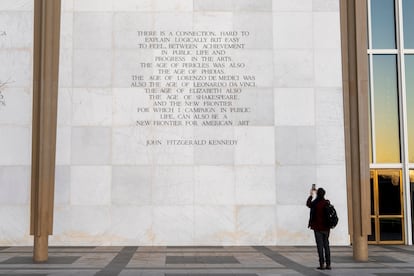
Given what we’ve seen, Trump is also plotting a phenomenal revenge. In the six weeks he’s been in office, the president has turned countless orders of American life (and the world order) upside down and has particularly targeted Washington, the city, and the idea of power it represents. He has launched an unprecedented assault on its cultural institutions, from its temple of music and the performing arts, the Kennedy Center, to the museums, which he has ordered to end their inclusion policies. He has harassed the nearly 373,000 public employees who live in the region. He has pulverized the rules of the press that covers the White House. And he has questioned its civil architecture, instructing that it comply with the criteria of “regional, traditional, and classical architectural heritage.” He has even threatened to take control of the District of Columbia (D.C.) because, he claims — with his conflictive relationship with the truth — that “there is too much crime” and “too many homeless camps.” He could, in theory: D.C.’s government, not being a state, depends on whoever controls the House of Representatives — the Republicans, in this case.
“Their calculation is that taking on the capital might do the rest of the country a political favor,” explains The Atlantic reporter Mark Leibovich, author of two brilliant books about life in Washington under Barack Obama (This Town) and during the first Trump term (Thank You for Your Servitude). “Both parties have been campaigning for years on changing it, though no one has sold the idea that it’s a rotten place, a stinking swamp, better than Trump.”
Leibovich, who has lived through several changes in administration, says that this time there are more people than ever affected by the new regime and that this has taken his neighbors by surprise, who, according to experts, could be facing a recession with so many layoffs and such a contraction in consumption. Accustomed to being supporting characters — with a couple of lines, at most — in the great theater of Washingtonian power, they suddenly find themselves converted into protagonists.
First, Trump has gone — with the help of Elon Musk — after the civil servants. He has insulted, humiliated and fired them, while civil society, exhausted after 10 years of uninterrupted broadcasting of his political reality show, has organized timid protests against these measures, waiting to see if the courts manage to stop them and in view of the fact that the Democrats seem to be missing in action. In the crosshairs of this resistance is the richest man in the world and his collaborators in the Department of Government Efficiency (DOGE), a novel species in the habitat of the capital: they are very young, they roam freely in federal agencies, and they have already earned the nickname of “muskrats.”
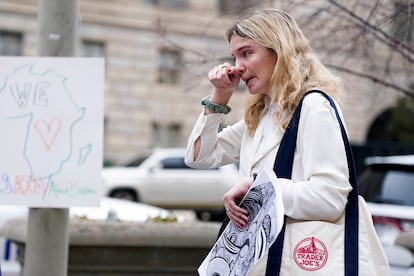
In another example of a vast repertoire of workplace cruelty, workers fired from the international aid agency USAID were given 15 minutes to gather their belongings last Thursday. A group of people waited outside to encourage them, and a young woman named Juliane Alfen explained with tears in her eyes that inside the workers were taking down photographs of humanitarian aid projects she had been involved in.
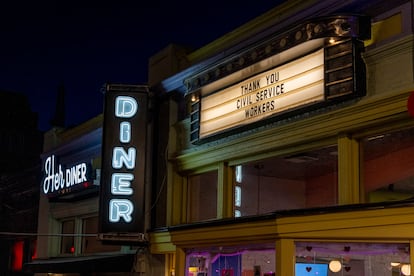
To comfort Alfen and others, ideas keep coming up to help them through the ordeal: coffee, free theater tickets, or discounts at shops. At a restaurant in Adam’s Morgan, the liveliest part of downtown, the “queer and inclusive” Her Diner has put up photos of civil servants in its window and a sign on its marquee: “Every evening, we open our doors to provide them with a safe space to share their stories,” explained manager Shane Patil on Friday night.
In the evening, in the Kennedy Center’s (KC) grand hall, attendees of a free National Symphony Orchestra concert were united in uncertainty about the future of a complex that was opened in memory of JFK and houses the city’s opera house and auditorium. In an unexpected move for someone who has never set foot in the place, Trump announced in early February that he was taking control of the cultural center, of which he became president. He dismissed the bipartisan board of trustees, appointed a new one full of Trumpist faithful such as his chief of staff, Susie Wiles, and country singer Lee Greenwood, and put Richard Grennell, former ambassador to Germany, in charge with the mission of cleaning up the “woke virus” from the KC, and specifically, “the drag queen shows aimed at young people.”
Cancellations and resignations
So far, shows like The Gay Men’s Chorus of Washington have been scrapped, and musicians (Rhiannon Giddens) and actresses (Issa Rae) have cancelled appearances. Soprano Renée Fleming and singer-songwriter Ben Folds have resigned from their advisory roles, and, according to Toni Codinas, a board member of the Washington Bach Consort, the city is already talking about “Kennedy refugees” in reference to donors, essential to the support of the arts in the U.S., who have decided to take their patronage with them in search of other horizons in the face of Trump’s assault.
Spanish conductor Ángel Gil-Ordóñez, who has lived in the United States since 1993 and regularly performs at the KC, says he has no intention of going “anywhere”: “It’s my home,” he adds. “The first thing authoritarian regimes do is try to control the arts; anyone who studies the history of Weimar knows that. You have to resist from within.”
The audience last Friday was divided between thinking the change would mean “more country and concerts by Kid Rock and that awful tenor Trump likes so much [Christopher Macchio]” and hoping the president has more pressing things to do than to tamper with a venue that hosts some 2,000 events a year, with one that stands out above the rest: the Kennedy Center Honors, which has recognized arts figures annually since 1978 in a tradition that Trump discontinued in his first administration, fearing a snub that he is now exacting revenge for. “It will be interesting to see who they pick next. Then [in September] it will be clear how far they will go to intervene,” Leibovich said.
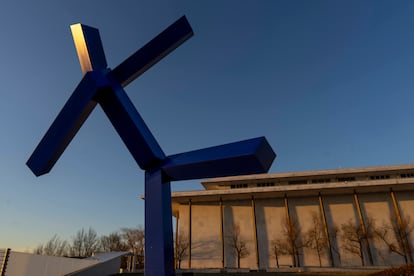
Until then, it is clear that Trump’s move is unprecedented. It is also widely supported by Washington conservatives, whose best-known faces include the Schlapp couple, two of the most Trumpist creatures of the swamp. Matt Schlapp chairs the Conservative Political Action Conference (CPAC), the most important Republican summit in the United States. His wife, Mercedes, is a media personality and hosts the event. She considers the assault on the KC to be “necessary” because it was “a drain on money” [it has a budget of $268 million and last year it registered a deficit of $1 million]. “We had to stop promoting the woke and the radical agenda,” she believes. Or, as Kassam, Bannon’s ally turned restaurateur, sums up: “It is one thing to put on La Traviata and another for the left to behave in a dictatorial way with culture, as usual.”
Schlapp is also pleased to see how Trump is “dominating the narrative, giving no respite to the media that has always been hostile to him,” and which is now forced “to cover all the sensational things he is doing every day.” In the same week in which Jeff Bezos, owner of The Washington Post, put the opinion page of the major newspaper at the service of the new government, the president, who has vetoed the AP news agency for its refusal to use the name adopted by decree for the Gulf of Mexico, has gone even further by taking away from the White House Correspondents Association the power to organize coverage of the pool, the group of journalists who follow the president and share information with the rest. Since 1914, they have decided which media would participate in this privileged access. White House spokeswoman Karoline Leavitt proclaimed on Wednesday that now it will be her team that will take care of that, to make room for “others,” who have also turned out to be Trump-friendly.
“A Moscow-like chill in Washington”
That’s why, during the unpleasant Oval Office ambush of Ukrainian President Volodymyr Zelenskiy last Friday, a representative of the MAGA conglomerate Real America’s Voice grabbed the microphone and told Zelenskiy off for not wearing a suit in such a solemn place (the same solemn place that Musk desecrates with his t-shirts almost every day). It turns out that the man was also the boyfriend of Marjorie Taylor Greene, the most Trump-friendly congresswoman on Capitol Hill (and the competition for that is tough).
In light of the new rules, The New York Times’ Peter Baker, one of the White House’s most senior and respected reporters, drew on his past as a Russia correspondent in the late 1990s to write that “there is a Moscow-like chill in Washington these days.”
Many in the Democratic city are experiencing similar chills. Others — some of whom regularly dine on bone marrow at Butterworth’s — will find Baker’s analysis “hysterical,” as the White House spokeswoman told the journalist in a post on X to which she added a clown emoji. Leibovich, the great chronicler of the ups and downs of Washington depending on who is occupying the White House, advises a little patience. Six weeks have passed that seem more like six years, but the capital has not yet surrendered, he says, to Trump’s siege.
Sign up for our weekly newsletter to get more English-language news coverage from EL PAÍS USA Edition









































