
Cuba calls the presence of US nuclear-powered submarine at Guantanamo Bay naval base a provocation
The U.S. State Department said it does not discuss the movements of U.S. military assets
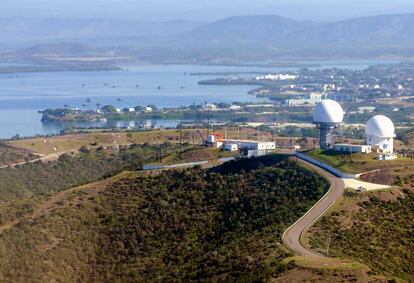
Cuba’s government on Tuesday called the presence of a U.S. nuclear-powered submarine at the Guantanamo Bay naval base for several days last week a “provocative escalation,” while a U.S. official said it was a logistics stop by the vessel at a U.S. base on its way to maritime exercises.
A statement from Cuba’s Ministry of Foreign Affairs said the submarine was at the U.S. naval base on the island from July 5 to July 8. It gave no more details.
“This constitutes a provocative escalation by the United States, whose political or strategic motives are unknown,” the foreign ministry statement said.
The U.S. State Department said it does not discuss the movements of U.S. military assets.
A U.S. Defense official, speaking on condition of anonymity to provide details of a military operation, said the Navy submarine made a scheduled logistics stop at Guantanamo Bay. It then continued south to participate in UNITAS, the world’s longest-running multinational maritime exercise.
“Today is the two-year anniversary of the July 11 protests by the Cuban people demanding their legitimate human rights, and of the Cuban government’s repressive response,” said State Department spokesman Matthew Miller. “Attempts by the Cuban government to distract the world from the significance of this day are transparent and risible.”
The July 11 street protests were the biggest in Cuba at least since those a quarter century ago, when then-President Fidel Castro personally went into the streets to calm crowds of thousands furious over dire shortages that gripped the island following the collapse of the Soviet Union.
Many protesters expressed anger over long lines and shortages of food and medicines, as well as repeated electricity outages. Cuba’s government called the protests a U.S.-backed attempt subvert peace and order, and hundreds were detained.
Cuba’s Foreign Ministry said on Tuesday that 33 Latin American nations signed an agreement committing themselves to be a “Zone of Peace” and warned about “the danger posed by the presence and circulation of nuclear submarines of the United States armed forces in the nearby Caribbean region.”
Cuba considers the U.S. presence at the Guantanamo Bay naval base an occupation and has unsuccessfully demanded its return.
Sign up for our weekly newsletter to get more English-language news coverage from EL PAÍS USA Edition









































