
Roblox: The video game where millions of children interact with strangers
The platform has introduced an age-verification system following failures to protect minors, who are exposed to contact with unknown adults. This issue has alarmed parents, pediatricians, and prosecutors
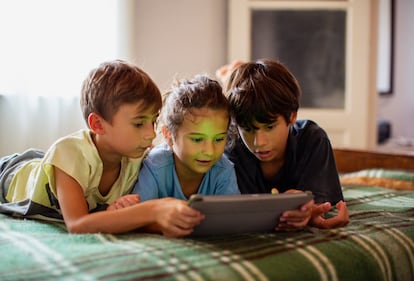

Roblox is played daily by 152 million people worldwide. One notable detail: nearly 40% of the users on this video game platform are under 13, enjoying interactive environments like Brookhaven or Grow a Garden. But they also share this virtual playground with adults who aren’t required to verify their identity to participate. Kids who have been taught not to talk to strangers on the street are playing and chatting on Roblox with adults from anywhere in the world without even knowing it.
As the platform’s popularity has grown in recent years, so have the problems: adults using it to harass minors, bullying among peers, exposure to violent content, and cases of addiction or scams involving its virtual currency, Robux. The company has responded with measures like facial recognition for users, but it continues to face criticism from parents, doctors, and prosecutors, who accuse it of not doing enough to protect children.
The platform has been in the spotlight since August, when it canceled the accounts of several “vigilantes” in the U.S. — volunteers who patrolled games to detect potential harassment and alert authorities to security gaps. Roblox justified the blocks, saying the accounts had “started impersonating children and actively sought to connect with adult users,” which violates its terms of service.
Amid the controversy, the company has been sued by several U.S. prosecutors, including in Texas, where it is headquartered. Texas Attorney General Ken Paxton accused Roblox of “profiting from a digital playground that conceals predators and a manipulative psychological design behind a façade of ‘family fun.’” This is on top of the other accusations in Florida, Louisiana, and Kentucky, as well as lawsuits from private individuals. One Dallas family is suing Roblox for reckless homicide following the suicide of their child, claiming that an adult convinced him to disable the game’s parental controls and move their conversation to Discord, another gaming platform, where he was later extorted for intimate photos and videos.
On Tuesday, Roblox announced a new age-verification feature that uses the camera and facial recognition to estimate a user’s age for accessing communication functions. Once assigned to an age group, users will only be able to chat with participants of similar ages — for example, a 12-year-old can only talk with users aged 15 or under. The company has opened a voluntary registration period and said the feature will become mandatory in early December in selected markets such as Australia, New Zealand, and the Netherlands, and worldwide in January.
Police investigations
The rise in inquiries about Roblox prompted a report from the Chief Inspector of the Child Protection Unit of the Central Cybercrime Division of the Spanish National Police. The report notes that between 2019 and September 2025, the unit has conducted 24 investigations related to sexual abuse, child prostitution, incitement to suicide, and scams involving minors on Roblox, resulting in six arrests. Three investigations are still ongoing.
The inspector, who prefers to remain anonymous, clarified that these are not official statistics, but rather data to assess the evolution of this phenomenon. Roblox is not the platform with the most reports, but he declined to name the others to avoid alerting those under investigation: “There is an increase in complaints across nearly all platforms, which is logical because this modus operandi is facilitated by messaging apps where minors can share audio, video, images, and chat with people they don’t know.”
Roblox is just one of these channels. The police receive reports from individuals as well as from NCMEC, the international organization to which U.S.-based companies are required to report suspicious behavior.
Experts say the greatest risk for children is in the chat feature, which does not allow photo sharing and is monitored by AI and a team of staff. However, some adults bypass these safeguards using coded language to communicate or persuade children to continue conversations and exchange images through other, less regulated messaging apps.
Pediatricians raise alarm
The Spanish Society of Adolescent Medicine (SEMA) and the Health Promotion Committee of the Spanish Association of Pediatrics (AEP) issued a warning in September after noticing an increase in children and adolescents presenting “concerning symptoms” linked to misuse of Roblox.
These symptoms include self-harm, significant behavioral changes, anxiety, insomnia, social withdrawal, and unusual comments or behaviors regarding sexuality, identity, or violence. They also highlight the potential for addiction caused by the platform’s points system.
María Angustias Salmerón, a pediatrician and member of the AEP’s Health Promotion Committee, explained: “We are seeing many cases, and considering that this is just the tip of the iceberg, if there are consultations about this, it’s because there is a serious problem.” She notes that her colleagues in different parts of Latin America have observed similar diagnoses.
The doctor recommends that parents “be proactive in finding out where their children play online, ask them if they’ve had any experiences that made them feel uncomfortable, and if they detect even the slightest problem, take them to the pediatrician for an evaluation.”
Many parents are unaware of Roblox’s parental controls. According to Salmerón, they need to create their own account linked to their child’s account to manage chat, block users or experiences, limit purchases and screen time, and track which games their children spend the most time on.
When contacted about the issue, Roblox responded via email: “Every day we see an average of 6 billion chat messages and 1.1 million hours of voice communication in dozens of languages, the vast majority of which are everyday conversations, but a small number of malicious actors attempt to circumvent our system.” The company argued that “malicious actors adapt to evade detection” and recommended “ensuring children have an account with the correct information, such as their date of birth, so they have the additional protections enabled by default and see age-appropriate content.”
Antonio Planells, a professor at TecnoCampus at Pompeu Fabra University in Spain, argues that Roblox “has found that much of its rapid growth has been due to being a social network with a very user-friendly aesthetic, where minors felt very comfortable playing, and it hasn’t known how to manage this.” For the professor, the key “lies not so much in the access filter, but in the fact that a minor exposed on the platform has no defense or protection mechanisms.” He believes that “it must invest in making it a safe space through control over content creation and effective and extensive moderation of activity.”
The Spanish Data Protection Agency (AEPD) has opened proceedings against Roblox for “pornographic or violent content” that it allegedly allows children to access “without restriction,” and for processing personal data of 13- and 14-year-olds, who are legally minors. The AEPD is also investigating that “it’s possible to register as a new user using a birthdate, a fictitious username, and a password.” The agency told EL PAÍS it cannot provide information on ongoing cases.
The British research agency Revealing Reality evaluated the platform before and after the new parental controls and found some improvements. However, it noted that age verification remains insufficient, as adults can easily infiltrate spaces for minors, and chat and voice moderation are not fully effective.
Their recommendation is clear: “Don’t rely on platform promises or research reports — including ours — to decide if Roblox is right for your child. Create your own account; it only takes a few minutes. Spend time in the spaces your child uses. Listen to the conversations. Then make your own informed decision.”
Sign up for our weekly newsletter to get more English-language news coverage from EL PAÍS USA Edition









































