
How to repurpose abandoned railway tracks: Two projects explore driverless electric mini-trains
Autonomous rail vehicles with few seats could connect low-demand destinations at a very low cost, although Spanish legislation poses a stumbling block

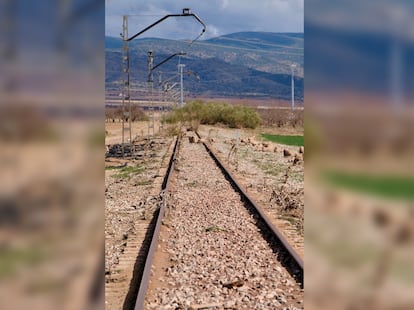
Since the 1980s, Spain has abandoned more than 2,800 miles of conventional railway tracks, due to their unprofitability or the need for expensive expansion. Nearly 1,250 miles of railway have been dismantled to become greenways (trails), while the rest remains unmaintained, as is the case in other European countries. But two pioneering projects believe that they could be used again.
These initiatives are seeking to build autonomous, small-seat electric mini-trains, prototypes that in the future could connect low-demand destinations, at a very low cost… and without drivers. However, Spanish legislation currently poses a major obstacle.
According to data from ADIF — the state-owned railway infrastructure manager — Spain currently has 9,726 miles of railway tracks, of which 7,252 are managed by ADIF (including the 741 miles that make up the narrow-gauge network) and another 2,473 miles are managed by ADIF AV (high-speed rail).
“The decision regarding the possible closure of railway sections or lines is the result of an analysis [conducted by] the Ministry of Transport and other affected public administrations,” says a spokesperson for ADIF. The organization estimates that 2,912 miles of railway lines have been closed, of which 1,176 miles have been restored and transformed into cycling and hiking routes. “Greenways create jobs in rural areas, generating economic activity and a new commercial network linked to tourism,” the spokesperson argues.
But this isn’t the only potential use for them. In Germany, the REAKT initiative, promoted by the Kiel University of Applied Sciences, seeks to reactivate disused railway lines through on-demand autonomous transport. According to its website, “the line and its vehicles will be interconnected and equipped with sensors. Additionally, an operational concept will be developed, [with the use of] data-driven artificial intelligence tools.” The German Ministry of Transport is funding the initiative with €5 million ($5.9 million) and has made an abandoned 10.5-mile line available between Malente and Lütjenburg, near Kiel, so that engineers can test the prototypes.
Inspired by this example from his home country, Rainer Uphoff — now a resident of Andalusia — has launched RuRail, a project that’s researching how this model could be implemented on conventional railways in Spain. He intends to collaborate with REAKT. “Autonomous rail service is simpler than [self-driving] cars: the Madrid Airport Terminal 4 shuttle train already operates without a driver, as do some metro lines in several countries. But this has always been done in sterile environments: that is, completely closing the route, with fences and gates, so that no one can enter,” he explains.
This sustainable mobility expert has connected experts from Kiel with the University of Granada, which has embarked on the research. “In April, we held a workshop in Guadix with the Alliance for Sustainable Mobility and Rural Innovation (AMSIR), led by Uphoff, where it became clear that most non-metropolitan rural areas suffer from severe transport poverty (due to a lack of basic public transit services),” explains Alejandro Grindlay, a professor of urban planning and spatial planning at the University of Granada. “That’s why we’re going to research several aspects: territorial rebalancing, artificial intelligence, railway infrastructure and signage.”
Small trains for 15 or 20 passengers
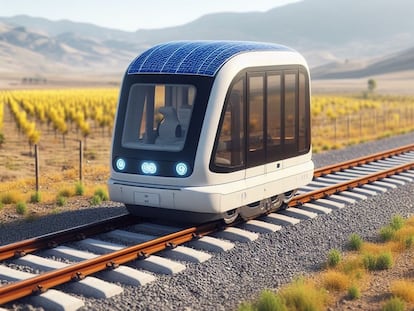
What will these vehicles be like in the future? “Let’s not think of large vehicles, but of a mini-train for 15 or 20 people, controlled autonomously from a distance,” responds Federico Aránega, president of the corREDores.eu Alliance, which promotes rail transport across the European continent. He elaborates: “These trains [will be able to] perform automatic maneuvers, stop at obstacles, adjust schedules on demand… [they] can be coupled or separated, depending on the load.” In other words, rather than a very long train, each of these trains will be more similar to a small bus, moving along the rails. Although, during high-demand times, several vehicles could run together.
“On non-electrified tracks, they could run on electric batteries and use solar panels,” the expert notes. He believes they could also be used to transport light goods: “Their potential is enormous for three reasons: low operating costs, adaptability to rural environments, and reduced emissions.” And, according to Professor Grindlay, they’ll seek Spanish and EU funding for the project in the fall.
In fact, REAKT is already designing vehicles with these characteristics. “They’re testing some models and hope to have results in less than five years,” Uphoff affirms. These vehicles aren’t yet commercially available, but the technology already allows for testing in real-life environments. “The mini-trains could take advantage of disused railways, which aren’t profitable, to connect small towns in rural Spain, either with on-demand transport or with limited frequencies. [Such a model] would be feasible for many routes,” Aránega says.
Industry sources consider it difficult to recover abandoned tracks for this purpose, as most were built more than a century ago, in the late 19th and early 20th centuries, and don’t meet current safety requirements. Adapting them is expensive and complex.
Uphoff has a different opinion: “Until now, railways have only been considered suitable for large volumes of traffic, but when it comes to unused infrastructure, they’ve already been [written off]. And the maintenance costs are very low. Recovering these routes would allow us to take advantage of the full potential of the rail system, which is four to 10 times more efficient and cleaner than road transport.”
Luz García Martínez, a professor in the department of signal theory, telematics and communications at the University of Granada, notes: “We use distributed acoustic sensing (DAS) technology that can be applied to predictive track maintenance, anomaly detection (due to landslides, train failures, or atmospheric phenomena), real-time train tracking (you can see where the trains are moving, as well as their speed) and safety monitoring (intruder or animal detection). She adds: “The idea is to analyze [this technology’s] applicability in the field of autonomous trains.”
“Our research project seeks to study how these vehicles might perform in a real-life operating environment,” Uphoff explains. “That’s why we’ve asked ADIF to use a railway line that has fallen into disuse in Andalusia.”
Representatives of ADIF confirm that the state-owned firm is in talks with the University of Granada “to analyze a still-[incipient] proposal” so as to “convert a section of the track on the conventional Granada-Antequera network — disused, but not closed — into a research and experimentation space, based on a new railway model for autonomous and connected micro-trains.”
Legal obstacles
The researchers will also be looking into operational and regulatory issues, because, for now, regulations are a hindrance, even for testing. According to Spain’s Railway Traffic Regulations, “the minimum number of personnel in the train’s driver’s cab for it to begin service will be one driver.” And, on some routes, even a second driver is required. Hence, the circulation of this type of self-driving vehicle wouldn’t be authorized.
ADIF confirms this: “Current legislation doesn’t permit the commercial operation of autonomous trains. At the European level, [no legislation has been drafted regarding] autonomous trains.”
A spokesperson for the Ministry of Transport agrees: “There are no regulations for this type of vehicle in Spain, nor are there any short-term projects to develop regulations.” Uphoff, in turn, voices a demand: “Let the future Sustainable Mobility Law open the door to these laboratories, [so that they can operate] beyond [the confines of] current legislation.”
For its part, RENFE, Spain’s state-owned railway company, is participating in the European ERJU project, which seeks to automate various railway operation processes… although a spokesperson for RENFE points out that the public company isn’t developing any projects independently.
Grindlay adds: “In Germany, the technology is already more developed; the idea is to also develop it in our country, via this [pilot] project.”
Sign up for our weekly newsletter to get more English-language news coverage from EL PAÍS USA Edition









































