
Tradition, money, and necessary change: The tennis puzzle still doesn’t quite fit together
Novak Djokovic has called for an ‘integral overhaul’ of a sport caught between several currents: romanticism, an atomized system, and players who feel ‘used’

Inside the bowels of the All England Club, veteran journalist Richard Evans — indefatigable at 87 — turns to Àlex Corretja during a conversation in the dining room and, before digging into his plate, murmurs: “We need Carlos…” And he’s right: today’s tennis needs the incomparable magic of Alcaraz to return, just as, lately, people have been studying and proposing ways to energize, unify, and modernize a sport long chained to tradition. Society changes, audiences demand new stimuli, and the rulers — tournaments, governing bodies, organizations, and investors — want to squeeze the concept of the industry to previously unimagined limits. In other words, to multiply the number of zeros.
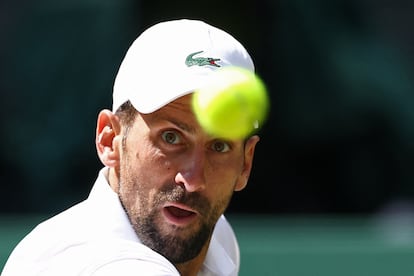
Novak Djokovic, who knows a thing or two about this, raised his voice on arrival at the All England Club and demanded an “integral overhaul” of a system that must reconcile the interests of all parties and stakeholders: the sporting with the commercial, the structural with the health of the main actors (the players), and respond — because that’s how this works — to the new habits of consumers who live with their phones in hand and no longer tolerate sitting for two hours in front of the television. The 39-year-old Serb, who has been competing at the highest level since 2003, came to demand that a growing imbalance be rectified, one that stems from the fact that every entity — money and more money — looks after its own interests with a selfish rather than a holistic perspective.
In another masterful analysis of the situation, Djokovic criticized the packed annual calendar, the proliferation of injuries — demonstrated by the statistics — and how, while some fatten their wallets disproportionately, others suffer. “I think tennis really needs a reset of some kind on a bigger level. I think our tours respectively are not functioning well at all. I mean, there are a lot of things that are happening backstage, meetings, relationships are not going in the right direction [...] What we have to do, in my opinion, if we want this sport to really improve and be able to compete with the popularity of all the other global sports, we just have to take all of the interested parties in our sport, all the key players, sit down, let’s see what we can do,” the Belgrade native warned. “I don’t see that happening because what I’ve been hearing and what I’ve been seeing in the last couple of years, there’s a lot more conflict within the governing bodies of our sport than there is unity.”
Djokovic said today’s “Band-Aids” aren’t sufficient and, despite his hard‑won privileged status, his demands have always been global, with special emphasis on lower-ranked players. He calls for more power for the players while pointing that the median age of a tennis fan is currently 61. “How do we get a younger audience to tennis?” he asked, while behind closed doors an endless debate continues, leading nowhere. Or rather, leading only to strictly economic considerations.
Reviving audiences
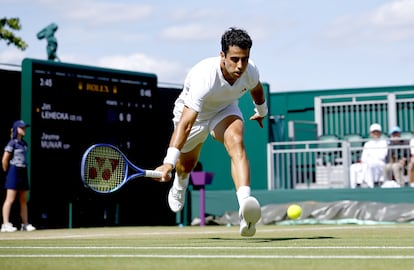
“I’m on the Players’ Council,” Spaniard Jaume Munar says. “And it’s true there are a number of complicated issues, but I don’t think we should be alarmist or overly disruptive. Should there be changes? Without a doubt. It’s a reality. Clearly we must review the product, but we shouldn’t forget that tournaments are, in general, more profitable than ever, that we have a lot of fan engagement and that the industry is growing hugely,” he tells this newspaper. The player himself admits some matches feel “long” to him and that he feels the need for something to “change” in terms of the spectacle.
Beyond executive matters and organizational fragmentation — Grand Slams, other tournaments, the ATP, WTA, ITF, owners... — voices calling for tweaks to the game to rejuvenate audiences are growing stronger. That premise was the basis for the new Davis Cup format, introduced in 2019 after 125 years unchanged: “Millennials want more excitement,” Gerard Piqué, the architect of the project, argued in EL PAÍS. “People have progressively less capacity for concentration and attention, that’s the reality. There are matches that are highly compelling and epic finals, but there are also first rounds lasting five hours that nobody watches,” Munar, 29 and ranked 44th in the world, elaborates.
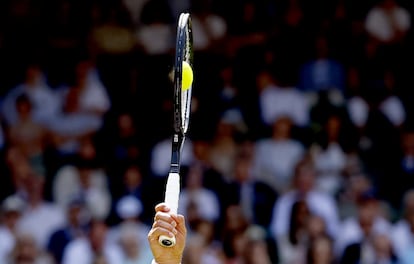
The physique of today’s players, like that of other athletes, has evolved exponentially compared with two or three decades ago, so some propose revising equipment — lighter and more powerful materials — redesigning them, or adding counterbalances so play isn’t too linear and not solely about power. Add creativity. “Average height has increased considerably, so why not raise the net?” suggests Toni Nadal. The coach also proposes shortening racket handles to lessen the leverage effect, while the legendary Martina Navratilova favors reducing the racket’s sweet spot.
“I would force players to use rackets with smaller heads. Technique would become much more important. It would reduce speed and demand more control. I spoke with Rory McIlroy in the Royal Box and he told me he would do the same with golf clubs; today’s clubs are huge and it’s exactly the same in tennis. Technique would regain value. We’d see more serve-and-volley, more net approaches...” Navratilova said recently on the Tennis Channel.
Rules and play
The Next Gen ATP Finals — the season‑ending event for rising stars, held in December — has become a testing ground since 2017. A number of changes have been trialled there, such as the removal of the let (on the serve; a net cord would still count) or the advantage rule (with a golden point on deuce), and sets of four games instead of six; trials that also affect the technological and even aesthetic aspects, such as the elimination of the doubles corridor, which was previously implemented at some events such as the former Masters. There is also the free movement of spectators during the competition itself. “I’d stick with the current format, but if I had to change anything, it would be for the men to play best-of-three sets instead of best-of-five,” says Galician player Jessica Bouzas, ranked 52nd in the world.
“Those kinds of changes seem too much…” Munar says. “But this is a very traditional sport and quite classist in many ways, so… of course changes need to be made! But they must be done carefully." Asked by this newspaper, world number 20 Alejandro Davidovich replies: “It’s always the same story, so there’s never any change. I won’t comment because whatever I say doesn’t matter, so I prefer not to. We go through the same every year, so why comment?” “I don’t care. I don’t have a say in the ATP….”
It’s the puzzle that won’t fit together. The parties express a willingness to change, but money calls the shots, dominates, and directs — as shown by the multimillion-dollar embrace of Saudi Arabia — and structurally tennis suffers. There’s no room left on the calendar and professionals — with exceptions like Djokovic — end up collapsing, whether physically or emotionally. They also disagree with how the spoils are divided. Prize money grows, but they believe their share should be larger and have threatened to strike. Meanwhile, the rift between them and those in charge widens. “They don’t listen to us. They only use us. It can’t be a one‑way relationship,” laments Andrey Rublev.
These are the disagreements, the perspectives, and the debates in today’s tennis landscape: prosperous, certainly. But also improvable.
Sign up for our weekly newsletter to get more English-language news coverage from EL PAÍS USA Edition









































