
The Chicago Cubs and the ‘rooftop wars’
The buildings surrounding Wrigley Field have become a highly lucrative tourist attraction against their owners’ will. After half a century of litigation, it appears the club now has the upper hand
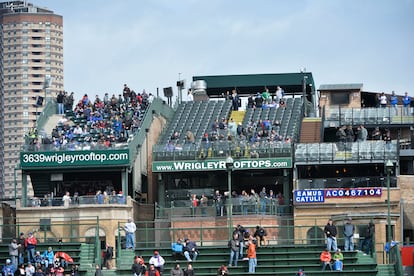

The United States professional baseball league (MLB) was suspended for three months between May and July 2020, at the worst point of the pandemic. When it finally resumed, it did so behind closed doors or with very restricted access. For the first time in many years, stars of the sport such as Mike Trout of the Los Angeles Angels and Christian Yelich of the Milwaukee Brewers had to celebrate their victories in front of empty stands.
The most striking exception was the Chicago Cubs. The Boys in Blue from north Chicago, long-time rivals of the White Sox, that summer enjoyed the support of hundreds of fans who followed their games from the buildings surrounding Wrigley Field, the Cubs’ spartan yet charming ballpark. Their best player, pitcher Kyle Hendricks, even dedicated a hard-fought August 3 victory that year over the Kansas City Royals to that small band of “clandestine” spectators.
Covid had turned the “roof kids” into their only fans, and that deserved recognition. Although many of them were not exactly local residents, they were people who had paid for a ticket to watch a live sporting event in the middle of a pandemic, when almost no one in the world could do so.
For your eyes only
This is not completely unheard of. Spanish soccer fans know well that from some apartment balconies in Vallecas you can see Rayo Vallecano’s matches perfectly, and the residential towers in Eibar have, since 1947, held an ideal vantage point over what happens inside the municipal stadium of Ipurúa. In Hungary it is often said that Haladás of Szombathely has many more spectators outside the stadium, on nearby terraces, than inside.
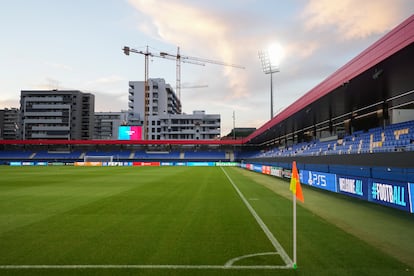
There are more cases. Portugal’s Famalicão and Mexico’s Cruz Azul (until 2024) have also played in stadiums located in high-density areas with very tall buildings and hundreds of fans enjoying matches from their home balconies as if they were in an elevated stand. Argentina’s Club Atlético Sarmiento has at least one rooftop, regarded as one of the most romantic spots in the city of Junín, where couples meet to drink mate and watch soccer on early dates. And from the upper floors of the buildings surrounding the Johan Cruyff Stadium, home to FC Barcelona’s reserve team, you can see the pitch and everything that happens on it perfectly. So much so that in September 2025, during the Barcelona–Valencia match played at that 6,000-seat ground, some residents received offers of up to €500 from tourists who wanted to use their homes to watch the match.
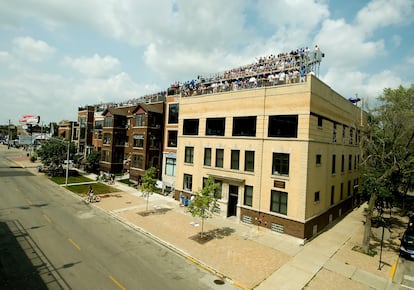
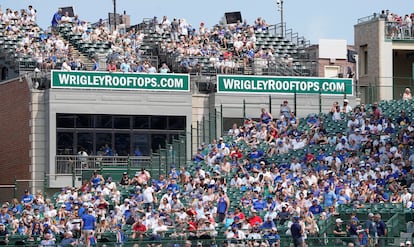
But Wrigley rooftops are another level. They hit the jackpot when Wrigley Park arrived in the neighborhood, and an increasingly lucrative industry has since grown around them. The pandemic, by emptying stadiums, led to the international press discovering the curious anomaly that rooftops represented in the summer of 2020, but any baseball fan visiting Chicago knows, at least since the 1980s, that the most exotic way to watch a Cubs game is to buy a ticket for one of the famous rooftops.
The news now is that the Cubs have sued the company owning one of those exterior stands because, according to the Chicago team, it was recording games and broadcasting them through private streaming channels. If this alleged foray into the high‑end world of TV piracy were true (the sued company denies it, saying the only thing it offers customers is “filmed mementos of the experience”), it would represent a new business model tied to the increasingly profitable rooftops.
There are 16 in total, but 11 belong to the Ricketts family, owners of the Cubs since 2009, or have reached exploitation agreements that, in practice, turn them into services subcontracted by the club. The problem lies with the five remaining buildings, the lone holdouts of an association that grouped all the owners together until 2016, when the Ricketts family, applying the old maxim that if you can’t beat your enemy you should join them, began buying rooftop after rooftop and became the main providers of a service they had previously regarded as unfair competition.
The core of the resistors still controls, despite everything, five of the best-located and most profitable rooftops. And they have turned them into luxury boxes with comfortable seats, bar and catering services, and even huge high-definition television screens to follow the game better or to see what’s happening in other stadiums. This is the case of Wrigleyville Rooftops 2, at 3609 North Sheffield Avenue.
Step right up and see
The story goes back a long way and has added complex subplots over the years. The Cubs, founded in 1870, moved in 1916 to what would become Wrigley Field (it was then still called Weegham Park). It was a handsome, modern stadium with a capacity of more than 30,000, but it had a problem: it sat in the center of a growing neighborhood — today called Wrigleyville and very fashionable — where residential blocks of more than five stories were beginning to be built. In fact, there were already several. From many of them the field was perfectly visible, but at that time no one seemed too bothered that a small group of lucky residents enjoyed games without passing through the turnstiles.
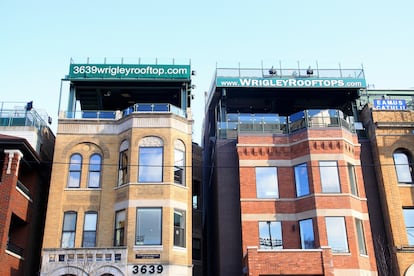
The Cubs would go through very dark years, with the team in crisis, the stadium almost empty and, despite everything, the surrounding rooftops packed to the rafters. More than a baseball team, they had become a tourist attraction — the losers you can watch from on high while sipping a mojito. And the business was being run by people outside the club, not by the club itself.
A lawsuit with a very long history
Of course, the Cubs sued their freeloading neighbors on multiple occasions. But the legal tangle, which ran for half a century, produced a trail of contradictory rulings. Most judges ended up urging the club and the owners to bypass the legal vacuum by reaching an agreement that would allow them to share the revenue generated by the parallel business the rooftops had become. The Cubs tried. But it proved very difficult to agree on percentages acceptable to both parties and, in addition, the club complained that the income figures declared by the promoters were far lower than the actual ones.
Everything changed with the arrival of the Ricketts family and their aggressive policy of buying rooftops and turning them into external stands managed by the club. Some sold outright and others reached agreements to become service providers. The accounts of the rooftops transformed into franchises were audited. The rooftops remained, but they were ceasing to be a fraudulent business.
Despite such obvious progress, the five buildings with which no agreement has been possible remain a thorn in the club’s side and a continuous source of tension. The allegations of illicit transmissions are only the penultimate chapter of an ongoing standoff. Although Michael McCann, in the digital magazine Sportico, believes the noose is tightening and that the Cubs are now likely to prevail.
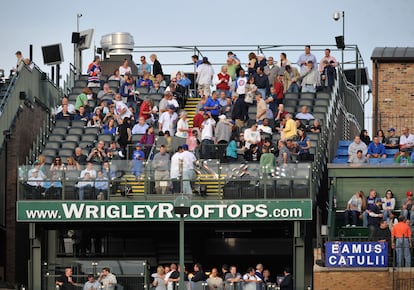
The club’s argument has been the same for a century: neighborhood residents have every right to watch the games for free from their homes or to invite friends to see them with them, but they cannot charge for access to a paid spectacle in whose organization they do not participate. On May 4, according to McCann, Judge Sharon Johnson Coleman denied a motion to dismiss filed by the owner of one of the independent rooftops, Aidan Dunican, and concluded “that the Cubs’ legal arguments are very plausible and it seems logical that they be taken to trial.”
That is what the Cubs need: an unequivocal court ruling forcing the independents to stop profiting at their expense. That way, if someone wants to watch the north-siders live they will be able to do so from the stadium or from the rooftops with pizza and cocktails, but always after going through the Cubs’ box office, since it is the club that fields a team in the professional baseball league. After all, McCann reminds us, “they are the ones who have spent $249.8 million on payroll this year.” No one makes such an investment only for others to make money off it.
Sign up for our weekly newsletter to get more English-language news coverage from EL PAÍS USA Edition









































