
The story behind the Basque Country-Palestine soccer match
Some 50,000 fans are expected to attend a historic game on November 15 in Bilbao
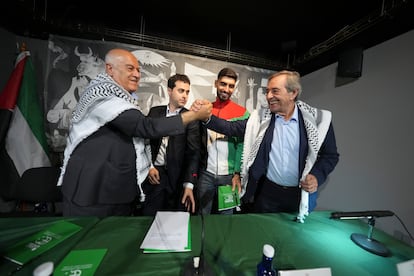
One afternoon in 2019, Yaser Hamed, who has a Palestinian surname but lives in Leioa, a few miles north of Bilbao, received a personal message on Facebook. It was written in Arabic, and with the help of Google Translate, he managed to figure out that it was a call-up to go to Ramallah, in the West Bank. “The first thing I did was check if the guy writing to me was really the national team coach, and then I found out that I was being called up to play for the national team.” Hamed was 22 years old and at the time played for Portugalete in the Spanish Third Division.
His father arrived in Spain in the 1970s to study medicine. He finished his degree and settled in the Basque Country, where he met his wife. They moved to Leioa to raise a Basque family with five children. “He never went back to Gaza. He didn’t instill in us the struggle of the Palestinian people or anything like that.” Yaser didn’t grow up surrounded by demonstrations or activism, but his role on the Palestinian national team has made him an idol and a well-known ambassador throughout the Arab world. “Last summer I was on vacation in Mallorca with my girlfriend. We found a huge bouquet of flowers in our hotel room. The cook, a Moroccan woman, had left it for me. When she found out who I was, she wanted to thank me for what I was doing for Palestine. It’s amazing,” Hamed recounts from Doha, where he plays for Al-Gharafa in the Qatar Stars League.
Since his first trip to Ramallah in 2019, Hamed has become increasingly aware of the importance of soccer for Palestinians. The national team now plays its home matches in Qatar and is one of Palestine’s main diplomatic assets. On his debut in 2019, he scored a historic goal against Yemen, and in the midst of the conflict with Israel in 2023, Palestine managed to advance past the group stage of the Asian Cup for the first time.
His first trip to the West Bank was a crash course in the plight of his compatriots. Passing through the Ben Gurion Airport in Tel Aviv and crossing the border was a baptism of violence and mistreatment that left a lasting mark. Today, he accepts the tension between Palestine and Israel as normal, referring to the latter as “the other country,” convinced that any political commentary will jeopardize his ability to continue playing for the Palestinian national team.
A few years ago, Hamed, a product of the Athletic Bilbao youth academy, had an idea that would also fulfill his greatest sporting aspirations. “I’ve always dreamed of playing at San Mamés and I played for the Basque Country team in regional competitions, so I contacted the last two presidents of the Basque national team, Javier Landeta and Iker Goñi, and put them in touch with the Palestinian national team. Between the tight schedule and the numerous obstacles, I thought it was going to be very difficult until this summer when the phone rang. The secret negotiations had finally come to fruition, and the dream of bringing Palestine to San Mamés was finally realized,” he explains.
The social mobilizations against the Israeli genocide, especially during the Vuelta a España cycling race, exposed the contradictions of European professional sport regarding its treatment of Israel. This social commitment turned the unthinkable into reality with the organization of a Basque Country-Palestine match on November 15 in Bilbao, which sold over 30,000 tickets in just a few hours on the Basque Football Federation’s website.
Hamed has played in Bahrain, Egypt, Kuwait, India, and Qatar. He’s a soccer globetrotter who gave meaning to his career through the power of the ball, using it to champion a just cause. Despite the suffering of the Palestinian people, he remains optimistic. “We’re going to play at San Mamés, but I also know we’ll play at home again, in the West Bank.” And in Gaza? “I hope so, but I see that as impossible,” he concludes.
Sign up for our weekly newsletter to get more English-language news coverage from EL PAÍS USA Edition









































