
Spain’s Civil Guard probes Spanish Super Cup move to Saudi Arabia
Spain’s former soccer federation president Luis Rubiales and ex-player Gerard Piqué negotiated the €44 million deal in 2019, recently extended until 2029
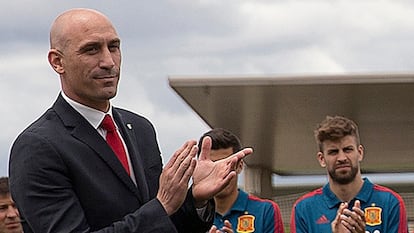

Spanish Civil Guard and Europol agents searched the Royal Spanish Football Federation (RFEF) headquarters in Las Rozas (Madrid) on March 20, seeking documents related to the controversial move of the Spanish Super Cup to Saudi Arabia. The search was prompted by a complaint in 2022 by Miguel Ángel Galán against disgraced former RFEF president Luis Rubiales and then-Barcelona player Gerard Piqué. Galán is the president of CENAFE, a public organization that runs soccer coaching courses. He lodged the complaint after Spanish digital news outlet El Confidencial released documents and audio recordings between Rubiales and Piqué pertaining to the deal to move the Spanish Super Cup.
In late 2018 Rubiales and Piqué announced the new format for the Spanish Super Cup, involving four teams instead of two, vying for the trophy across two semifinals and a final. They sealed a deal eight months later, with Saudi Arabia to host the tournament. The RFEF president marked the occasion by sending this audio message to Piqué: “Congratulations, Geri. And I’m not talking about yesterday’s game or your goal. It’s past 12, so the deal with Saudi Arabia is done. Thanks for everything, I’ve got your back. Well, except for those things you’re better off handling yourself. Big hug, take care buddy.” The agreement originally comprised three annual tournaments, with the RFEF getting €40 million ($43.5 million) annually and Kosmos, a company owned by Piqué at the time, receiving a €4 million ($4.35 million) annual commission. FC Barcelona, Piqué's club before his retirement, was one of the teams in the inaugural 2020 tournament held in Jeddah.
When details of the deal surfaced, Piqué held a press conference defending his commission. “We’re talking about something that’s completely legal. Some folks might wonder if it’s morally right or if there’s a conflict of interest,” he said about the money that he would receive directly from the Saudis, and not through the RFEF (as the leaked audios confirmed). “The 10% commission is market-based and pretty low, as they usually hover around 15% to 20%. It’s in line with what all agencies charge for this kind of thing.”
Rubiales also defended his involvement in the Saudi agreement during a recorded appearance at RFEF headquarters. “The agreement is impeccable and I have nothing to be ashamed of. The contract is exemplary,” he said at the time. Saudi Arabia has hosted two tournaments, in 2020 and 2022, with the 2021 event held in Spain due to the pandemic. The contract was extended for an additional three years until 2026, and subsequently extended again for another three years. It’s now set to expire in 2029.
The contracts between the Rubiales-led RFEF and Piqué are not the only aspect under scrutiny in the move of the Super Cup to Saudi Arabia. Several Spanish clubs have raised concerns about distribution of the contract proceeds, claiming they favor Real Madrid and FC Barcelona. These allegations seem to be supported by an audio message Piqué sent to Rubiales. “So, Rubi, if it’s about money, like if Real Madrid goes for eight, man, they pay eight to Madrid and eight to Barça... The others get two and one... that’s 19, and you’re left with six kilos [million] for the Federation. Before you got nothing, but now you’ve got six kilos. And we can push Saudi Arabia a bit, to maybe get more... We can say if not, Madrid won’t go for the deal... we might get one or two more things out of them...” In the end, the deal for the first tournament gave Madrid and Barcelona €6.8 million each, while Valencia was upset about only getting €2.5 million. In 2023, Real Betis complained about only receiving €750,000, while Valencia got €1.7 million and Madrid and Barcelona €2.8 million each.
Sign up for our weekly newsletter to get more English-language news coverage from EL PAÍS USA Edition









































