
The Mayan civilization experienced 44 years of drought in its last two centuries
Analysis of a stalagmite reveals that some extreme events lasted for more than a decade
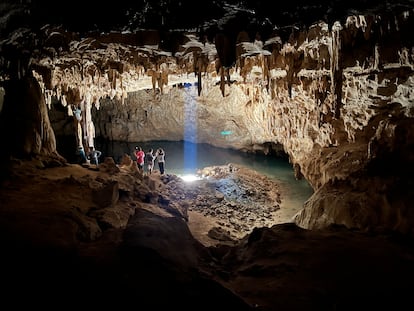

After centuries of prosperity, the Mayan civilization began to decline in the 8th century CE, collapsing completely over the next two centuries. They abandoned their cities — with their pyramids, stadiums, ceremonial plazas… and their fields, sustained by hydraulic engineering as ingenious and advanced as that of their contemporaries, the Arabs.
This decline has been attributed to local wars, invasions from the north and south, disease, climate change or a combination of several of these factors. Among them, however, the impact of climate on these agrarian-based societies stands out. Now, the study of a stalagmite from a cave near Mayan cities such as Chichén Itzá has helped clarify its role: according to this analysis, published in Science Advances, in the last 200 years of the Classic Period, at least 44 of them experienced extreme droughts.
Like the early agrarian empires of the Near and Middle East, which relied on urban exploitation of surplus field cereals, Mayan cities depended on the production of various crops, especially maize. And, like those earlier civilizations, drought may have wiped them out. Researchers have now discovered that between 870 and 1100 CE, there were eight extreme drought events on the Yucatán Peninsula, one of the core areas of Mayan civilization. They define an extreme drought as three or more consecutive years with the dry season extended by at least three months, or even years with no rainy season at all.
The first of these droughts began in 894. It was followed by a year with normal rainfall, then another five consecutive years with scarcely any rain. The longest event occurred in 929, when precipitation remained anomalously low for 13 years. It was the longest drought on record, both from pre-Columbian times and in the centuries that followed.
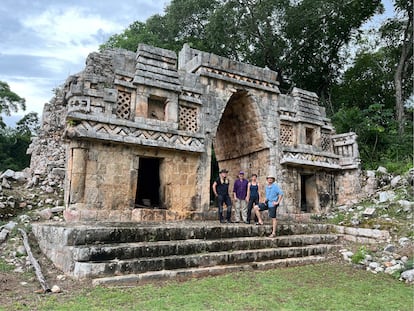
Sediments at the bottom of lakes and studies of other stalagmites had already highlighted the significant role of drought during the so-called Terminal Classic period of the Maya. Various speleothems (such as stalactites or stalagmites) grow drop by drop from minerals present in filtered water, forming layer upon layer each year. This allows them, much like tree rings, to serve as environmental records, particularly of rainfall. The major contribution of this study is that researchers were able to track precipitation variations not just year by year, but almost month by month.
“Knowing the average annual rainfall doesn’t tell us as much as knowing what each rainy season was like,” explains Daniel James, a researcher specializing in past climate reconstruction at University College London and first author of the study. Maize grows throughout the wet season and is harvested at its end. And crop yield depends on rainfall. “Being able to isolate the rainy season allows us to accurately track the duration of the drought from the rainy season, which is what determines the success or failure of crops,” adds James.
The researchers found that their dating of drought events corresponded fairly well with data obtained from other speleothems and lake sediments. Overall, they saw that the climatic data matched archaeological evidence: inscriptions on commemorative stelae, monument construction, and political activity at several major northern Maya sites came to a halt at various points during this period of climatic stress.
It could have been even worse. The segment of stalagmite they studied, from the Tzabnah Caves, located a few dozen miles from Maya cities like Chichén Itzá and Uxmal, records the period between 870 and 1100. However, there is a roughly 50-year gap, between 1021 and 1070, during which the speleothem did not grow.
James, who conducted this study while at the University of Cambridge, recalls in an email that “there are many possible reasons for this, one being that there could have been so little rain that the dripping stopped completely during a severe drought.”
Or, “just the opposite,” says David Domínguez, a geologist at the University of Salamanca. “If it rains too much, dissolution occurs, preventing growth,” explains the Spanish scientist, an expert in speleothems who was not involved in this research.
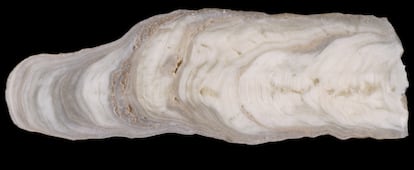
Stalagmites form when water drips from a cave ceiling and minerals — particularly calcite — precipitate. Trapped within them are isotopes of elements like oxygen and carbon, which help determine the source of the water. In the case of the Maya cave, researchers estimated that rainwater took about a month to infiltrate.
By dating and analyzing the oxygen isotope layers in the stalagmite, they could detect droughts and their duration. The layers don’t indicate the exact amount of rainfall, but “in years with little rain, the isotopes are heavier,” explains Domínguez.
Cities such as Uxmal were abandoned at the end of this period, while others show more ambiguous signs. Evidence suggests that Chichén Viejo declined, but what is now known as Chichén Itzá prospered for a while longer. “The differences between sites reflect different social responses to drought,” says James. “Chichén Itzá had a wide range of trade networks and was highly centralized, which would have allowed for the accumulation or importation of resources in times of scarcity.”
A separate 2021 study showed that a short drought — lasting just a few months or a single wet season — would cause supply issues, but 89% of production would still succeed. However, in cases of extreme drought, as defined in the new study, crop yields could drop to one-tenth of normal levels. One of the authors of that study, Scott Fedick, professor emeritus of anthropology at the University of California, Riverside, believes the new study underestimates the resilience of Maya cities.
“In our [2021] paper, there is a marked difference between the food plants available during moderate and extreme drought,” Fedick writes. ”While most annual species will not produce enough, a wide variety of nutritious perennial food plants would."
He argues that the new study places too much emphasis on the impact of drought on annual crops such as maize, beans, and squash, without recognizing “the potential contribution to food security from numerous drought-resistant perennial species that would endure a moderate drought and only decline gradually under an extreme one.”
Historian Rafael Cobos, a professor at the Autonomous University of Yucatán (Mexico) and an expert on Mayan civilization, notes that cities in the region faced similar pressures. “My research suggests that both Uxmal and Chichén Itzá were contemporaneous, and both pre-Columbian cities completed their development and peak at the end of the 11th century, just as the great drought that affected Yucatán and the rest of the world was at its peak,” he says via email.
Although some scholars argue, based on the archaeological record, that centers like Chichén Itzá continued to flourish despite this climatic adversity, Cobos concludes that “the Maya civilization, with a society dependent on maize cultivation for food, could not sustain its large population, leading to social, political, and economic collapse.”
Sign up for our weekly newsletter to get more English-language news coverage from EL PAÍS USA Edition









































