
SpaceX ignites giant Starship rocket in crucial pad test
Thirty-one of the 33 first-stage booster engines ignited simultaneously for about 10 seconds in south Texas
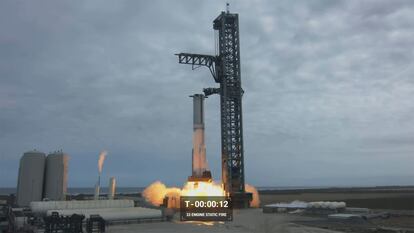
SpaceX is a big step closer to sending its giant Starship spacecraft into orbit, completing an engine-firing test at the launch pad on Thursday.
Thirty-one of the 33 first-stage booster engines ignited simultaneously for about 10 seconds in south Texas. The team turned off one engine before sending the firing command and another engine shut down — “but still enough engines to reach orbit!” tweeted SpaceX’s Elon Musk.
Musk estimates Starship’s first orbital test flight could occur as soon as March, if the test analyses and remaining preparations go well.
The booster remained anchored to the pad as planned during the test. There were no signs of major damage to the launch tower.
NASA is counting on Starship to ferry astronauts to the surface of the moon in a few years, linking up with its Orion capsule in lunar orbit. Further down the road, Musk wants to use the mammoth Starships to send crowds to Mars.
Only the first-stage Super Heavy booster, standing 230 feet (69 meters) tall, was used for Thursday’s test. The futuristic second stage — the part that will actually land on the moon and Mars — was in the hangar being prepped for flight.
Altogether, Starship towers 394 feet (120 meters), making it the biggest and most powerful rocket ever built. It’s capable of generating 17 million pounds of liftoff thrust, almost double that of NASA’s moon rocket that sent an empty capsule to the moon and back late last year.
SpaceX fired up to 14 Starship engines last fall and completed a fueling test at the pad last month.
Flocks of birds scattered as Starship’s engines came alive and sent thick dark plumes of smoke across the Starship launch complex, dubbed Starbase. It’s located at the southernmost tip of Texas near the village of Boca Chica, close to the Mexican border.
Sign up for our weekly newsletter to get more English-language news coverage from EL PAÍS USA Edition









































