
Trump stirs up trouble near Iran
The deployment of colossal forces by the United States in the Middle East could have the corrupting effect of encouraging the president to use them
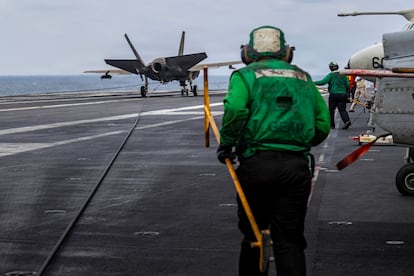

The United States government has deployed a powerful fleet in the Arabian Sea, posing a threat to the Ayatollah regime. The aircraft carrier Abraham Lincoln and three missile-equipped destroyers are currently sailing in the waters of the Middle East. The deployment includes F-35 fighter jets and a host of specialized aircraft. Also present are the more than 40,000 troops stationed at Washington’s military bases in the Persian Gulf. Attention is focused on Donald Trump and his bluster, and the entire world awaits his next stunt. Such a show of power, however, cannot be easily improvised, so it is important to remember that, beyond the current occupant of the White House, there is a vast machine where diverse economic, military and bureaucratic interests converge that was already operating before he came to power, and will continue to do so after he loses it. Within this machinery, a complex network of agents studies, recommends, suggests, proposes, or even imposes the guiding principles that shape the policies of this great world power. The most unsettling problem these days is that at the helm of it all is an unpredictable, narcissistic, and capricious individual.
The swift intervention in Venezuela, the threats to seize Greenland, the disdain for the European Union, and now the deployment near Iran: things are changing. It seems as if invisible forces are beginning to operate, guiding the great ship toward still unknown horizons, but under an increasingly explicit mandate. The United States wants to be great again, whatever that means, but achieving it won’t happen overnight; the plan may well extend over several presidential terms (until victory or final ruin). With the urgency of a world in turmoil, governed in terms of communication by a social media environment that demands constant updates, audiences are hanging on Trump’s every grunt. It’s worth remembering that any change takes time.
A simple look back reveals how many stories began that way and became more complicated later. When John F. Kennedy took office in 1961, Vietnam was still a marginal issue for his country. The debate then centered on whether to simply advise and support the Saigon government from afar, or to consider deploying large combat units there. The machinery behind every president didn’t want the United States to become great again—it already was, and believed itself to be, great—its obsession was defeating communism.
Historian Max Hastings makes an observation about those years in his book Vietnam: An Epic Tragedy that may be relevant today. “Possession of armed might can be corrupting: it feeds an itch among those exercising political authority to put them to practical use,” he writes. “Successive Washington administrations have been seduced by the readiness with which they can order a deployment and see their instructions promptly executed.” That could now be the temptation facing the Trump administration: to succumb to that “corrupting” effect and use its armed might without understanding what it is up against. Perhaps someone should remind the president what happened in Vietnam, and who won that war.
Sign up for our weekly newsletter to get more English-language news coverage from EL PAÍS USA Edition









































