
Serving without a master
Since colonial times, Black bodies have been viewed as mere labor, rather than as subjects with full rights. The four Afro-descendant children who were murdered in Ecuador were victims of structural racism. The notion of serving without a master means embracing practices of care and creation that don’t answer to state hierarchies or the market. It’s about serving the community — serving life — without being accountable to visible or invisible patterns

“Serving something without a master is a totally open form of love.” With this phrase from the book All Incomplete (2021), cultural theorists Fred Moten and Stefano Harney remind me that there are other ways of living in a world governed by hierarchies, capital and violence. And I’m not talking about naive love or simple tenderness; I’m referring to an ethic of commitment that opposes the mandate to obey the boss, the caudillo, the strongman, the armed state. I think about this possibility when I try to write in Ecuador, a country where life has become prey to organized violence. The streets have been militarized, while the political authority treats poor, Black, racialized and migrant bodies as internal enemies. Here, writing is about insisting on a love that answers to no master. And, at the same time, it’s about asking what it means to continue creating art in a place that’s been ruptured by terror.
I recently read a short story by the writer Mafe Moscoso. At the end of her text, her biography notes: “She was born in a banana-growing country.” That phrase struck me, because it’s not just an ironic gesture, but a stark truth: we grew up in a country named and defined by the monoculture that we export. Years earlier, while working in a bar, I heard an Argentine political scientist argue with a bartender about the policies of Rafael Correa’s government (2007-2017). The political scientist claimed that, before the social reforms undertaken by this presidential administration, Ecuador was nothing more than a “small banana republic.” While he used this expression in a derogatory manner, I now think of it as a persistent metaphor: we continue to organize our collective life around monocultures that are destined for export. The best is sent abroad, while we are left with the remainder.
A memory confirms this. When I was a child, a distant uncle who worked on a banana plantation made a comment while the family was eating: “The bananas we Ecuadorians eat are leftovers; the good stuff is exported.” That minimal gesture encapsulates an entire politics of dispossession: life here is the residue, what’s left over, while wealth circulates abroad. This metaphor extends beyond fruit: we also export bodies. Young people, even with bachelor’s or postgraduate degrees, face unemployment and violence. They must migrate, illegally, to the Global North. Ecuador exports its labor force in the same way that it exports bananas or shrimp. The best is stripped away, not permitted to be nurtured.
I grew up in a Black family in the coastal city of Esmeraldas, the descendant of migrants who moved there from the countryside. My parents and aunts were teachers and engineers; they firmly believed that education was the best possible legacy. They had studied in precarious conditions, making superhuman efforts to finish university, believing that was worth the sacrifice if it guaranteed us a more comfortable future. This was the great promise made to us, the children of the working class, who grew up in the late-1990s and early-2000s. We were told to study, graduate and “be somebody in life.”
But today, that promise seems meaningless. Having a degree doesn’t guarantee employment or dignity. Armed violence and state precariousness have destroyed the idea that education is a safe path. For many young people, university is merely a detour before migration or unemployment, while others simply don’t have access to higher education at all. I’ve seen how classmates – who dreamed of writing, teaching, or conducting research – ended up trapped in call centers, low-paying jobs, or, in the worst cases, recruited into illicit economies.
Education, once imagined as an inheritance, has become a debt: an economic debt, because studying is expensive; a moral debt, because we feel that we’re failing our families by not “getting ahead”; and a political debt, because the state has given up on guaranteeing the basic conditions of employment, health and safety.
The most visible symptom of our era is radical individuality. Every young person, every family, tries to survive as best they can in a country where public life has been hijacked by armed violence and state negligence. I see it in my friends and colleagues: the urge to accumulate capital, to work at whatever it takes, to dissociate from reality so as not to go completely bankrupt.
We were taught that success depended on the ability to “make it on your own,” as if precariousness were an individual failing, rather than a system of exclusion. Against this backdrop, the notion of community appears as a luxury or a hindrance. Solidarity seems impractical when the instinct for survival demands competition, migration, or flight.
However, I perceive another urge: to serve the system, albeit critically, from within the cracks. This is where Fred Moten’s proposal comes in: to serve without a master. What does this mean in Ecuador? Perhaps it means continuing to write, even if there aren’t enough readers; teaching, even if the salary isn’t enough to live on; insisting on community life, even if everything pushes us to lock ourselves in the bubble of self-preservation. Serving without a master isn’t about obeying. On the contrary, I believe it’s a form of betting on connections that aren’t mediated by the logic of capital or the yoke of the state.
The data is brutal. In less than five years, Ecuador went from being perceived as a relatively safe country to becoming one of the most violent nations in Latin America. Prison massacres, contract killings, disappearances, curfews… daily life has become a hostage to the war between illicit economies and the militarized state.
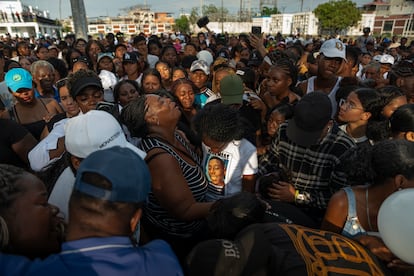
The case of Ismael, Josué, Nehemías and Steven — four Afro-descendant minors who disappeared and were murdered in the city of Guayaquil — revealed the brutality of this situation. Not only because of the irreparable pain of their deaths, but also because the social media trolls attempted to portray them as members of organized criminal groups. They weren’t children: they were “suspects.” They weren’t citizens with rights: they were “disposable bodies.”
To the racist insults — “go back to Africa” — was added the indifference of the state apparatus. This discursive and symbolic violence reactivated a historical memory: plantocracy, the Black statelessness on which the Ecuadorian nation state was founded. From colonial times until today, Black bodies have been viewed as a labor force, not as subjects with full rights. What happened to the four children in the neighborhood of Las Malvinas wasn’t an isolated incident. It’s part of the long-standing racism that structures the nation.
In this context, insisting on living in Ecuador seems like a crazy act. For many, staying is synonymous with condemnation. However, it’s also a gesture of courage. In the midst of violence, spaces emerge that sustain life: community kitchens, reading clubs, writing workshops, support networks among neighbors, as well as artistic collectives that refuse to leave the country and — even from the diaspora — give back to those who remain.
Here, life is sustained in the details. A mother cooks for other people’s children. A workshop brings kids together to write instead of getting recruited on street corners. A popular festival defies the curfew. Persistence isn’t just resistance, it’s also imagination. Because it’s not only about survival, but also about the possibility of narrating ourselves differently. It’s about telling our own stories without intermediaries and inventing shared horizons.
Writing in Ecuador today means working with the background noise of bullets, with the fear of not returning home. There’s the uncertainty that the book will never be published, because there are no state funds to help publishers — who operate in impossible circumstances — willing to take the risk. And writing also means bearing witness, leaving a record and creating openings in the official discourse, which tries to reduce us to statistics.
Here, art is neither neutral nor ornamental: it’s a way of surviving. I think of the Afro-descendant communities that have sustained their memory through songs and spoken word, even during the most terrible moments in history. I think of the murals painted in neighborhoods besieged by fear, of the poems circulating online like small flares that illuminate us.
But creating literature in the midst of violence also poses dilemmas: to what extent is writing enough? Isn’t it naive to believe that a poem can confront hired assassins or state corruption?
The answer is complex. Art doesn’t save us in immediate terms, but it produces memory, opens cracks and generates community. And, in a country where the official discourse seeks to erase, silence, or criminalize, those cracks are vital.
What horizons do we have as artists living here? It cannot just be about idealizing resistance, because resistance also exhausts and sickens. But there are alternatives.
Self-management and community networks. Cultural collectives have shown that, without depending on the state, it’s possible to generate spaces for training, exhibition and circulation.
The diaspora can be an ally. Those who migrate can sustain networks of economic, editorial and symbolic support with those who stay behind. The forced export of bodies can become a circulation of memories and knowledge if we manage to forge horizontal links.
Caribbean thought and Black feminisms are currents that remind us that we are not alone and that our struggles resonate in other geographies that are also plagued by racism and violence.
To serve without a master is to commit to practices of care and creation that don’t respond to state hierarchies or the market. To serve the community, life and collective desire, without being accountable to visible or invisible patterns. To insist on esthetic rebellion against a system that’s only interested in our workforce, in the most dehumanizing sense possible.
To insist on Ecuador, to write from Ecuador, isn’t romanticism. Rather, it’s confrontation and hope. It’s knowing that we’re part of a country that exports us like residue, that militarizes our streets and that despises its young people. And it’s also betting on the possibility of narrating ourselves differently, of weaving life with fragile, yet stubborn threads.
Here, to serve without a master means to continue writing when fear insists on silencing us and to continue creating when the economy insists on reducing us to waste. It’s about continuing to live, when violence insists on burying us. It’s an open commitment to radical, stubborn love.
And perhaps, in that stubbornness, lies the seed of another way of living, another way of imagining. Even in a country armed to the teeth.