Inside the making of the century‑old pot everyone wants
Le Creuset casserole dishes – which turned 100 in 2025 – come from a small French town. EL PAÍS went inside the factory to see how these covetable objects are created


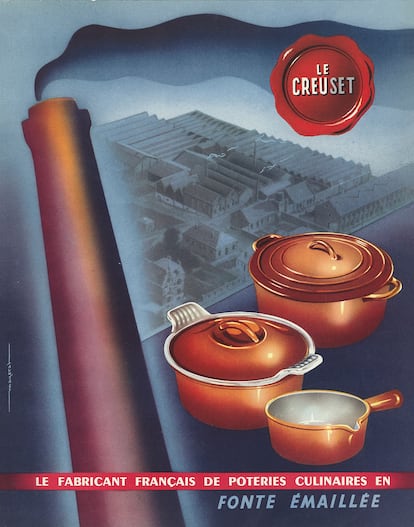
April, 1924. The city of Brussels hosts another edition of the International Trade Fair, where manufacturers from more than 20 countries come to showcase the latest advancements in their respective sectors. There, two Belgian industrialists meet: Armand Desaegher and Octave Aubecq, one a specialist in cast iron and the other in enameling. Together, they begin to craft what will become one of the most iconic cooking pots of the 20th century. Unbeknownst to them, they were sowing the seeds of a century-old kitchenware empire.
A year after this meeting, Le Creuset was born. It was founded across the border, in the town of Fresnoy-le-Grand, located in northern France. This is where Desaegher and Aubecq established their factory. Despite its small size, Fresnoy‑le‑Grand enjoyed a privileged location: the railway line running through it made it ideal for receiving all the raw materials they would need.
EL PAÍS goes inside this factory — now renovated and expanded — to see how the famous enameled iron cocottes are born.
The cocotte, or Dutch oven — a cast-iron pot with a lid — has been around since the 18th century. Its success lies in its ability to distribute heat evenly and retain the moisture in food (hence the reputation that everything cooked inside it tastes better).
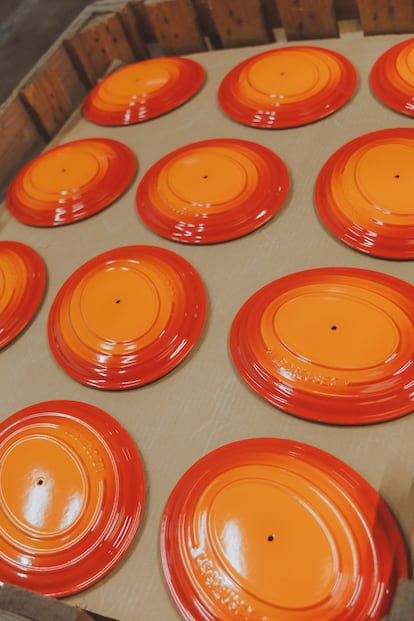
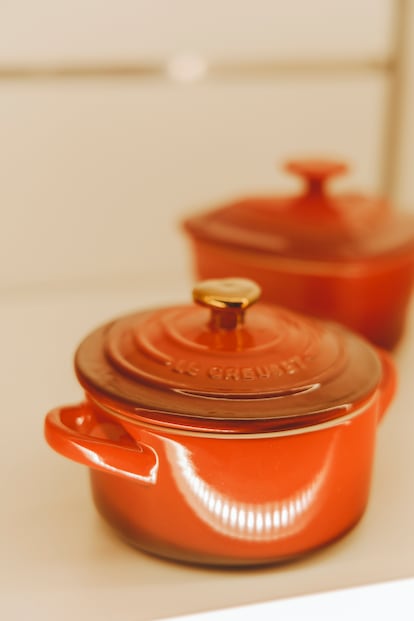
By combining their expertise, Desaegher and Aubecq didn’t invent anything new, but they did improve what already existed. Enameling the iron made the pots more resistant, durable and easy to clean. And applying color set them apart from all the others. They chose the now-iconic “volcanic” orange, a tribute to the incandescent metal that gives rise to their pieces.
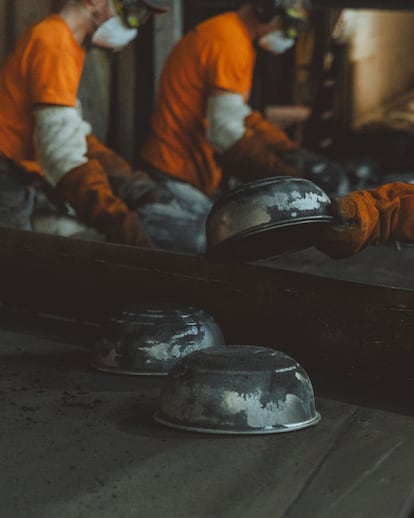
At the entrance to the Fresnoy-le-Grand factory, a small shop displays some of its colorful cocottes in the window. They stand out against the mist that envelops the village on the cold morning of our visit, much like what happens when we step through the foundry gates. Inside, gray tones predominate, but your eyes are drawn to the areas where the brand’s signature orange appears repeatedly: the molten metal and the workers’ clothing (both key players in the manufacturing process).
In Fresnoy-le-Grand, Le Creuset incorporates the latest industrial technology, but the human element remains crucial: each product, we’re told, is inspected by 15 people throughout the entire supply chain. The more than 800 employees who work at this factory ensure that 10,000 cast iron pieces leave the facility every day.
Besides their vibrant colors, Le Creuset pots are known for their prices: the brand’s flagship round cocotte ranges from $175 to over $600, depending on the size. They do, however, come with a “lifetime guarantee,” which justifies the expense as an investment. Looking at their manufacturing process, however, helps you understand more clearly why they cost what they do.
These pots are the result of a balanced combination of technique and craftsmanship. And the process of enameling iron, we’re told, is no easy task. Metal and glass expand at different rates when heated, which poses a problem when you’re making pieces that will spend a significant portion of their lives in a kitchen, in direct contact with fire and heat. The enamel on Le Creuset cooking pots is formulated in such a way that, at room temperature, it remains slightly constricted; thus, when heated, it can expand along with the metal, without cracking.
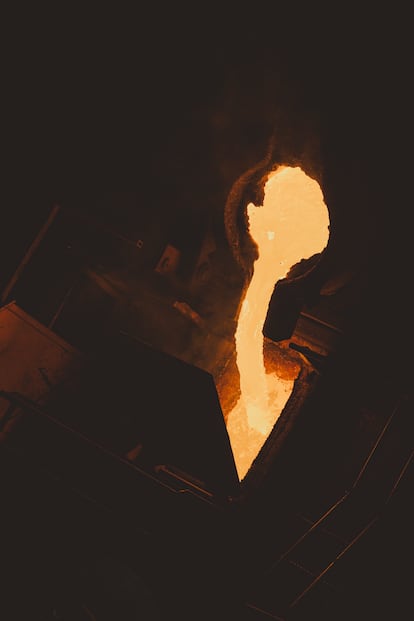
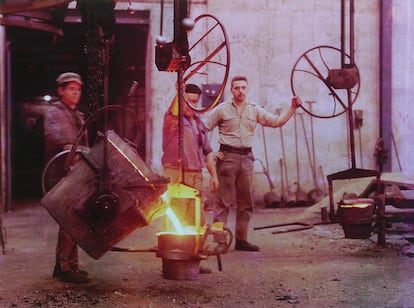
All the cooking pots are made from blocks of iron, recycled steel, rail fragments and leftover material from the manufacturing process itself. These ingredients are combined in the correct proportions (according to the formula) and melted in the crucible, which is the vessel that gives the brand its name and inspired its logo. Once molten, the metal is poured into sand molds — unique to each piece — which are destroyed and recycled after they’ve served their purpose.
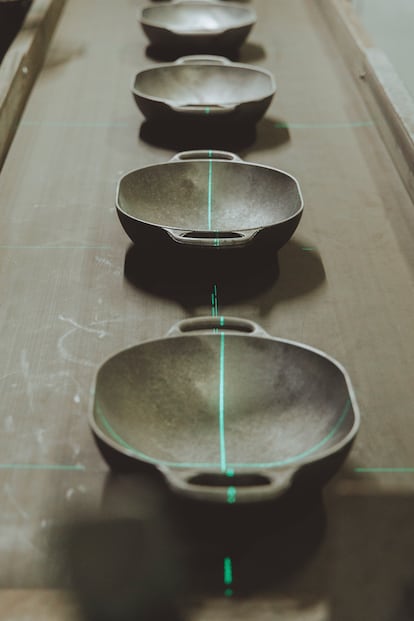
Once cooled and removed from the molds, several operators inspect them as they come off the conveyor belt, in order to ensure that they meet quality standards. Next, robots scan them and file down any burrs resulting from the joining of the two mold halves. These gigantic machines have only been in the factory for five years; before that, this process was also done by hand, by the workers.
“Our problems start with the glazing,” they joke at the factory, alluding to the first challenge that Desaegher and Aubecq had to overcome when they began making their cocottes back in 1925. But first, the pieces must be thoroughly cleaned inside a machine: it sprays them with tiny metal particles, in order to remove any dust and create a rough surface that allows the glaze to adhere. An initial, colorless coat is applied to this surface. Among other functions, this prevents the product from oxidizing.
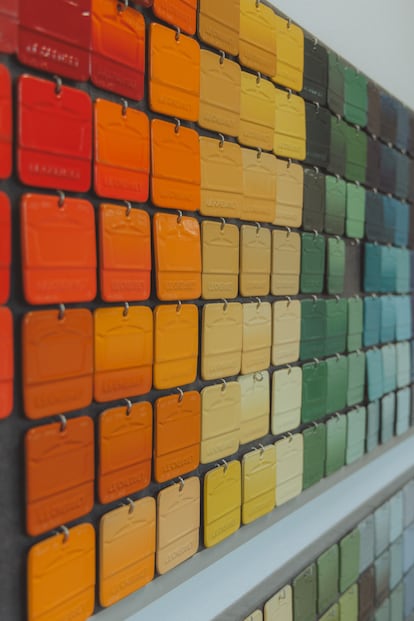
The colored glaze is applied inside special booths, using aerosol cans. It has an appearance similar to paint (even though it isn’t). The mixture contains sand, glass, clay, water and pigments. The only part of the cocotte that isn’t glazed is the rim, where the lid rests. This glaze is removed by hand, piece by piece, with sponges.
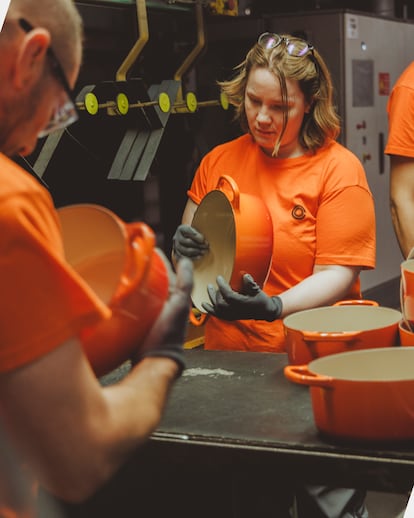
Once dry, the pots are fired, so as to fuse the enamel and metal completely. When the process is finished, several employees again inspect the products for any defects.
The final stop is the packaging area, where items such as lid knobs are added. Each knob is checked to ensure that it fits perfectly with the base of its corresponding pot. The box is then sealed and the label identifying the product’s color is affixed. From there, they’re shipped to one of the 60 countries where Le Creuset sells its cookware.
All the enameled cast iron pieces are produced in Fresnoy-le-Grand, while the ceramic pieces come from the company’s factory in Lamphun, Thailand. The French headquarters also houses a small museum, where visitors can see historical pieces from the brand, such as the cocottes designed by Raymond Loewy, Enzo Mari and Jean-Louis Barrault between the 1950s and 1980s.
Le Creuset hasn’t only managed to survive for a century: the firm has also reinvented itself along the way, maintaining its classic models, while simultaneously innovating with more contemporary designs. In 1988, after a period of stagnation, South African businessman Paul van Zuydam acquired the company, initiating a process of modernization and expansion. He broadened the product range to include stainless steel, ceramic, non-stick cookware, textiles, as well as accessories of all kinds.
Having become aspirational objects, Le Creuset casseroles resonate with new generations. This is thanks to their colorful, Instagrammable aesthetic, but also because of their association with values like quality and durability: they’re objects that endure in a constantly-changing world.
As with previous generations, acquiring one of these pots remains a marker of adulthood. It’s something worth investing in, or even collecting. The brand has also attracted this younger clientele through its “Factory to Table” sales, offering substantial discounts, special editions (including those dedicated to Harry Potter and Pokémon) and new products, like pumpkin-shaped or heart-shaped cocottes.
Who says that a product meant to last a lifetime can’t have many different lives?
Sign up for our weekly newsletter to get more English-language news coverage from EL PAÍS USA Edition