
No justice for the passengers of Flight 164: Deported by Trump, detained by Venezuela, killed in the earthquake
Migrants expelled by the United States are no longer sent to facilities like the hotel where more than a hundred Venezuelans were buried when it collapsed in La Guaira on June 24

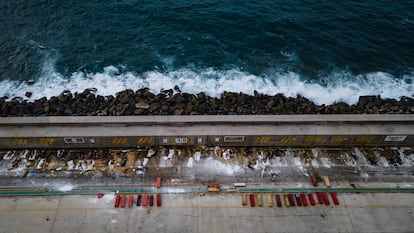
“Ma’am, that’s my husband.” Those words still haunt Danielys Hurtado. A woman said them to her amid dozens of bodies in bags at Los Silos, a former grain-storage complex at the port of La Guaira that was converted into an improvised morgue after the June 24 earthquakes in Venezuela.
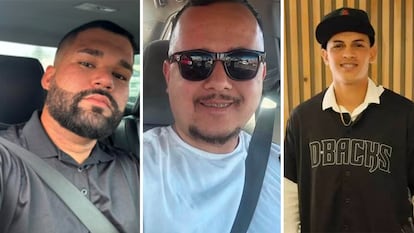
Danielys came frighteningly close to taking home the body of a man who was not her husband. She had spent five days searching for him in La Guaira, a city she did not know and that had descended into chaos, following leads and piecing them together as her fears grew with each passing hour after the twin earthquakes struck Venezuela. Eduardo José Osal Mujica, 32, was one of the 146 passengers on Flight 164, which landed in Maiquetía at 11:40 a.m. on June 24, carrying Venezuelans deported from the United States.
Before setting out on the long journey from Barquisimeto, more than five hours from Caracas, she knew very little about what had happened to him. Using the phone of an officer from the Bolivarian Intelligence Service, Eduardo had called his mother just before midday. “Mom, I’m finally in my country,” he told Danielys’s mother-in-law. His mother asked if she could go pick him up immediately and the policeman on the phone told her no: “We’re going to give him a checkup; tomorrow at 11 p.m. he’ll be at home.” Eduardo, along with all the other deportees, had been taken to the Negra Hipólita Health Hotel in La Llanada. But the families were not even aware of that detail.
According to other friends who had also been deported back to Venezuela, authorities in Venezuela take away their documents, belongings and cell phones, which must be handed over without passwords so police can inspect them. They are interviewed and undergo medical examinations while their criminal records are checked, before being sent back to the cities where they lived before emigrating.
At the heavily guarded four-story hotel, they were kept locked inside. Thousands of deportees arriving on more than 160 flights under the Plan Vuelta a la Patria (Return to the Homeland Plan), a program coordinated between Washington and Caracas since 2025, have gone through the same procedure, which extended the detention they were already subjected to after being taken into ICE custody in the United States.
Venezuelan authorities have said that the stay at the hotel was part of a “triage” process designed to assess the deportees’ health upon arrival. But that procedure changed after the earthquake and the tragedy that unfolded at the hotel. Deportation flights have since resumed through an airport in eastern Venezuela while Maiquetía remains out of service. Deportees are no longer detained in Venezuela. That was the case with the two flights that have arrived in August. Upon disembarking, passengers have their information recorded, undergo medical examinations, and are then immediately transported to their final destinations.
So far, nearly two months after the earthquake, the government has provided no official information about those who died while in the custody of intelligence services following their deportation. The number of survivors is believed to be somewhere between 12 and 32. Some families are still searching for the bodies of their relatives.
Eduardo reached the United States by crossing the Darién Gap. He crossed the border from Mexico, turned himself in to immigration authorities and applied for asylum. His entry process moved quickly. He found work installing roofs, later worked as an Uber driver, and settled in Denver. Earlier this year, he moved to Wyoming in an effort to earn more money when, during a traffic stop, local police detained him. He was transferred through detention facilities in Colorado, Arizona and Texas before signing a deportation order. He kept the document in his trouser pocket, and it was ultimately what convinced Danielys that this time she had identified the right body.
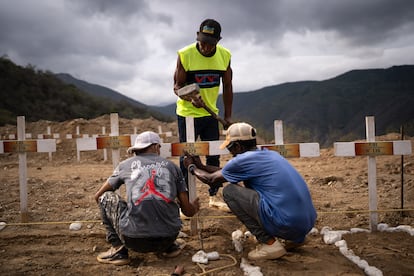
At Los Silos, the bodies recovered from the health hotel were identified with wristbands bearing the word “Repatriated.” The first body Danielys believed was her husband’s had one. The people accompanying her never left the black body bag, following the advice of the forensic pathologists, who from the first days of the disaster had warned that bodies were being misplaced. Danielys had not seen Eduardo for three years, since he had left for the United States. But they had been together for 15 years.
“There, under the heat and the sun, I truly thought it was my husband. That’s why I began processing the death certificate. I had already hired the funeral home, which was waiting to cremate him, because given the state of decomposition, he couldn’t have made it to Barquisimeto. If that woman had come two minutes later, I would have taken another body. God helped us,” she recounts.
As soon as she arrived in Caracas, the first place Danielys went looking was the headquarters of the Bolivarian Intelligence Service (SEBIN). “When I gave them his name, they told me he was at an unknown location, because some ran and escaped. He didn’t show up as dead or alive. That’s when I started to cry.”
Danielys, like other relatives of people on that flight, is haunted by the idea that their tragedy could have been avoided. They organized a WhatsApp group to support each other and demand answers from the authorities. Oswadeliz Núñez, the mother of Daniel Núñez, has insisted that the Venezuelan government has given no explanation of what happened and is organizing with other families to demand justice from officials.
“They were locked in those rooms. The night of the earthquake, I wrote to the numbers on the Vuelta a la Patria page and no one answered me,” she says angrily. “If they have no criminal records, why were they held as detainees? Why doesn’t ICE notify families when it hands a Venezuelan over to the government and why doesn’t the government inform their relatives?” These are some of the questions Oswadeliz cannot stop asking.
Daniel was detained in Jacksonville while driving his vehicle. He had spent four years in the United States, but had left Venezuela eight years earlier, at age 20. That was the last time his mother hugged him.
Latin American families have learned to use ICE’s online detainee locator to track relatives in custody. Communication is limited and costly, requiring money to be deposited from abroad, just as they do to provide decent food while their loved ones are held in U.S. detention facilities. Oswadeliz learned that Daniel had been deported when his name disappeared from the ICE registry on the morning of June 24. He managed to call her about half an hour before the earthquake, using the phone of a SEBIN agent. He told her they would see each other the following day.
“If I had known my son was arriving there, I would have gone to La Guaira to wait for him and taken him home. But he was a victim of the earthquake because he was wrongfully detained,” Oswadeliz says. “When I learned they had detained him and were going to deport him, I made his room as nice as I could, but he didn’t arrive. I received a little box with his ashes.”
In Venezuela, the Plan Vuelta a la Patria repatriation program has yielded few answers for families seeking information about what happened. The documents, money and cell phones Eduardo had when he arrived at the health hotel were never returned. Yet, through tracking one of the devices, his wife was able to determine that it was last switched on in Valencia, after everything had happened. Oswadeliz says that, after repeatedly speaking out on social media, she was able to recover a phone, but not her son’s wallet, which contained his credit cards and identification documents.
Inocencia del Valle González, the mother of 20-year-old baseball player Elomar Alexander Reyes, did manage to travel to La Guaira in hopes of receiving her son there. The young man had been in the United States for only three months when he was detained. He had arrived by plane on a tourist visa with plans to pursue a baseball career. The previous year, he had trained with an Arizona team that had signed him, according to his father, Ivys Reyes.
Elomar’s mother traveled from the state of Sucre, Venezuela’s easternmost state, a 10-hour journey from La Guaira. She was there on the day the deportation flight landed and somehow made her way up to the hotel perched on a hillside. She managed to record a video showing some of the newly arrived deportees outside the facility. One of them had bleached blond hair like her son’s, but it was not him. Police officers told her the deportees would be released the following day.
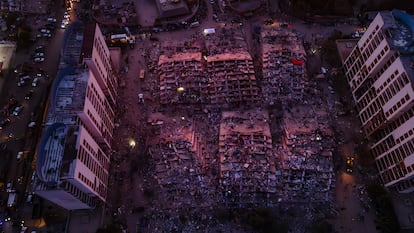
Inocencia decided to spend the night with friends living in the OPPPE 26 housing complex in Caraballeda, which, along with the hotel where her son was being held, was completely flattened by the twin earthquakes that struck later that day.
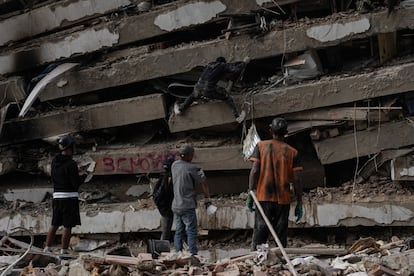
The next day, Ivys traveled from Bolívar state, in southern Venezuela, to Caracas. He went straight to the hospital morgue where his son’s body had been taken. Authorities handed over the body, but not any of his documents or personal belongings. He arranged the funeral and then spent five days helping dig through the rubble in search of his ex-wife’s body, until he ran out of leave from the state-owned company where he works.
“She never got to see him or take him home,” he says. Inocencia’s body was recovered nearly a month later.
Sign up for our weekly newsletter to get more English-language news coverage from EL PAÍS USA Edition









































