An underwater window on World War I
Turkey seeks to preserve the shipwrecks from the Gallipoli battle as divers and researchers document their findings in the surrounding deep waters

Under the clear summer sky, waves break on the rocky Anzac Cove with a rhythmic, hushed solemnity, almost as if unwilling to disturb the dead. From the water, the earthy cliffs of Ariburnu, cloaked in pines and junipers, look impregnable; one wonders who in their right mind would choose to launch an invasion precisely here.
But that was the idea of the British Admiralty, led by Winston Churchill, which on the night of April 25, 1915 ordered the landing of the Australian and New Zealand Army Corps (ANZAC) intending to seize control of the Dardanelles and sail on to Istanbul, forcing the Ottoman Empire out of World War I.
Only that first night hundreds of young men died on each side as the Ottomans fiercely defended their positions, resisting bombardments from naval vessels and wave after wave of recruits — turned into cannon fodder — during 10 months in what is today one of the great feats etched into Turkey’s collective imagination. In December 1915 the Allied command finally ordered a withdrawal, leaving behind more than 100,000 dead and several dozen wrecked ships, sunk by mines, German submarine torpedoes, or scuttled by their own crews to prevent capture by the enemy.
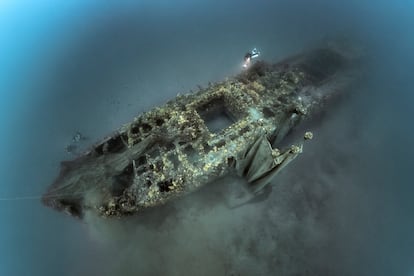
Between turquoise waters a swim from the shore, and at just five meters of depth, lies one of those ships: the SS Milo, a steamship used as a landing platform. Corroded by time and currents, only the keel and ribs remain, covered in posidonia and algae, but it is easy to reach even by free diving.
The neighboring Suvla bay shelters another wreck, at 13 meters deep: the HMS Louis, an 82-meter British destroyer engaged in rescue operations that in October 1915 collided with a tug and ran aground until it sank completely. Today part of the wreck lies buried in the soft seabed sand, but on the exposed section the massive Yarrow boilers, cannon-like in appearance, are visible; marine life inhabits them and bright yellow anemones have grown on them, as if the sea wanted to perform one final act of pacifism by neutralizing the weapons and warships much like those who, in the 1960s and 1970s, placed flowers in soldiers’ rifles.
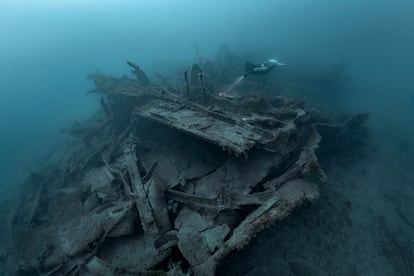
Across the Gallipoli peninsula there are dozens of wrecks like these, which Turkish authorities have now turned into an underwater park, a genuine treasure for lovers of diving and history. Beyond their structure, in some — deeper — wrecks the cabins, weapons, engine rooms, protective nets and even personal belongings of officers and sailors are clearly visible. “Diving into them is like stepping into a time tunnel,” says Ismail Kasdemir, director of the Gallipoli Historic Site, at the opening of a conservation project to which this reporter was invited.
So far, 19 of the 36 identified wrecks have been opened to diving. But there is a problem: since experts from Turkey’s Scientific and Technological Research Center (Tübitak in Turkish) and several universities began identifying and documenting the wrecks last decade — besides the underwater surveys, they are being modeled with 3D images — they realized that, because of climate change and rising water temperatures, the remains of the ships had already begun a process of rapid deterioration. If nothing were done, they would disappear within half a century.
Oxidation is an electrochemical process in which the metal of the hull acts as an anode that loses electrons when in contact with salt water. To slow it, the Ministry of Culture and Tourism this year began implementing a cathodic protection method similar to that used on bridges and offshore oil platforms. The system connects the wrecks via underwater cables to zinc blocks that act as sacrificial anodes, so the electric current causing corrosion is diverted to the zinc, causing it to corrode instead of the historic ship structure.
But these are experimental methods — also used on wrecks in Australia and Croatia — and it is unclear how they will perform on sunken vessels where rust has already penetrated several layers beneath the surface. At least, authorities hope, “it will slow the deterioration.” “It is our responsibility to preserve this legacy to pass it on to the future [generations]” argues Kasdemir.
Sign up for our weekly newsletter to get more English-language news coverage from EL PAÍS USA Edition