
Hope in atoms: A new method to search for missing migrants in Mexico
Argentine experts will join identification efforts by using stable isotopes found in bodies and remains to understand which country or region they came from
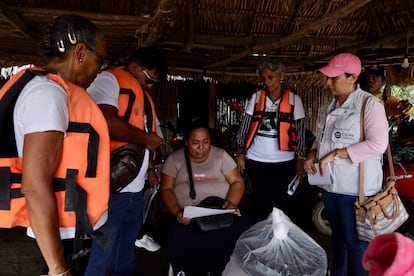
“Where do the disappeared people in Mexico come from?” That is the question Dr. Luciano Valenzuela, a biologist, posed as he opened the workshop the Argentine Forensic Anthropology Team (EAAF) organized to explain a new search method. It will be part of a project carried out over the next three years in Mexico and Central America to shorten the search for migrants who have disappeared on Mexican territory.
The forensic tool will make it possible to determine which country or region remains or bodies belong to when they have no identification, are in mass graves, or in morgues. That way authorities can be more certain whether the physical traces found correspond to a migrant. Mexico continues to suffer a human rights crisis that has left over 133,000 people missing and at least 72,000 bodies and human remains unidentified, according to a report titled “Diagnosis on the forensic situation in Mexico,” prepared by the Plataforma Ciudadana de Fosas, an initiative of the nonprofits IBERO, Data Cívica, and Article 19.
EAAF’s method is based on the analysis of stable isotopes to speed up the process. Isotopes are atoms or small units found in the chemical elements of the body and of planet Earth and, in this case, they are stable because they were formed long ago and do not change. The analysis to be applied measures the chemical composition of human tissues to determine the geographic regions where a person lived. This is possible thanks to the abundance of chemical elements that accumulate in the human body and are related to diet: based on what a person ate or consumed, one can determine their country of origin by comparing the chemical elements in the physical remains with those of Central American territories.
This is explained by Dr. Valenzuela, who will be responsible for the scientific analysis component of the project. He will conduct this work from the Laboratory of Human Evolutionary Ecology at the National University of Central Buenos Aires (UNICEN), where he works as a researcher.
The databases
The tissues that can be studied include collagen, tooth enamel, and the chemical elements of hair and nails. For that reason, the initiative will also create a database of samples to be obtained through partnerships between Central America and Mexico, according to Argentine anthropologist Mercedes Doretti, founder and program director for Central and North America at EAAF.
EAAF is a scientific institution that applies methodologies and techniques from different branches of forensic science for investigation, search, recovery, determination of cause of death, identification and the return of missing people. It was founded in 1984 at the request of the families of victims of Argentina’s dictatorship, who asked that independent anthropologists, archaeologists, and forensic specialists carry out the exhumations ordered by various judges.
Its work expanded worldwide and, in 2009, it launched the Border Project for the forensic search for missing migrants who were unidentified or unclaimed along the migration corridor formed by Central American countries, Mexico, and the United States. Between 2010 and 2025, through this initiative, 2,480 missing migrants were recorded and 444 identifications made. The largest number of missing migrants come from Central America, especially Honduras, El Salvador, and Guatemala.
Doretti says they plan to seek other collaborations, mainly with dental associations, since teeth extracted at dental clinics can be useful for identifying the chemical components of people from different Central American countries to be added to the sample database.
The director also notes that all of this is part of the forensic work with a migration perspective carried out in Mexico, in which they aim to separate data and records related to missing migrants to facilitate their search.
In addition, Luciano says that with the developed databases it will be possible to make measurements that connect the origin of the chemicals analyzed in recovered skeletal remains with no identity-linked information.
Search for justice
While EAAF presented the new methodology, relatives of the 83 migrants who disappeared off the coast of Chiapas, Mexico, between September and December 2024 arrived in that border state to begin the first real search operation for their loved ones.
EAAF’s founder stresses that family search committees have always been their best allies. As of December 31, 2025, families had contributed 6,290 genetic profiles, which have been compared with bodies or physical remains without identification held in Mexican morgues. Doretti believes the stable isotope analysis project will be no exception and that family members will likely be the primary seekers of sample donors.
Fabianne Cabaret, director of the Justice Foundation, explains that this new technique is an opportunity for families, authorities, the Mexican government and organizations. The foundation was created in 2011 to provide transnational legal support and accompaniment to Central American families seeking justice for relatives who were victims of massacres, enforced disappearance, kidnapping, and trafficking in Mexico.
The new alliance could do a lot: they still need to identify nearly 100 bodies from the cases they are assisting on, including those from clandestine graves, the Güémez massacre and the massacre of 72 migrants in Tamaulipas — a crime that exposed the violence migrants face in Mexico and shocked an entire region.
Sign up for our weekly newsletter to get more English-language news coverage from EL PAÍS USA Edition









































