
The volunteers who hug babies who are alone in Chile: ‘It’s amazing how the children blossom’
The Abrázame Foundation is promoting a pilot program to support infants just weeks and months old and provide them with a key emotional bond in their development
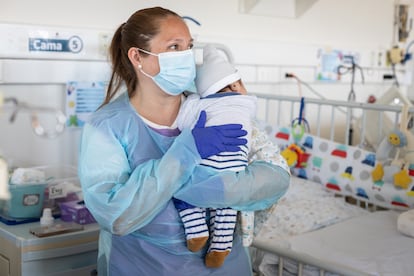
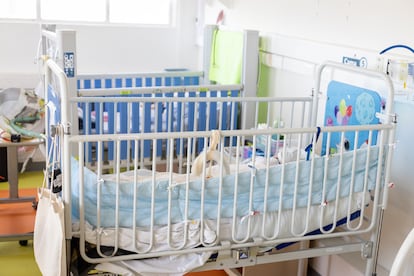
He just turned two months old and, though healthy, remains in the Pediatric Unit of San Juan de Dios Hospital, part of Santiago de Chile’s public health network. It’s also unclear when Esteban—a pseudonym for this story—will be discharged. The reason he is still hospitalized despite not being ill is that he has no mother or father to care for him. This is the situation faced by dozens of babies in Chile who remain in hospitals after birth because they were given up for adoption, abandoned, or because their parents are unable to care for them.
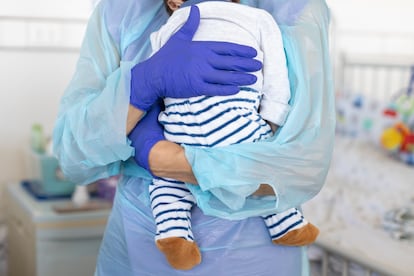
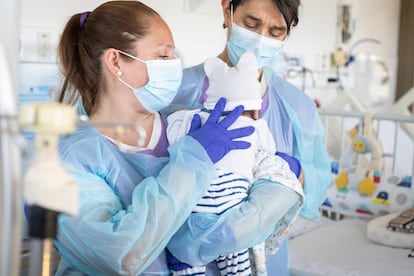
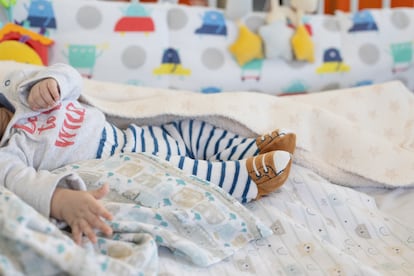
However, Esteban sleeps peacefully in the arms of one of the two volunteers who have committed to providing him with a stable, daily emotional bond until he can go live with his biological, adoptive or foster family, a process that could take up to two years.
This is a pilot program by the Abrázame Foundation to prevent what is known as chronic emotional deprivation, and to help young children without their parents achieve better development, both in terms of nutrition and neurological development, as well as in their emotional bonds and interactions—something that occurs in the first hours, days, and weeks of life. Otherwise, there is a risk that the baby will become withdrawn and develop future psychological and behavioral problems.
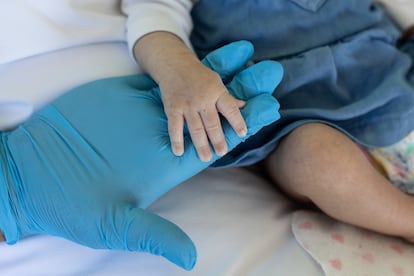
The psychiatrist and psychoanalyst Eduardo Jaar, considered the inspiration behind this initiative, explains to EL PAÍS that “the newborn is an eminently social being, seeking contact from the very first moments of life (...). Skin-to-skin contact with their caregiver, holding the baby, fosters an adjustment of muscle tone and reciprocal body posture between the child and the adult. This adjustment has a containing effect on the baby’s emotions.” He adds that the repetition of “certain behaviors promotes familiarization, learning, anticipation, and the attribution of meaning to actions in the baby.” This fosters the “establishment of primitive bonds” between the baby and their caregiver, which are the “foundation of their emotional development.”
But when all of that is missing, the baby, among other things, is more prone to illness, as there is a “global delay in development, loss of appetite, a tendency to withdraw, and avoidance of contact with adults,” Jaar explains. “The child will develop a pattern of early emotional and sensory deprivation,” she says.
A report by the media outlet The Clinic, from March 2025, estimated that at least 400 babies had been placed in the care of Chilean hospitals since 2018 due to abandonment, adoption, or because their parents were unable to care for them. This situation has only gotten worse in recent years, and the problem is further complicated by the long wait these newborns and young children face for a family court to decide their future.
For the pediatrician and neonatologist Carolina Méndez, head of the Neonatology Service at San Juan de Dios Hospital, a medical institution is not a place for healthy children. “We regret that children are hospitalized because there is nowhere else for them to wait for their family [biological, foster, or adoptive], because a judge keeps them here for months,” she tells EL PAÍS. “A hospital is not a place for a healthy child. There are children here with illnesses, there are infections,” she explains.
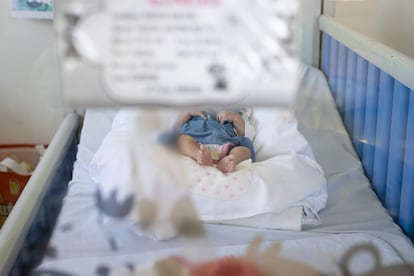
Furthermore, young children who are not regularly visited by a loved one in the hospital do not receive the care, attention and bonding they require. Bárbara Valdivieso, a psychologist in the Neonatology Department at San Juan de Dios Hospital, states that babies need “another person to build what will become their mind, all their psychological traits.” That person—the mother, the father—must be someone stable over time, whose hands, smell, and voice the baby recognizes, thus establishing an emotional bond. In this process, “at first, babies are more demanding, they cry more, they become more irritable. They are trying to get the world to hold them in some way. But if this continues [and no one attends to them], eventually, a point is reached where that baby stops crying, stops having this contact with the world, no longer makes eye contact, and sleeps a lot. This means that this child is psychologically shutting down because they don’t have the support they need,” says Valdivieso.
“If we get there early, the story changes”
In order to help these babies, just weeks or months old, the hospital joined a pilot program of Abrázame (Hug Me), a foundation that emerged in 2015. It began with a program supporting children in residential care facilities. According to official figures from last December, 5,190 children currently live in these types of homes. The initial Abrázame program now involves some 450 volunteers, working weekly in 22 residential facilities in the Metropolitan, Valparaíso, O’Higgins, and Biobío regions, where nearly 500 children, ranging in age from zero to 18, reside.
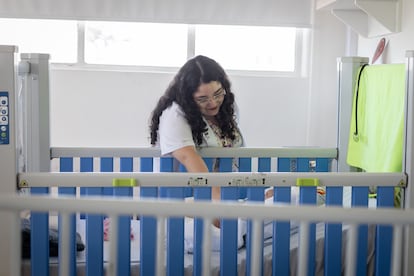
In 2024, with the support of Dr. Jaar, the foundation decided to move forward and create the Abrázame Más (Hug Me More) program, still in its pilot phase, providing daily support to babies. A call for volunteers was issued, and after months of selection and preparation, eight volunteers began working with four babies in a residence in the Providencia district of Santiago.
It’s a very long preparation process because, as Cecilia Rodríguez, executive director of Abrázame, says, “the commitment is indefinite, until the child goes to their birth, adoptive, or foster family, and that can be anywhere from three months to two years.” The volunteers have to do intense work because the caregivers at the residential facilities “do everything possible to be present [with these babies], but working with 15 or 20 children is nonstop activity. They don’t have the time to dedicate to one. And they can’t, because the others also require assistance.”
Two volunteers are in charge of a baby, and they must visit daily for at least two hours, Monday through Sunday, for at least the first three months, to build a bond. After that, they can take turns. “The key is commitment, not missing a day, love… and it’s amazing how the children blossom,” she tells EL PAÍS. “That’s why preparation, support, and follow-up are so important,” Rodríguez says, explaining that, for now, the lack of financial resources to have a team of professionals to support the volunteers prevents the Abrázame Más program from moving beyond its pilot phase.
Last year, Abrázame reached an agreement with San Juan de Dios Hospital to help babies who are not being visited. “We know that if we get there early, the story changes,” Rodríguez emphasizes. Thus, a new call for volunteers was made, and 10 were selected and trained.
Two of those volunteers, after five months of preparation, have been accompanying Esteban since January. Every day at 11:30 a.m., Marjorie Jiménez (48) arrives at San Juan de Dios Hospital and is relieved at 2:00 p.m. by Jacqueline Duhalde (58). They bathe him, change his clothes, and give him his bottle. They also rock him, talk to him, sing to him, and tell him about their own lives. They even take his clothes home to wash them.
“He has been very receptive to us. The first time I held him in my arms, my heart ached, because I thought: just a few days old and he already has to fight such a big battle,” says an emotional Jiménez, while the baby ignores the noise of the visitors and continues his peaceful and protected sleep.
Sign up for our weekly newsletter to get more English-language news coverage from EL PAÍS USA Edition









































