
Trump says Putin agreed to stop strikes on Ukraine’s cities for a week
The US president says the Russian leader has promised to stop bombing as freezing cold temperatures grip the country
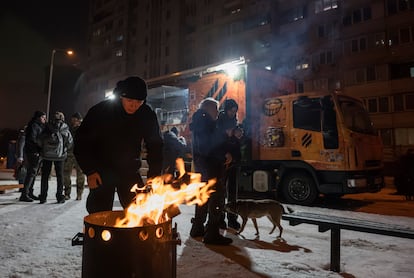
U.S. President Donald Trump announced on Thursday that his Russian counterpart, Vladimir Putin, has agreed to a temporary halt in the periodic bombings that are destroying Ukraine’s energy system. “I personally asked President Putin not to fire into Kyiv and various towns for a week, and he agreed to do that,” Trump said in Washington.
The Kremlin has not confirmed the halt in strikes. Earlier in the day, Putin’s spokesperson Dmitry Peskov avoided commenting on reports of a possible agreement limited to energy infrastructure, telling reporters: “No, I can’t comment on that yet.”
If confirmed, the pause would offer a brief respite from the severe conditions Ukrainians are facing in major cities. With temperatures expected to fall below –20°C (-4ºF), millions are living without hot water, electricity, or heating. Trump said that he framed his request to Putin as an act of clemency given the dire situation. The Ukrainian government considers Russia’s destruction of the energy system a war crime, a view also supported by the European Commission.
Ukrainian President Volodymyr Zelenskiy thanked Trump for his mediation and said the possibility of a halt in strikes on energy infrastructure had been discussed between Ukrainian and Russian delegations during last week’s trilateral meeting in Abu Dhabi: “Our teams discussed this in the United Arab Emirates. We expect the agreements to be implemented. De-escalation steps contribute to real progress toward ending the war,” he posted on X.
Zelenskiy’s remarks suggest Ukraine would also suspend its drone strikes on Russia’s oil sector and the electrical grid in regions near the border.
This would be the second temporary truce of this kind brokered under Trump’s auspices. The first, agreed in March 2025, lasted until August, when Ukraine resumed attacks on Russia’s oil and gas industry to weaken its exports. Russia restarted its campaign against Ukraine’s electrical grid in the fall.
Iuliia Mendel, Zelenskiy’s former spokesperson, criticized the decision to resume strikes on Russia’s energy sector in 2025, saying: “The economic impact of Ukraine’s deep strikes inside Russia doesn’t even come close to the devastating damage Russia inflicts on Ukrainians every day.” She confirmed that Washington had been pushing for a new truce.
Russian Foreign Minister Sergei Lavrov gave an interview ahead of the third round of Abu Dhabi negotiations scheduled for Sunday. The bilateral meeting is not expected to lead to major progress. In addition to demanding control of the entire Donbas region, Lavrov insisted that the Kremlin wants more.
The veteran Russian diplomat likened Zelenskiy to Hitler and Napoleon, and accused the U.N. Secretary-General António Guterres of “clearly playing into the hands of those who want to keep Ukraine’s Nazi regime in power.” He reiterated that Russia’s aims include not only occupying Donbas but also installing a puppet government in Kyiv. “We keep hearing claims that security guarantees are the key to preventing this conflict from re-igniting. They are the key to open an absolutely different door, though,” said Lavrov.
Lavrov added that Russia has not seen the full 20‑point plan promoted by Kyiv and Western governments, claiming that “even the provisional versions do not include the requirement to respect the rights of national minorities,” added the Russian minister, using this as a pretext to justify further expansion of the invasion of Ukraine. Furthermore, Lavrov reiterated that a complete ceasefire is unacceptable to Moscow, arguing that Ukraine has used every respite to “round up people in the streets of Ukrainian cities by droves and ship them to the front.”
Sign up for our weekly newsletter to get more English-language news coverage from EL PAÍS USA Edition









































