
Battle for the skies redefines the war in Sudan
In the last year, paramilitaries have gained a notable aerial presence, especially with drones, challenging the army’s superiority and wreaking havoc among the civilian population
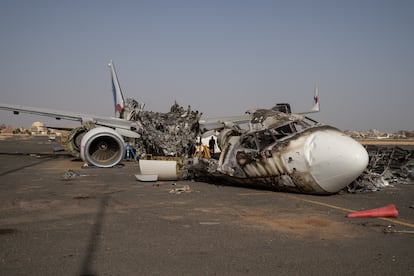

In early January, a swarm of drones descended from the skies above the city of Merowe in Sudan’s North State. The regular army reported a few hours later that they had been launched by the paramilitary Rapid Support Forces (RSF) and shot down before hitting the country’s largest dam and nearby military installations. Just days later, hundreds of miles away, the rebels boasted of intercepting an army drone as it flew over Nyala, the capital of South Darfur and one of the RSF’s strongholds.
Although the exchange of blows did not result in major setbacks, it reflects the transformation the war in Sudan has undergone in the last year. In 2025, the RSF, which receives substantial support from the United Arab Emirates, evolved from a predominantly ground force to one with a significant air power projection, enabling it to challenge the Sudanese regular army’s traditional air superiority. This reconfiguration has also led the conflict into a more sophisticated phase, with serious consequences for the civilian population.
The main factor in this shift in the balance of power has been unmanned aerial vehicles (UAVs). The army has Turkish-made Bayraktar TB2 and Akinci drones, has used Iranian aircraft such as the Mohajer, and has recently developed its own models like the Safaroog, with a range of around 370 miles. The RSF, for its part, has primarily deployed versatile drones of Chinese design, such as the FH-95 and CH-95, at least some of which were manufactured in Serbia and likely supplied to the group by Abu Dhabi.
In 2025, the conflict monitoring organization ACLED recorded 472 drone attacks by the two main warring factions in Sudan, a marked increase from 277 the previous year and 152 in 2023, after the war erupted in April of that year. Evidence of the fierce struggle for control of the country’s skies, the army carried out 57% of the attacks and RSF the remaining 42% (201), even though between 2023 and 2024 they had conducted only 22 such operations.
Geographically, 88% of drone strikes last year were concentrated in Kordofan, Darfur, and Khartoum — the major combat zones, according to ACLED data — confirming their increasing use on the battlefield. However, the other 57 strikes hit states far from the front lines, suggesting an attempt to spread violence and erode public trust in areas controlled by the opposing side. In 2023 and 2024, these attacks struck nine states, while in 2025 all 18 Sudanese states recorded at least one.
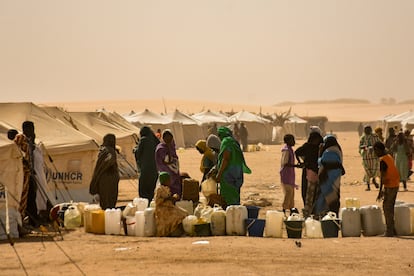
The impact on the civilian population has been enormous. Since the start of the war, drone strikes have resulted in at least 2,200 deaths, 80% of them in 2025, according to data from ACLED, which indicates that the majority were caused by the military. One of the deadliest incidents, attributed to the RSF, occurred on December 4 in Kalogi, South Kordofan, when a drone first attacked a kindergarten, then those who came to the aid of the wounded, and finally the hospital where the victims were taken. Some 79 people died, including more than 40 children. On December 25, another attack, this time attributed to the military, killed 12 people who had gathered to celebrate Christmas in the village of Julud, in the Nuba Mountains in the south.
Drone strikes have also targeted civilian infrastructure such as power plants, refineries, and hospitals, causing blackouts, shortages, and disruptions to basic services. The UN warns that these attacks could constitute war crimes. Even foreign observers have not been safe. On December 13, an attack attributed to the RSF on a UN peacekeeping force base in South Kordofan, in Abyei, a disputed area between Sudan and South Sudan, killed six Bangladeshi soldiers.
Defense and interference systems
Beyond drones, the RSF has developed sophisticated integrated air defense systems over the past year, including man-portable short- and medium-range surface-to-air missile platforms. They are also increasingly deploying jamming systems to disrupt or disable military electronics. In their brutal takeover of El Fasher, the capital of North Darfur, in October, the RSF made extensive use of all these new capabilities, often with the assistance of foreign mercenaries.
Since the RSF lacks conventional planes, the army still maintains a certain advantage with manned aircraft. But the growing air power of the paramilitaries is also challenging this superiority. In 2024, the regular forces carried out 919 airstrikes with manned aircraft, the vast majority on major battlefronts, according to data compiled by ACLED. In 2025, however, the figure dropped to less than half (446).
Furthermore, since April of last year, with the sole exception of August, there has not been a single month in which the military has carried out more than 50 manned aircraft strikes, something that had only occurred three times since August 2023. This suggests increasing caution on the part of the military leadership, which has already seen several of its aircraft shot down by the RSF. As a precaution, the Sudanese army transferred some aircraft to neighboring Eritrea last year.
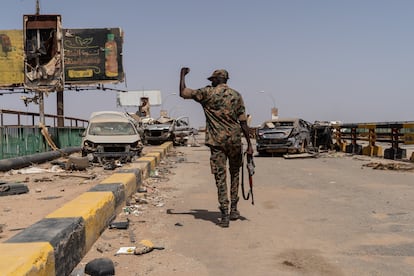
This gap is even more pronounced when compared to the situation just over a year ago. In September 2024, when the army launched a series of operations on multiple fronts in Sudan, putting it on the offensive for the first time, it was precisely the month in which it carried out the most manned airstrikes (153), according to ACLED data. The following month, the number again exceeded 100. Since then, however, the figure has plummeted. In an attempt to reverse this trend, the army is currently finalizing a major deal with Pakistan that includes fighter jets, drones, and air defense systems.
As with drones, airstrikes have had a serious impact on the civilian population. Since the start of the war, these military attacks have resulted in at least 4,500 deaths, according to data from ACLED, which includes both civilian and military casualties. Similarly, the investigative platform Sudan Witness, which has documented 384 airstrikes, reports that more than half of them hit civilian areas, including residential neighborhoods, health and educational facilities, markets, and camps for displaced people.
Sign up for our weekly newsletter to get more English-language news coverage from EL PAÍS USA Edition









































