
Sharks become easy prey for criminal groups
Los Choneros, the reigning criminal organization in Manabí, Ecuador, is linked to shark hunting and finning, complimentary activities to its primary trade of drug and fuel trafficking
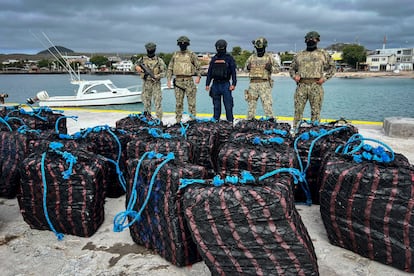
In February 2023, an article in the Mexican press announced the capture of a vessel some 195 nautical miles from the port of Lázaro Cárdenas in the state of Michoacán. It had been carrying nearly 700 pounds of cocaine packaged in plastic-wrapped bricks, in addition to 1,650 liters of hydrocarbons in 33 plastic containers.
Two Ecuadorian fishermen were among the five detainees, and their immigration records showed unusual activity. Both had arrived by air from Mexico, Guatemala, and El Salvador on several occasions since 2016. But there were no records of them leaving Ecuadorian soil by plane. Apparently, their movements followed a pattern: they departed from the coast of Manabí province with illegal cargo that they delivered on the high seas, then abandoned their boats, only to return to their country of origin on commercial flights.
The drug trafficking organization to which the detainees in Mexico belonged was headed by Leonardo Briones Chiquito, alias “Iguana” or “Mexicano.” He got his start as a fishing boat captain, and was well-versed in the secrets of the sea. Briones Chiquito had close ties to the criminal group Los Lobos, which fights for control of maritime routes in the Pacific with rival organization Los Choneros. The latter group has dominated illegal activity, particularly off the coast of Manabí. Los Lobos, a dissident faction, spread throughout the country, and expanded its criminal portfolio to include extortion, illegal mining, and kidnapping.
Ecuadorian officials have been able to document Briones Chiquito’s criminal group through wiretaps, surveillance, and raids that were conducted over a year. EL PAÍS gained access to judicial proceedings that reveal the drug-related criminal activity now includes trafficking in marine species.
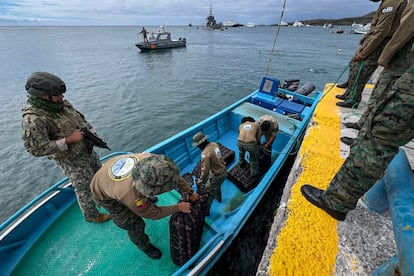
The investigation revealed that the organized crime group had personnel dedicated to recruiting sailors to transport packages of drugs in speedboats from Manabí ports like Jaramijó. When they detected nearby law enforcement, crew members would quickly toss the packages of drugs into the ocean. Sometimes, they installed geolocation devices onto satellite buoys in order to recover the packages and avoid reprisals from their higher-ups, who have been known to kill underlings over loss of merchandise.
Members of Briones Chiquito’s organization found out that the vessel had been detained in Mexico when one of the Ecuadorians who had been apprehended was able to call his spouse. Later, they organized another excursion to rescue the merchandise that had been jettisoned.
Drugs in the water
Communication between the fishermen was intercepted during the investigation. “Light a candle for the Virgin Mary for us to be able to move forward. They saw drones on the high seas and threw the jute bags overboard,” runs an extract from one of the infiltrated conversations. In another exchange, they explain how the boat was transporting “Colombian inspectors” and that its engines were new, suggesting that they may be able to operate at higher speeds. In another excerpt, they asked who had caught the “fish.”
Briones Chiquito was linked to the investigation carried out by Ecuadorian law enforcement. He did not receive a prison sentence, and was instead ordered to report periodically to the court. When authorities raided his properties in relation to a different criminal investigation, this time tied to money laundering, they found a three-foot alligator at the home of one of his relatives.
In mid-July 2025, Briones Chiquito and his wife were fatally shot by hitmen while traveling in a luxury armored car guarded by former members of the military. In response to the killings, a wave of violence broke out in Manabí on the night of the crime in which 18 people lost their lives.
The money laundering investigation continued, eventually uncovering links between a fishing business specializing in seafood exports and the criminal organization. The company had laundered $17 million between 2021 and 2024, according to authorities.
Contraband fins
In August 2018, the U.S. Coast Guard cutter Tahoma intercepted a ship carrying 16 packages containing 1,700 pounds of cocaine. Five crew members — two Mexicans and three Ecuadorians — were arrested and taken to Florida. Six satellite phones and GPS devices were also found on board.
So began a transnational investigation that ended up lasting three years, and that unmasked a narco-trafficking organization in alliance with the Sinaloa Cartel. From the coast of Manabí, a fleet of at least 10 ships transported petroleum to fuel vessels waiting in the Pacific Ocean. Speedboats carried sacks of cocaine to Central America, Mexico, and the United States. Along the way, they passed by the Galapagos Islands to the south.
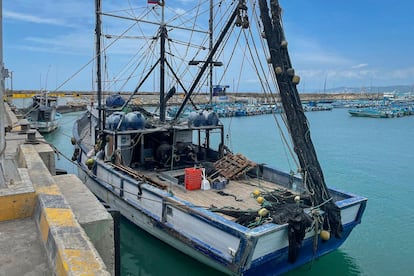
Investigators detected that certain vessels left the illicit merchandise and later caught sharks using longline fishing, a technique that consists of a long, thick line with hooks attached at regular intervals. In Ecuador, a regulation has been in effect since 2007 to encourage small-scale fishing that allows sharks caught “accidentally” to be kept and sold.
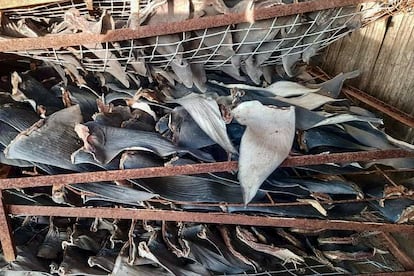
An official who investigated the group confirmed to EL PAÍS that catching sharks served as a complimentary activity to the trafficking of drugs and fuel. The fish were killed for their fins, which were then transported to the Galapagos Islands to be preserved and stored. Fin shipments were later sent to China, where they are seen as a gastronomic delicacy and attributed with aphrodisiac properties.
Ecuadorian courts charged the group with drug trafficking, but not for crimes related to the illegal capture of marine species. Despite evidence that was presented in court, two of three judges who initially oversaw the case did not find the individuals guilty.
According to Colonel Carlos Ortega, director of the Anti-Narcotic Police between 2024 and 2025, two fishing boats were intercepted navigating the outskirts of the Galapagos Islands. In total, they had been carrying 27 tons of shark fins destined for Asian markets. The most recent capture took place on August 10 when the U.S. Coast Guard detained a fishing boat that was transporting 10 tons of fins. 18 Ecuadorians were apprehended, 13 of whom were from Manabí, two from Esmeraldas, and one from Quito. Another operation took place in April 2024 that was part of the so-called Operation Phoenix 113, in which the U.S. Navy and Coast Guard seized 16.6 tons of fins.
On both occasions, according to Colonel Ortega, the fishermen were navigating close to the Galapagos along the route used to traffick cocaine to Central America and the United States. Authorities think they had previously used the vessels to transport cocaine from Ecuadorian ports. After delivering the drugs, the sailors, who work for criminal groups like Los Choneros, fished for sharks to later sell the fins to intermediaries from the Chinese fleet that fishes for a good part of the year in international waters near the Galapagos.
Guido Núñez is a security and organized crime consultant. He belonged to an elite police unit that began to detect the presence of drug trafficking vessels at the end of the 1980s. For several years, he has investigated criminal groups and environmental offenders. Núñez found a series of holes in official oversight. Up until mid-September, fishermen were receiving state-subsidized fuel, but there was no mechanism that prevented it from being used for drug trafficking. He also found that sharks trapped by longline fishing were being harvested for their fins. Typically, their fins are removed and on occasion, their bodies shipped to Manabí ports, where they were then sent on to Quito. There they were sold, labelled as corvina fish, in city markets.
Criminal groups on the high seas
Los Choneros is the dominant criminal group on the Pacific Ocean, according to retired police general Freddy Sarzosa. “Fishermen engage in these acitivites because of the insecurity at sea,” he says. “They are attacked by pirates, who steal their outboard motors, but there are also critical factors like the lack of job alternatives and the precarious nature of employment.”
Manabí has an ancestral tradition of fishing. Local fishermen are experts at navigating without technological instruments, and that expertise is exploited by criminal organizations, says Sarzosa.
A trip to transport drugs by sea can mean a payment of between $10,000 and $30,000 for fishermen, when successful. But there are enormous risks. Generally, half of the payment is received upon completion of the deal. Some are extorted when they receive their pay.
There is also a considerable risk of being intercepted by maritime authorities. In such cases, fishermen often opt to throw their illegal cargo into the sea. Once captured, they are taken to prisons in Central America, Mexico, or the United States. According to organizations of spouses and family members of fishermen who have been apprehended outside of Ecuador, there are hundreds of such detainees in other countries who are not allowed to communicate with their embassy.
When merchandise is lost, the fisherman’s family can suffer retaliations. “It’s a complex problem that has gotten worse. The family is left in a vulnerable state. That should drive public policy to deal with the issue,” says Núñez.
The role of Chinese fleets
Chinese ships dedicated to large-scale fishing operations in the international waters near the Galapagos serve as a bridge for such activity, according to an intelligence agent who asked to remain anonymous. “We have had cases of cocaine being transported by fishing boats that have embarked from Salinas and Manta, and been captured in Australia and South Korea. So it’s very likely that they are also arriving in China,” he says.
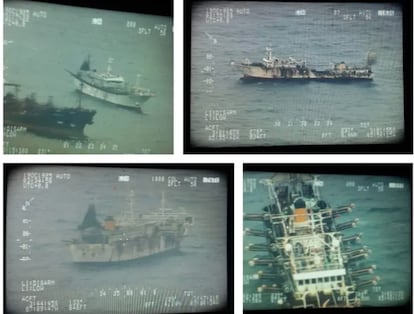
Still, the investigator says that it is difficult to get solid proof of this, as China does not share information on seizures. “The explanation for that is simple,” he says. “The country does not disclose figures because it would affect its image as a system that works and does not have the same problems as Western countries, like drug trafficking and drug use.”
In the shark fin trade, it appears that Los Choneros remains the dominant group. “We have evidence that many boats that serve as floating gas stations for speedboats also traffic species,” says the intelligence agent. In exchange for the animals, subsidized fuel, and drugs, the ships return with weapons. The high-caliber arms are mostly of U.S. origin and have contributed to increased violence in Ecuador, where in the last year crime has reached such a point that, on average, there is a violent murder every hour.
This story was produced with the support of the Pulitizer Center.
Sign up for our weekly newsletter to get more English-language news coverage from EL PAÍS USA Edition









































