
Millennia-old Yuracaré language resists extinction through 900 speakers and a new dictionary
Their history marked by cultural seclusion, the people of a tropical Bolivian region publish the most complete work in their language to-date
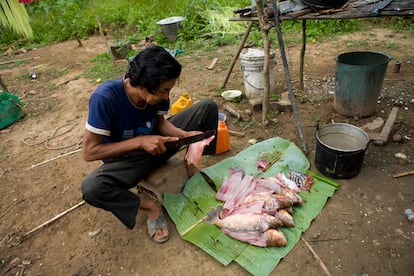

The history of the Yuracaré can be told through their refusal to integrate with Bolivia’s colonial system. They settled on the border between the country’s mountain foothills and its plains and valleys. There is no evidence that they had contact with the Incas, as was the case of other tribes of the Antisuyo lowlands, the northeastern region of the Inca empire. During the reign of the Spanish viceroyalty, evangelizing missions were able to make few inroads with the Yuracaré. Later, beginning with the second half of the 20th century, Quechuas and Aimaras migrated to the same area to practice agriculture. Now, a new chapter has been written in the story of the Yuracarés with this year’s publication of a Yuracaré-Spanish dictionary — an attempt to save a language currently spoken by some 900 individuals.
Developed over the course of a quarter-century, the new reference book was finally published in September. It has more than 6,000 entries, and though previous versions do exist — one hails from as far back as the 19th century — it is the most complete, and the only one to offer a grammatical decoding of the language. At least, that is how it is being presented by its creators: French anthropologist Vincent Hintzel and Dutch ethnolinguist Rik van Gijn, who met while carrying out their post-graduate studies in the tropical regions of Bolivia. They were joined by Gerónimo Ballivián Asencio Chávez, Alina Flores and Rufino Yabeta, four members of the 6,500-person Yuracaré community, according to a 2024 census.
Ballivián is 77 years old, which is within the average age range of the majority of those who speak Yuracaré today. He spends his time working as a carpenter, mechanic, woodworker, architect and language teacher. He lives in the tropical Cochabamba region, one of the Bolivian departments, along with Beni, that form the traditional lands of his people. “I am very happy with the dictionary, it is a gift from God,” he says. Ballivián was converted to Christianity by foreign missionaries when he was 12 years old. He has witnessed the gradual disappearance of his ancestral religion, wardrobe, social practices and funeral rites. Still, he carries a strong conviction that his community will ensure the survival of its culture, a mission that is reflected in the work of organizations like the Institute of Yuracaré Language and Culture (ILCY).
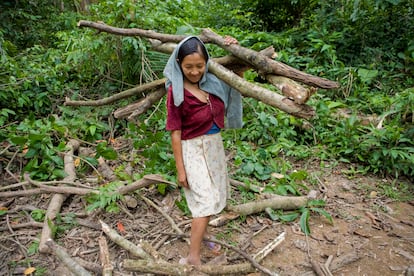
“There is a lot of work to be done with our history. Marriage, dances, celebrations, how to live — these things are no longer practiced. If no one tells about it, writes about it, explains it, with time, it will be lost,” says the septuagenarian. He speaks of “building a small wooden building” where people will be able to meet and be taught the history and culture of his people. “There needs to be Yuracaré documents, even laws. I would have liked to make a book to distribute in schools. It will be the children themselves who tell many things to their parents.”
One of the reasons behind the extinction of these traditions has to do with their practitioners’ shame when they encountered the moral norms of the Western world, according to the French perspective of the dictionary’s co-author Hintzel. The anthropologist lived for long stints, beginning at the end of the last century, with Yuracaré families and witnessed their now-extinct rites of initiation into adulthood, in which adolescent men and women inserted animal bones into their bodies. “There was a terrible pressure at the time from the neighboring colonized Andeans, who called these customs savage and barbaric. That didn’t help in maintaining their practices. In their world vision, they are linked to a society that depended heavily on hunting, and required physical resistance to pain,” says Hintzel.
Language would seem to be the last line of defense against cultural domination. It is the first bold step being taken by the peoples of the tropical regions of Bolivia, who are fewer and less organized relative to the Andeans, who have been demanding recognition and participatory citizenship since the 1990s. This mission was institutionalized in the country’s 2009 Constitution, which allowed Indigenous peoples to organize by territory. This is how their land was recognized, and the Yuracaré Educational Council, the institution that supported and contributed to the dictionary, was created. The text looks to be an honest and up-to-date representation of the language, explaining the structure of prayers and using examples from everyday speech.
To Hintzel, this is the definitive version, compared to the three dictionaries that were previously published. “It’s a dictionary tied to grammar, which does not reduce it to a list of words or a vocabulary primer,” says the anthropologist. “Nor have we used translations of the Bible [as previous editions did], but rather, of the ontological narratives of the Yuracaré, something that was not done by the missionaries. We collect what is said, from mythological examples to Christian ones.”
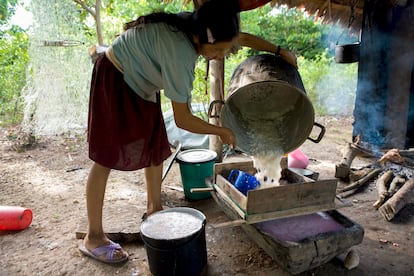
In the search for honesty, it was important to include the vast array of Yuracaré words to describe the jungle environment crossed by numerous rivers where the community lives. “They haven’t left any insect, sound, plant, bird or fish unnamed,” says the French anthropologist. “Everything is perfectly understood. With that comes an encyclopedic knowledge of the life of these species that co-exist in the same space. Every man and woman can recognize 260 kinds of birds, sometimes through their song, the color of their eggs, or the kind of fruit they eat alone.” As with other Amazonian languages, Yuracaré includes a large variety of onomatopoeia. There are songs dedicated to trees and animals, the wind and the waters, that are sung in order to win their favors. Shamans tend to obtain their powers from the patron spirit of the forest, who lives in a great house within the ceiba trees.
The dictionary is an important step towards staving off the disappearance of the language, but the problem is structural, not only due to the number of its speakers, but also, their average age. A significant proportion of people understand the language, but do not use it. “Older adults speak the language among themselves, they can also speak it to their offspring, who know how to answer. But when their children go home, they don’t speak Yuracaré, they speak Spanish. And the grandchildren only hear it when they are with their grandparents, they understand less and speak poorly. That’s the situation among more or less three generations,” says Hirtzel. The government has attempted to address this with the 2010 Avelino Siñani Law, which advocates for an inclusive educational system that respects cultural and linguistic diversity.
That initiative was promising, but its enactment has proven inefficient or frankly, nonexistent. It provides technical resources for the production of educational materials, but there are no Yuracaré teachers. To avoid extinction, Hintzel says, the process requires “political” and decisive action by speakers. Such initiative would seem to correspond with the nature of a people that did not directly reject interaction with other cultures, preferring instead to retreat, rather than confront. As the dictionary’s co-author puts it, the Yuracaré are “looking for their own path forward.”
Sign up for our weekly newsletter to get more English-language news coverage from EL PAÍS USA Edition









































