
Mexico’s large water debt to the US originated under previous president López Obrador
Claudia Sheinbaum’s government now has one month to deliver a huge amount of water to its northern neighbor despite a prolonged drought since the late 1990s. The demand has become a central issue for Texas Republicans
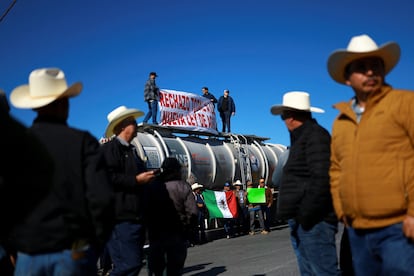

Mexico is once again having to walk a tightrope to appease U.S. President Donald Trump, who is constantly threatening to impose tariffs if his demands aren’t met. After transferring dozens of drug traffickers to the United States, acting as America’s border wall against migrants, and committing to increasing efforts against drug trafficking, the government of Claudia Sheinbaum now has to deliver 249 million cubic meters of water before January 31, 2026, to comply with the 1944 Water Treaty. This is only a small part of the total shortfall. During former Mexican president Andrés Manuel López Obrador’s six-year term in office, there was an accumulated deficit of 1.6 billion cubic meters, another inherited problem that his successor has been trying to address for a year.
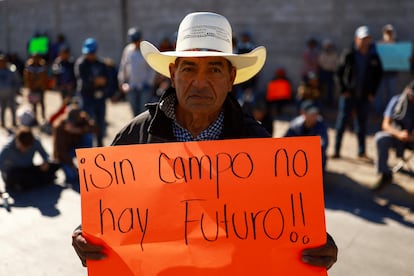
“There has been a prolonged drought since the late 1990s, which, combined with the water demand on both sides of the border and extensive agriculture in Mexico, has led to a water crisis that limits payments to the United States,” explains Alfonso Cortez Lara, a professor and researcher in urban and environmental studies at El Colegio de la Frontera Norte. “If there has been one state that has experienced extreme drought, it is Chihuahua. As a result, the water could not be stored, and the delays began,” he adds.
According to the 1944 Water Treaty between Mexico and the United States, Mexico is obligated to deliver 2.2 billion cubic meters from the Rio Grande in five-year cycles. From 2020 to 2024, during the last four years of López Obrador’s presidency, Mexico delivered only 500 million cubic meters of water. Since Sheinbaum took office, the country has begun to catch up and has delivered more than 600 million cubic meters. A significant portion of this progress was made after April, when the United States pressured Mexico with a series of measures, including tariffs, precisely because of these breaches.
“What they have done since April was extraordinary,” said Cortez Lara. “They obtained water from other rivers and streams, they brought in water from Nuevo León to fill the Amistad Dam, and it was water that was scarce. What I want to know is how they’re going to do it now,” he wondered. “If they manage to fill it, it’s going to be spectacular.”
According to the binational statement, by January 31, 2026, a plan for “the timely redress of the exceptional deficit from the previous water cycle” will be on the table. This is yet another of the various problems that the current administration has inherited, as has also occurred with criminal violence, the shortage of medicines, significant pressure on public spending, and the corruption cases that arose during the previous six-year term.
Cortez Lara notes that, for the moment, Mexico is not in breach of the treaty. Since the previous five-year period saw full deliveries, the treaty allows for a grace period during the first years of the 2025-2030 term. He notes that this isn’t the first time a similar situation has occurred. “Between 2001 and 2003, a significant amount of water was also owed, and what the United States did then was exert pressure, but it also offered $40 million to invest in the river area and improve efficiency,” he recalls. “What’s happening today,” he says, referring to Trump’s threats, “is unprecedented.” For the U.S. president, these deliveries are vital to keeping the Texas electorate happy, a key state for conservatives where local Republicans had been calling for a crackdown on Mexico for some time due to these breaches.
The Water Treaty between Mexico and the United States includes two other basins: the Tijuana River basin and the Colorado River basin. In the latter, the United States is committed to delivering a total of 1.85 billion cubic meters of water to Mexico annually. The United States has not delivered this full amount since 2021, although there were a series of negotiations in which Mexico agreed to reductions. While the shortfalls were not significant before, by 2025 total delivery to Mexico had decreased by approximately 350 million cubic meters.
Sign up for our weekly newsletter to get more English-language news coverage from EL PAÍS USA Edition









































