
The thousand and one ways to heal the wounds of colonization in the Caribbean
On the islands, the concept of restoration is heterogeneous. While academics cling to it as a principle of social justice, other groups delve into self-repair
In April 2024, a 40-centimeter-long lizard specimen, known as the Jamaican giant galliwasp, which is now presumed extinct, traveled from the Hunterian Museum at the University of Glasgow, Scotland, to its homeland: Jamaica. Preserved in a jar of formaldehyde and nicknamed Celeste after its scientific name, Celestus occiduus, the specimen was repatriated thanks to an agreement with the University of the West Indies as an act of reparation for the island’s slave-owning and colonial past. The animal, which had been taken from the Caribbean country around 1850, was returned as a symbolic gesture for a past in which even science and research were colonized.
After the University of Glasgow publicly acknowledged that it had benefited from the slave trade, in 2019 it joined forces with the University of the West Indies to explore how to make amends to countries that still bear these scars. Together, they created the Glasgow-Caribbean Centre for Development Research, through which the institutions seek to raise £20 million (about $25 million). This is one of the thousand faces of historical reparation that seeks to redress the damage of colonization and slavery in the countries of the Global South.
The term reparation, which emerged in the context of the first Pan-African Conference held in London in 1900, served to begin charting a course in favor of the struggles of Africans and Afro-descendants for their total emancipation. Although it takes many forms — ranging from the return of art to economic or psychological reparations — there is one essential first step: acknowledging the facts. For Puerto Rican academic Barbara I. Abadía Rexach, a professor at San Francisco State University, Afro-reparations are “imperative” in order to establish responsibilities and “seek solutions to the problems that have historically afflicted Black communities, but are currently very distant from reality, slow, and, for many peoples, non-existent.”
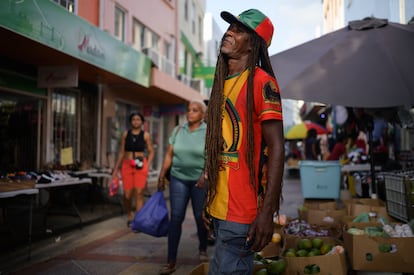
Despite being a matter of state and a crime against humanity, according to the United Nations, in the region these types of petitions are usually led by anti-racist civil movements. “We seek to settle a historical debt that has been a real nightmare for our peoples,” says Dominican historian and cultural manager Darío Solano. “Part of the relevance of reparations is that they are not repeated. Today, more than ever, it is necessary to articulate a major movement in favor of reparations.”
The vice-chancellor of the University of the West Indies, Sir Hilary Beckles, one of the leading figures in the field of reparations, recalls that the purpose of the nations that were built through slavery was to extract wealth from these peoples and communities and transfer it to the industrialized nations of the Global North. “If we want sustainable development, we have to solve this problem. And the best way to do that is through a framework of restorative justice in which the countries that have extracted wealth from our people have to give back a portion of that wealth to facilitate basic development,” stated the president of the Caribbean Community Reparations Commission (Caricom) in a video made by the United Nations to commemorate the International Day of Remembrance of the Victims of Slavery and the Transatlantic Slave Trade.
Created in 2013, this Caribbean commission seeks to prepare the legal arguments for a potential case in which the governments of the former colonies provide reparations to Indigenous and Afro-descendant communities in the region whose ancestors were victims of slavery, the slave trade, racial apartheid, and genocide. Caricom has made a direct appeal to Europe through a 10-step plan to achieve this reparation, beginning with a “full and formal apology” in which these governments accept responsibility and commit to non-repetition and to repairing the damage caused.
The next steps Caricom lists are the creation of development programs for Indigenous peoples; funding for communities that want to return to Africa to do so; restoration of historical memory; assistance in remedying the public health crisis left by slavery; educational programs; improvement of historical and cultural knowledge exchanges; psychological rehabilitation as a result of trauma transmission; and the right to development through the use of technology. The last point is perhaps the most talked-about and controversial issue: debt cancellation and monetary compensation.
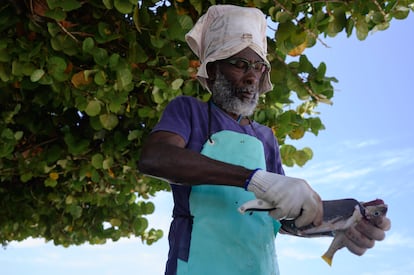
Haiti, the latest nation to join the Caricom Reparations Commission, is the perfect example of the snowball effect caused by the absence of economic reparations. More than two centuries after the period of slavery, the first American country to gain independence from colonial power and abolish slavery (in 1804) is mired in an unprecedented security and political crisis.
The liberators of the world’s first independent Black republic executed 4,000 colonists and destroyed the fields where Haitians had been enslaved. But the cost of freedom was high. France agreed to recognize it as a nation on one condition: compensation of 150 million francs (about $21 billion today) to make up for the loss of land and slaves, an amount equivalent to 10 times the state’s income. It took 122 years to pay off the debt of independence and, ironically, Haiti became the only country in the world to “compensate” its own colonizer.
Although some Haitian presidents have asked France to repay that debt and interest, it has so far refused. For Jennie-Laure Sully, a member of the Solidarité Québec-Haiti organization and anti-imperialist activist, talking about reparations is “in most cases, empty rhetoric.” “The foreign powers that govern Haiti allow talk of reparations because they know that no one can do anything to actually make them happen,” she laments. This critical discourse on reparations is repeated throughout the Caribbean. For many activists and academics, demanding reparations is a mere formality, as gestures of forgiveness and reparation have been few and far between.
The interpretation of reparations is as diverse as the Caribbean islands themselves. Many Rastafarians in Jamaica said it would mean returning to the African continent. In Barbados, they have advocated for reforming the financial system that suffocates countries affected by extreme weather events for which they are not responsible. In the Dominican Republic, a country whose public discourse denies its past of slavery, the day of its abolition is commemorated almost in secret and reparations are not on the political agenda; and in Puerto Rico, there are laws that advocate for an end to discrimination based on Afro hair or skin color. In Cuba, the close economic relationship with Spain has dismantled the discourse of reparation.
Rolando Rensoli, secretary of the Coordinating Group of the National Program against Racism and Racial Discrimination “Color Cubano,” points out that the island cannot be thought of as a “fractured nation”: “We are genetically mixed, phenotypically diverse, and ethnically we are one people.” According to him, 105 of the world’s 110 skin tones exist in Cuba. And although he does not deny that discrimination exists or that reparations are being sought, he rules out that such requests have been made at this time.
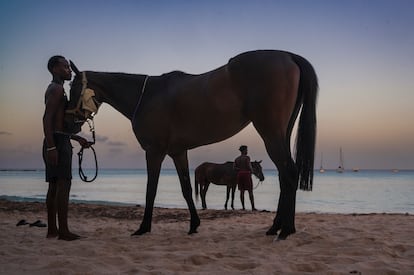
For Geydis Fundora, sociologist and professor at the University of Havana, the legacy of the Cuban Revolution narrowed some of the many gaps left by colonization with regard to Black people. Access to public education and housing was part of a process of self-repair and equality that was shaped from within. “Universal policy has allowed for upward development, but there is still a need to correct the gaps that remain along the way. The decolonial perspective is not yet a critical reflection that has entered the government with force,” she explains. “One of the current challenges is to position these views, which are being addressed in feminist and anti-racist spaces, and incorporate them into public policy.”
Given the historical contexts and diverse languages of the Caribbean countries, the academics consulted believe it is normal for the various demands to have arisen in parallel and independently. Abadía Rexach, however, regrets that the region has focused on differences rather than on what unites it. “In Puerto Rico, we see the world through the eyes of the United States, so we are not necessarily aware of the demands of our Antillean neighbors. If we could fulfill the dreams of Ramón Emeterio Betances and other philosophers who dreamed of a pan-Caribbeanism, of a single Caribbean, the history of historical reparation here would be different.” Faced with the cultural perspective, “very scattered, based on the recovery and validation of historical memory” on which the reparations agenda in the Caribbean has been rebuilt, the Dominican Solano proposes seeking common ground and overcoming fragmented positions. “The African diaspora has a right to better luck,” he says.
From school to land: self-reparation in Barbados
Meanwhile, in other parts of the Caribbean, such as Barbados, other forms of reparation are being tried out. Lawyer Tempu Nefertari, who was deputy director of the Pan-African Affairs Commission, has pushed for what she calls self-reparation. “Reparations, first and foremost, have to address human capital,” she says. As part of her work defending children’s rights, she began implementing workshops in schools to improve students’ self-esteem because she had detected that they had “an inferiority complex.” The program included exercises in recognizing African roots, classes on Black kings, African dress and cuisine, and hair braiding contests. They even worked with a book that suggested Jesus Christ could have been Black. “Some parents were so upset that they said their children would no longer participate in the workshops,” the lawyer recalls.
Created in 2010, the program to boost the self-esteem of children of African descent expanded to other Caribbean islands and served as the basis for a similar program by the Barbados Commission for Pan-African Affairs called Mabalozi, which means ambassador in Swahili and included the establishment of Black History Month in the island’s schools. Although both initiatives have now ended, Nefertari — who changed her own name to an African one during this search process — believes that these exercises are vital. “If people are not aware of the damage, they will not be able to seek redress.”
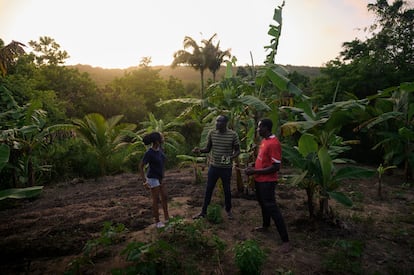

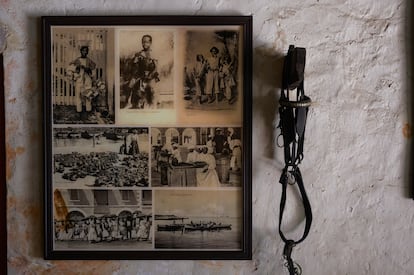
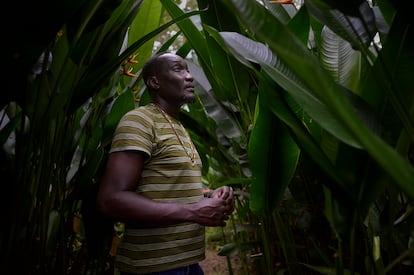
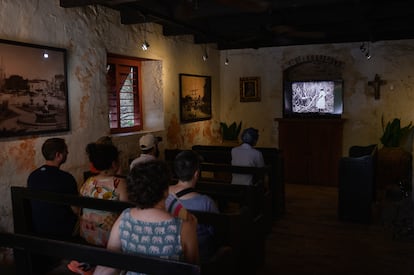
Aldair “Sky” Sobers also works on self-repair. As he walks through land that was once a slave plantation, he explains that he now leases it from the government to carry out the work of The Sojourner Foundation, the charity he leads and where he works with young people. “Much of the conversation around reparation has come from government circles, where they don’t even acknowledge that they have been complicit,” he says. “We must be careful to try to be liberators, but without being oppressors.” For him, reparation is an act of healing. “And all healing, really, is about having access to land: being able to plant food, watch it grow, and then be able to eat it.”
That’s what he does with his foundation. “If young people have access to land, they also have freedom,” he insists, emphasizing that land is not property, but a space to rest, to understand how patience and discipline work, and to exercise climate justice. “There is a liberation in being able to grow my own food instead of having to follow the rules and wait for a ship to arrive or for prices to be reasonable.”
Along similar lines, Professor Zaira Simone-Thompson, coordinator of the Caribbean Studies minor at Wesleyan University in the United States, explains that while compensation and wealth redistribution are important, they do not replace the urgency “to redesign an educational curriculum and create a process that is controlled by Afro-Caribbean people.” Although she was born in Brooklyn, she has dedicated her academic career to exploring reparations practices in the Caribbean, including Caricom’s 10-step proposal.
“The fact that racial capitalism can survive even in the absence of colonial agents makes me think that the transformations have to be more profound,” she says. Simone-Thompson argues for the need for self-reparation, which she defines as “the social, cultural, and psychological dimensions of healing” in an article explaining how the removal of the statue of Lord Horatio Nelson — a slave owner considered a hero by the British — from Heroes’ Square in Bridgetown, Barbados, sparked a conversation about reparation.
Self-reparation, Simone-Thompson continues, “can include the restoration of cultural and spiritual practices that have been hindered or marginalized by forms of racial violence, while reparations such as payments or the restitution of property seek to redress more material damages.” Reparation, says the scholar, means putting an end to “colonial nostalgia.”