
Ukrainian astronomers continue to observe the stars amid the war
The Russian invasion has shut down one of the world’s largest radio telescopes, a Soviet project that has been damaged during the fighting
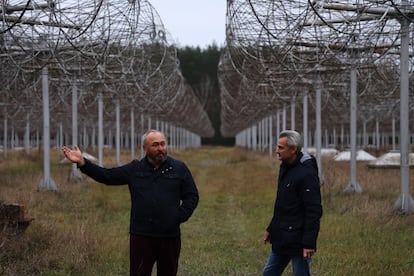

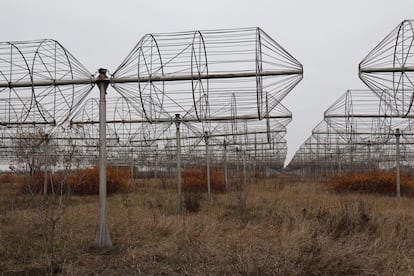
Located 25 miles from the front lines in Ukraine is the world’s largest low-frequency radio telescope. Its technical name is UTR-2, and to the untrained eye, its more than 2,000 antennas and diamond shape might resemble a gigantic art installation. But UTR-2 was a Soviet astronomy project to decipher the formation of galaxies. Half a century after it entered operation, the Russian invasion has left it disconnected from the stars.
Igor Bubnov was one of the astronomers at UTR-2 until Russian troops occupied it in the winter of 2022. In their counteroffensive the following summer in the Kharkiv region, the Ukrainian army liberated the radio telescope. However, the fighting had damaged its infrastructure. Its facilities are located in the heart of a war zone and are too close to the enemy, says Bubnov, so restarting it would be foolish.
Bubnov was unable to return to UTR-2 and transferred his position to URAN-2, another low-frequency radio telescope built by the USSR in the 1970s, this one located in the Poltava region, 60 miles from the Russian border. Bubnov and his colleagues at the National Institute of Radio Astronomy of Ukraine continue to operate from URAN-2 and two other telescopes in the Volhynia region (in the west, near Poland) and the Odesa region, collecting data (detecting radio waves emitted by celestial bodies) that helps decipher the mysteries of galaxies and the solar system. On February 24, 2022, when Vladimir Putin ordered the invasion of Ukraine, UTR-2 was pointed at Jupiter.

URAN-2 is located on the edge of a village comprised of a few old farmhouses in the traditional Ukrainian style. Its 512 antennas capture the electromagnetic radiation from celestial bodies, and also the concert a group of geese performs for visitors. Astronomers sleep on folding cots in the radio telescope’s administration building. They keep beehives in one of the flowerbeds at the entrance to make their own honey, and on the other side of the antenna field, there’s a forest where they pick mushrooms.
The tranquility of the location is ideal for the operation of such sensitive technology, although war makes the work of science much more difficult. For starters, explains Rostislav Vaschishin, Bubnov’s fellow astronomer, there’s the problem that the geolocation system is deactivated several times a day. This happens throughout Ukraine: when the air raid siren sounds due to the arrival of Russian long-range drones, the GPS stops working to hinder the unmanned vehicle from continuing its course toward its target.
This means, for example, that thousands of drivers in Ukrainian cities suddenly lose their signal on traffic maps, or that Ukrainian radio telescopes cannot synchronize. Radio telescopes across Europe cooperate by pointing their antennas at a specific point in the universe. Without the GPS signal, URAN-2 cannot operate in sync.
Other drawbacks of the war for astronomers are the periodic power outages and the fact that the radio spectrum is saturated with signals, whether from drones or from radio-electronic weapons that seek to disrupt the connection of unmanned vehicles.
“Despite everything, at least we shouldn’t be a direct target for the Russians; our antennas have no possible military use,” Bubsov adds, “although perhaps some pilot of the observation drones believes they are a new anti-aircraft weapon and attacks them.”
Youth exodus
The worst part, they say, is the mass exodus of young people during the war. Millions of minors and tens of thousands of Ukrainians of college age, perhaps even of scientific age, have left the country. Last August, President Volodymyr Zelenskiy authorized Ukrainian men between the ages of 18 and 22 to cross the border to study abroad. The result has been an exodus of people in this age group, primarily to avoid military service.
“It’s becoming increasingly difficult for scientists to graduate from our universities,” says Bubsov. This researcher reveals that the average monthly salary for staff at the National Institute of Radio Astronomy of Ukraine barely reaches $175: “The minimum wage in our country is 8,000 hryvnias [$190] a month, but the administration forces you to take sabbaticals so they can pay less.” Bubsov, 48, who holds a senior position, earns around $350 per month. “Why would anyone want to be an astronomer in Ukraine?” Vaschishin laments.
Vaschishin’s dream is to focus as much as possible on studying the 21-centimeter hydrogen line that marked the birth of the first stars after the Big Bang. “Since I won’t be able to live on my pension if I retire,” says the 58-year-old scientist ironically, “I’ll continue working for the rest of my life.”
Vaschishin believes that people “never look up at the sky.” He admits it’s a strange feeling to study galaxies and be aware of how tiny a human being is while people are killing each other all around. “After all, we are all atoms; each individual is a universe unto themselves,” his colleague Bubsov points out. “We are no different from the rest of the universe; everything is an infinite process of creation and destruction,” Vaschishin agrees. “Human society is killing itself in the same way that one day the sun will destroy our planet.”
Studying the stars in the midst of war invites reflection on existence. But the matter is seen differently if one is a soldier in the Kharkiv province, like the one who was guarding the perimeter of UTR-2 on November 7: “The Big Bang isn’t the kind of explosion that interests me right now.”
Sign up for our weekly newsletter to get more English-language news coverage from EL PAÍS USA Edition









































