
Joy sweeps through Gaza as people dream of returning home and rebuilding their lives
Gazans came together to share their joy, while thousands of displaced residents face the decision of whether to return to their destroyed neighborhoods or wait for clearer security guarantees from Israeli forces
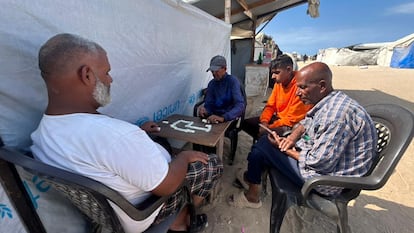
For the first time in months, 40-year-old Mohammed Hamdan Abu Shahab sat down on Thursday with his friends to chat and play dominoes, his favorite board game. That simple gesture — sitting at a table on the beach, in a zone considered relatively safe — was something he had feared doing during the two years of war in Gaza. Abu Shahab smiled as he spoke about his immense joy upon hearing the announcement from U.S. President Donald Trump that Israel and Hamas had signed an agreement to achieve a ceasefire. “The greatest achievement is stopping the killing,” he says. “In the last few days, we feared going to sleep at night and not waking up in the morning.”
Beside him, his son Naim plays with him. “From dawn until now, I haven’t been able to close my eyes for joy and happiness,” Abu Shahab says. At daybreak, his wife let out zaghareed, traditional celebratory ululations, waking hundreds of families in nearby tents, who came out to celebrate. The women gathered, lit fires, made tea in the early hours, and everyone stayed awake until sunset.
Abu Shahab and his family left their previous home five months ago, and now they are unsure how — or if — they can return, mainly due to Israeli military restrictions in the area. Still, Abu Shahab speaks with determination about the future. “We are the children of Gaza. We have tremendous human energy and the will to reclaim our lives,” he says. “The important thing is that we free ourselves from this occupation, that the siege is lifted, and the military operations cease, that they stop killing us. We will take it upon ourselves to rebuild Gaza.”
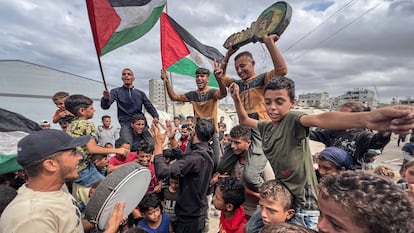
Like Abu Shahab and his family, minutes after Trump’s announcement, thousands of Gazans emerged from their tents and displacement camps in spontaneous gatherings, singing and celebrating what many called a return to life.
“We have a ceasefire! The war is over! We are alive again!” echoed across the camps in Khan Yunis and throughout southern Gaza. Residents expressed immense relief. The crowds sang Palestinian national songs, and elders and children joined the celebrations, taking to streets that had been shrouded in darkness and fear for two years.
Throughout the day, spontaneous gatherings continued at schools converted into shelters, among rows of tents, near bakeries, and at food distribution points. People came together to hug, embrace one another, and share their joy.
Thousands of displaced people, however, now face the same difficult decision: return to their destroyed neighborhoods or wait for clearer security guarantees from Israeli forces. One such person is 67-year-old Khayriya Abu Gamea. She urges caution to her husband, Samir. Their conversations revolve around which areas are safe to return to. Abu Gamea fears the dangers her husband might face crossing these areas before official permits are granted.
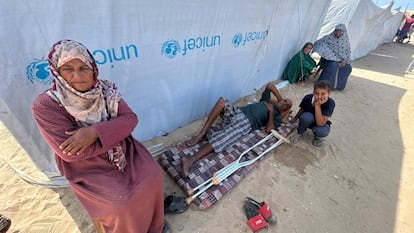
“Everyone in Gaza is filled with unprecedented joy,” Abu Gamea says. “We were waiting for this day, but we are also in a state of shock because we didn’t expect this agreement to be reached. Despair had gripped us to the point where we were certain the killing would finish us all off, until this agreement came.”
Abu Gamea explains that she has not slept since hearing the news, following developments minute by minute. “People came out of their tents cheering, clapping… Everyone was crying with joy,” she recalls. “Here, people feel like they’ve gone from death to life.”
The conflict has killed more than 67,000 Palestinians, according to Gaza’s Health Ministry, run by Hamas — the United Nations considers these figures reliable — and has damaged or destroyed over 90% of Gaza’s homes, according to the U.N. Office for the Coordination of Humanitarian Affairs (OCHA).
The uncertain return
The ceasefire agreement — announced by Trump and approved by the Israeli cabinet — outlines a phased plan, starting with a hostage and prisoner exchange. The first phase includes the release of 20 living Israeli hostages and 28 bodies in exchange for 250 Palestinian prisoners serving life sentences and 1,700 detainees from Gaza.
“Now hope is returning to us, the hope of stopping the death, the killing, the destruction, and the displacement,” Abu Gamea says. “What we need now is simply to return to the area where we lived, which we were forced to leave.”
In another area of Al Mawasi, Samer al Masry, 63, sits with his children under the tent that has become home to his entire extended family. The retired official shares the tent with his son Mohammed, 31, a daughter, 27, who works as a medical laboratory specialist, four university-aged children, and his grandchildren. Al Masry recalls with deep sorrow the destruction of his family home in December 2023, as well as a property he later rented to a relative for $4,000. As tears stream down his cheeks despite his attempts to hold them back, he reflects on the complex emotions felt by many Gaza residents.
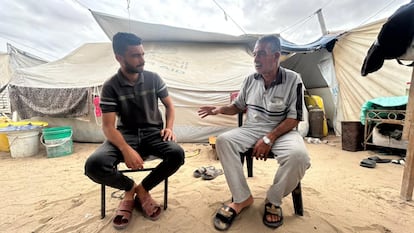
“Yes, today the killings have stopped, and we are happy about that, but we are facing a different kind of destruction,” he laments. “How will we manage now? We are literally on the streets. We have nothing.” He points to the tent where they live. “I don’t even own it; I borrowed it from my brother. I don’t have a single piece of clothing, a tarp, a blanket, or anything else I could take home to the Sheikh area, in the center of Khan Younis, where my two-story building has been destroyed: one floor was mine and the other belonged to other people.” “At my age today, I cry, first out of joy that the killings have stopped, and then out of sadness for our situation,” he notes.
Still, if authorities allow him to return to the center of Khan Yunis, Al Masry says he will immediately begin rebuilding his life. “I will work hard to transport everything available or buy everything I can to set up a tent there. We want to live on our land,” he says.
As a retired civil servant, Al Masry faces enormous financial difficulties. “What I receive from my pension isn’t enough to feed my family. How will I be able to cover the costs of setting up tents, toilets, and other necessities?” he asks. His son, Mohammed, a civil engineer who once had promising career prospects, now shares his father’s uncertain future.
Cautious optimism
Abu Gamea expresses both the hope and lingering anxiety shared by many Gaza residents. While she celebrates the end of immediate violence, she fears hostilities could resume after the hostage exchange, especially given the past experiences with ceasefires.
“Previous experience with the occupation has taught us to be very cautious,” she says. “But now we feel that the whole world is with us, that Almighty God is with us. Israel had planned to complete the annihilation, destruction, and displacement, but God intervened, along with the sincere support of friendly peoples, especially Spain.”
She mentions statements from Spanish Prime Minister Pedro Sánchez. “I heard his nine-measure plan translated on local radio. I felt he was a friend of the Palestinian people, like a father and a brother who feels our pain for the children we have lost and the homes that have been destroyed. His position and that of others are what have brought us to this moment of calm.”
Sign up for our weekly newsletter to get more English-language news coverage from EL PAÍS USA Edition









































